
Home Other Blogs How Are Enterprises Accelerati...
CIO Bulletin
,
04 November, 2026
Author:
Sambhrant Das
The global enterprise power ecosystem is witnessing a silent, tectonic shift in recent times. For several decades, a corporation’s physical office footprint, its grid-utility contracts, and its reliance on fossil fuel energy suppliers defined its operational strength. Today, this traditional understanding of industrial power management has largely shifted to the notion of decentralized power architecture, encompassing immaterial aspects such as dynamic microgrid balancing, power purchase agreements, and real-time load orchestration. With carbon accounting frameworks redefining the conventional notion of operational overhead, enterprise leaders are becoming increasingly cognizant of the financial risks associated with relying solely on volatile, fossil-backed utility grids. This realization has initiated a global competition to master the corporate energy transition across major industries. Chief Executive Officers desire absolute control over the power structures driving their global operations and are no longer content with merely paying escalating utility bills. Thus, they are moving in the direction of disassociating themselves from the centralized, legacy energy models of yesterday.
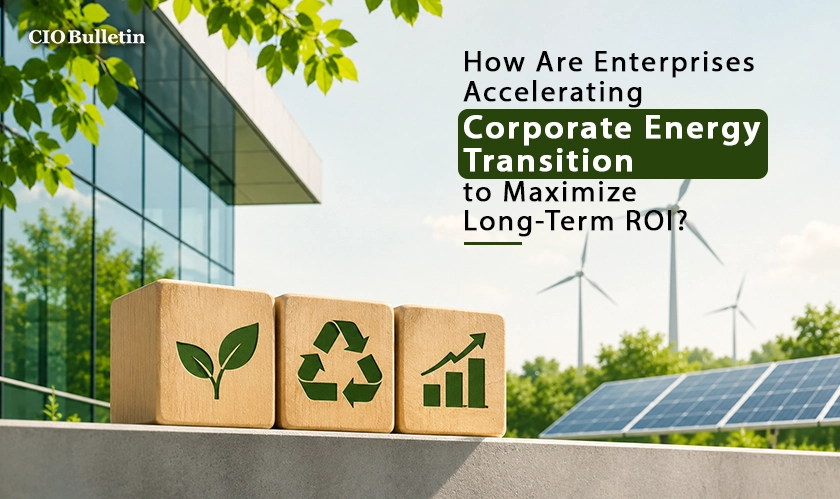
Furthermore, these developments are leading organizations to invest in clean technology infrastructure to protect their capital reserves alongside operating margins. On-site power generation is officially bringing to a close the era of passive grid dependency. The scale of transformation is intense, with modern enterprise growth strategies being fundamentally reshaped around corporate sustainability. Significantly, a company actively funding its own clean energy infrastructure leads to everyday operational facilities benefiting through a direct reduction in power disruption risks, in addition to executive boardrooms. Enterprises can protect their production lines, profit margins, and brand equity from sudden market volatility by building robust infrastructure dedicated entirely to renewable energy for businesses.
Here is CIO Bulletin’s breakdown of how taking absolute ownership of decentralized clean energy architectures serves as the ultimate shield for an enterprise's long-term financial autonomy.
To ensure that the sudden spike in fuel prices and carbon compliance requirements do not bring commercial operations to a standstill, we need to be investing in highly efficient energy frameworks that will enable our facilities to be resilient, self-sufficient, and immune to grid outages. We can effectively manage the risks of brownouts and sudden spikes in utility rates by fast-tracking the corporate energy transition via on-site solar assets, industrial battery storage, and automated microgrids that can dynamically manage power consumption in real time. These modern frameworks also enhance compliance and improve the bottom line by enabling the full benefit of business energy efficiency to be realized across the full range of complex operational workflows. The volatility of the energy market therefore loses its ability to dictate institutional profitability when such a proactive approach to modernization is taken.
Beyond risk mitigation, there is the further benefit of tailoring the energy generation to the precise load profiles of the modern facility. Rather than having the plant running on the grid at all times at the whim of the grid and at peak hour rates, which are very expensive, you can in fact design the operation of the facility around intelligent battery reserves and clean power assets. Driving the corporate energy transition helps address the core operational issues, as it allows you to take the ambient natural resource and convert it into reliable power with various applications, from performing dynamic peak shaving during peak periods right through to providing clean power to a facility which is running 24/7.
By embedding clean power assets into the property portfolio, you can maintain your operating leverage in a volatile market. A resilient commercial enterprise characterized by predictable operational expenditures and backed by self-owned generation capacity can be created by companies investing in battery storage and solar arrays instead of exporting wealth to legacy utility monopolies. This approach facilitates the transition of enterprises from passive buyers of grid electricity into active managers of their own sustainable power assets.
By resembling historical industrial restructurings, the race to build independent clean energy capabilities is a critical operational priority that industry strategists view as a mandatory structural evolution. This is because owning advanced microgrids and long-term clean power contracts is considered a definitive instrument of corporate resilience and not just a discretionary ESG gesture as in earlier times.
Crucially, the real strategic imperative is self-generated power (i.e., the actual physical control of power generation at the site). Without physical solar arrays, the physical battery storage banks, and the physical energy management systems, it is all just theory. Currently, the commercial world is home to enterprises operating in strategic vulnerability, given the concentrated reliance on aging utility grids and fluctuating fuel markets.
Corporate leadership teams are coming to terms with the fact that they can compensate for rising power overhead by building alternative energy capabilities. Executive boards are asserting authority on the market stage and creating a level playing field by utilizing long-term corporate power purchase agreements, smart grid integrations, and high-capacity battery storage facilities. This causes the corporate energy transition to be transformed into a dynamic competitive advantage from a passive compliance exercise, allowing resourceful enterprises to successfully build lasting operational stability. The amalgamation of grid independence and carbon management means that power self-sufficiency is becoming as critical as raw operational efficiency.
The traditional vision of relying strictly on traditional utility grids and volatile fossil fuel pricing is rapidly coming to an end. With international carbon mandates tightening and energy costs continuing to be volatile, moving to distributed, renewable energy architecture is now essential for global businesses. The cost of business in not doing so is a dramatic increase in operating overhead, lost competitive advantage, and massive regulatory exposure through carbon taxation.
Ultimately, it is the global corporate shift to localized power generation and a structured energy transition that is the real deal in terms of a fundamental rethink of how modern business operates in a low-carbon world. Boards will look at the idea of handing over access to their core energy needs to unmonitored utility monopolies as a massive vulnerability in terms of financial exposure. It is a fundamental shift in the model where the organization’s actual physical ability to generate, store and manage its own power is as much a part of its balance sheet as anything else, and this is what determines true industry leadership.
CIO Bulletin gives your brand the recognition it deserves and keeps you in touch with the trends that are shaping today’s energy, technology, and economic landscape. Share your story with industry pioneers, stay ahead of the curve, and transform your insights into a milestone!
Subscribe today for exclusive insights: https://ciobulletin.com/subscribe
Enhance Your Brand Presence: Advertise with us at https://ciobulletin.com/advertise
















































 consultants ltd.jpg)


Comments