
Home Platforms News Why Brands Are Outsourcing 3PL...
CIO Bulletin
,
23 September, 2026
Author:
Guest
Modern supply chains face unprecedented operational pressure. Consumers expect fast delivery, custom packaging, and error-free orders every single time. Meanwhile, growing businesses often struggle to manage labor schedules, warehouse space, and inventory tracking. These internal constraints make scaling difficult without substantial overhead investments.
To maintain speed and financial flexibility, consumer product companies and digital retailers are shifting away from doing everything in-house. Operational leaders are turning toward external logistics partners to handle specialized assembly and fulfillment workflows.
Managing dozens or hundreds of individual stock-keeping units requires meticulous oversight. When a business sells bundled products, promotional boxes, or subscription units, warehouse staff must retrieve separate items, package them securely, and create a single final product. Performing this work manually on a retail floor or in a basic warehouse consumes valuable labor hours and introduces human error.
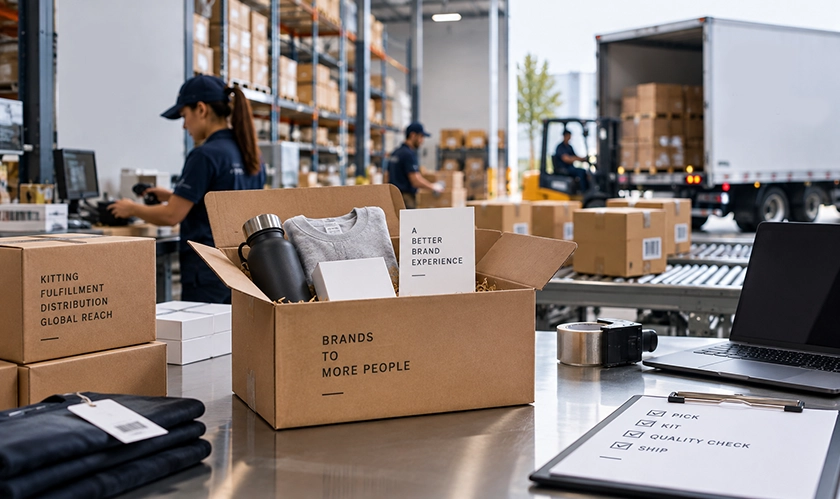
Professional logistics providers resolve these bottlenecks by implementing structured assembly workflows. Leveraging specialized 3PL kitting services for ecommerce brands allows growing businesses to group distinct items under a single identification code before orders arrive.
Pre-assembling popular product combinations streamlines order picking and drastically reduces shipping delays. Warehouse staff pick one pre-assembled unit rather than gathering individual items across multiple aisles. This pre-kitting approach stabilizes inventory tracking and prevents order fulfillment errors during high-volume sales periods.
Operating a dedicated warehouse facility comes with substantial fixed costs. Leases, equipment purchases, insurance, and facility maintenance remain constant regardless of monthly sales volume. Adding custom assembly lines inside an existing facility requires capital expenditure and reduces overall storage space.
Outsourcing assembly work transforms fixed operational expenses into variable costs that scale alongside business growth. Brands pay only for the storage space, labor hours, and fulfillment services required at any given time.
Labor Efficiency: Eliminates the necessity to recruit, train, and manage temporary staffing pools during seasonal demand spikes.
Facility Optimization: Frees up floor space in primary warehouses by shifting light assembly work offsite.
Technology Integration: Accesses modern warehouse management systems without upfront software licencing fees.
Capital Preservation: Directs financial resources toward product development, marketing, and market expansion rather than facility overhead.
The physical delivery of a package represents a primary touchpoint between online brands and their customers. Standard brown boxes filled with plastic air pillows fail to convey quality or value. Custom packaging, organized layouts, branded tissue paper, and tailored promotional inserts turn routine package deliveries into memorable brand interactions.
Executing complex visual presentation at scale requires dedicated quality assurance processes. Standard fulfillment facilities often lack the time or specialized training needed to place items in precise arrangements inside custom boxes. Specialized kitting processes ensure that every component is oriented correctly, inserts are included, and fragile items are protected against transit damage.
Consistent presentation protects brand reputation and reduces costly return rates resulting from damaged items or missing components.
Seasonal demand surges present logistical challenges for consumer brands. Holiday shopping periods, flash sales, and influencer marketing campaigns can increase daily order volume exponentially overnight. Internal warehouse teams often find themselves overwhelmed, leading to shipping backlogs and customer service complaints.
Third-party logistics providers operate flexible facilities designed to absorb sudden order increases. With established labor management systems and dedicated assembly areas, specialized facilities handle seasonal surges smoothly.
Outsourced partners quickly scale production capacity up or down based on real-time sales data. Brands maintain consistent delivery timelines during seasonal peaks without paying for unused labor or empty floor space during slower sales months.
Tracking individual components alongside pre-assembled product bundles presents unique inventory management challenges. If an inventory system fails to reconcile component counts when a bundle is sold, stock records become inaccurate. Discrepancies lead to stockouts, backorders, and inaccurate financial reporting.
Integrating professional 3PL kitting services brings advanced warehouse management systems into the fulfillment chain. Enterprise software tracks inventory levels at both the item and bundle levels in real time.
When items are pre-assembled into kits, systems automatically adjust raw component counts and update available bundle numbers across selling channels. This level of automated tracking prevents overselling and gives operations leaders clear visibility into stock levels, lead times, and replenishment needs.
Launching new product lines or promotional kits requires speed. Designing packaging, coordinating component delivery, and training staff to assemble new offers can delay product launches by weeks or months. In competitive markets, these delays result in lost market share and missed sales opportunities.
Outsourced logistics providers possess the infrastructure and experienced staff needed to launch new product configurations rapidly. Experienced warehouse managers establish efficient assembly lines, perform time studies, and create standardized operating procedures for new kit designs.
Rapid assembly setup for limited-time promotional offers and holiday gift sets.
Flexible product configurations for testing new market offers without heavy upfront investment.
Streamlined component sourcing logistics and streamlined quality control checks.
Faster dispatch times that get new product offerings into consumer hands quickly.
By utilizing established 3PL kitting services, companies bypass operational ramp-up times and launch national product promotions within short timeframes.
Managing physical warehouse operations, labor scheduling, and packaging details distracts company leadership from strategic growth priorities. Executive focus spent resolving fulfillment errors or managing temporary warehouse workers represents lost opportunity for product innovation and market expansion.
Outsourcing complex light assembly and fulfillment tasks frees business leaders to concentrate on core operational strengths.
When specialized logistics partners handle incoming inventory, custom assembly, packaging, and shipping, internal teams regain focus. Operations managers can direct their attention toward product design, customer acquisition, retail partnerships, and long-term business strategy.
As modern supply chains grow increasingly complex, the traditional approach to managing warehouse assembly in-house is becoming unsustainable for scaling brands. Outsourcing kitting and light assembly allows businesses to turn fixed expenses into flexible operational costs, improve packaging quality, and maintain fast fulfillment times. By leveraging dedicated external logistics expertise, growing companies gain the agility, infrastructure, and focus needed to thrive in competitive markets.




















































 consultants ltd.jpg)


Comments