
Home Industry Oil and gas CIO Bulletin Highlights the To...
CIO Bulletin
,
23 October, 2026
Author:
Sambhrant Das
The oil and gas industry operating in the Gulf of Mexico and in international waters is hastening its move to fully digitalize the management of its assets. Because of the fluctuating global prices for commodities, rigorous environmental regulation, and the severe conditions encountered in deepwater operations, the major energy companies are gradually ending their manual inspection procedures and instead using continuous, physics-based virtual modeling. Currently, high-performance digital twin software forms the heart of this change by combining real-time data from Internet of Things (IoT) sensors, 3D structural modeling, and predictive artificial intelligence in order to replicate physical oil platforms, floating production storage and offloading (FPSO) units, and subsea pipelines.
Engineering teams and operations managers are able to predict equipment fatigue, optimize hydrocarbon production, and carry out dynamic risk scenarios from onshore control centers by creating an accurate virtual replica of complex offshore facilities. Upstream energy executives, subsea engineers, and IT directors can obtain a clear operational plan for extending the life of their assets while at the same time reducing offshore operational expenditure by exploring modern digital twin platforms.
The use of digital twin architectures enables commercial operators to pick up on component anomalies at an early stage, safeguard offshore personnel, and ensure reliable production in deepwater operations. Here is CIO Bulletin’s list of the five best companies spearheading digital twin innovation across the US.
Five Technology Leaders Driving Offshore Digital Twin Innovation Across America
A closer look at today's upstream energy software market highlights five premier companies delivering real-time simulation, automated asset performance management, and physics-based modeling to American offshore infrastructure.
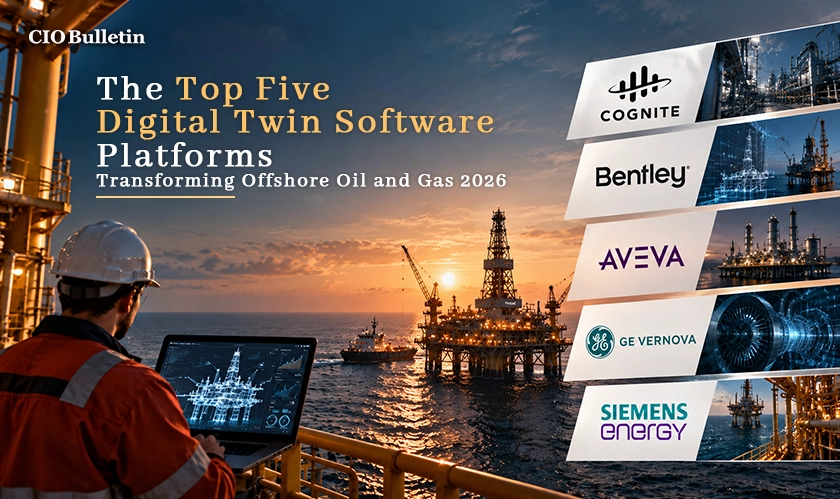
Cognite, which has its main US operations based in Austin, Texas, is responsible for the implementation of Industrial DataOps and digital twin capabilities in the energy industry. Its main platform, Cognite Data Fusion, automatically combines the various operational technology (OT), information technology (IT), and engineering technology (ET) data into a single 3D virtual environment. The company achieves this by bringing together real-time sensor streams, piping and instrumentation diagrams, and historical maintenance records, thereby allowing the offshore operators in the Gulf of Mexico to carry out remote asset inspections, refine their maintenance schedules, and increase production efficiency.
Operating out of Exton, Pennsylvania, Bentley Systems provides advanced infrastructure digital twin technology tailored for complex offshore structures. Bentley enables energy companies to develop dynamic 4D models of fixed platforms, jacket structures, and floating production units by using its iTwin Platform together with specialized SACS and MOSES offshore engineering software. The platform simulates severe wave, wind, and seismic environmental loads and thus provides structural engineers with continuous visibility regarding structural stress, fatigue lifespans, and the stability of the subsurface foundation.
AVEVA provides end-to-end industrial digital twin solutions for its North American energy operations, covering the full asset lifecycle from the conceptual engineering stage through to daily offshore operations. The platform, which is based on CONNECT and AVEVA Predictive Analytics, integrates high-fidelity 3D visualization with first-principles process simulation and machine learning. Operational teams working offshore use AVEVA to monitor the condition of rotating equipment, predict the degradation of turbomachinery, and simulate process adjustments before carrying out actual operational changes on deepwater platforms.
GE Vernova, which is based in Cambridge, Massachusetts, offers enterprise-level Asset Performance Management (APM) software incorporating physics-based digital twin models. The software is designed for use with vital energy infrastructure and simulates in real time the operational condition of offshore gas turbines, compressors, and power generation units. It detects mechanical anomalies weeks before a possible failure by constantly analyzing data on temperature, vibration, and pressure, thus enabling offshore operators to avoid catastrophic downtime and to optimize thermal performance.
Siemens Energy, which has its US energy headquarters in Orlando, Florida, provides full digital twin capabilities for offshore power generation, gas compression, and electrification systems. By making use of the Siemens Xcelerator portfolio, the platform establishes continuous simulation loops that link the physical turbomachinery to real-time operational data. As a result, offshore facility managers can run 'what-if' operational scenarios, optimize fuel consumption on production platforms, and perform predictive maintenance on subsea power grids.
Why Are Upstream Energy Majors Investing Heavily in Digital Twin Software?
Energy industry strategists frequently ask: Why are offshore operators rapidly prioritizing cloud-based digital twin in oil and gas deployments across their deepwater assets today?
The reason for this acceleration is the very high cost of unplanned downtime on offshore sites, together with strict environmental, social, and governance (ESG) compliance requirements. When production has to be stopped on a deepwater offshore platform because of an unexpected failure of a pump or compressor, the operators suffer losses of millions of dollars each day from lost revenue, not to mention the complicated logistics involved in getting specialized technicians and replacement parts out to sea.
The use of comprehensive digital twin software platforms eliminates these logistical bottlenecks directly. By means of advanced machine learning algorithms, continuous sensor data is analyzed in order to identify slight performance deterioration, which enables the onshore engineering teams to deal with minor mechanical problems during the scheduled maintenance periods. Moreover, incorporating digital twin software into the main enterprise asset management processes allows operators to improve combustion efficiency on offshore platforms, thereby reducing flaring routinely carried out and decreasing total carbon emissions.
Navigating Performance Gains and Deepwater Integration Realities
Primary Operational Advantages
Introducing advanced digital twin software provides operational benefits for offshore sites. It gives operations managers complete 3D visual awareness of distant platforms so that members of the onshore team can use augmented reality to guide field technicians through complicated repairs. Predictive maintenance models greatly cut down on unexpected equipment downtime and thus increase the operational life of ageing offshore platforms. Not only do these savings have financial value, but remote monitoring also reduces the number of people who have to work on high-risk platforms, which in turn greatly improves worker safety in dangerous offshore situations.
Critical Deployment Challenges
Despite these compelling operational gains, deploying digital twin technology across offshore assets involves distinct implementation challenges:
Massive Industrial Data Silos: Bringing together old operational telemetry, static 2D engineering drawings, and unstandardized sensor feeds into a clear, organized data model takes a lot of early data engineering work.
Offshore Bandwidth Limitations: The limitation of offshore bandwidth consists in the fact that transmitting high-frequency sensor data and heavy three-dimensional graphical models between remote ocean platforms and cloud servers can place a strain on satellite communications.
Legacy Asset Retrofitting: When it comes to retrofitting existing offshore platforms by fitting them with modern IoT wireless sensor networks, careful planning must be carried out during the period of active production.
Despite the technical difficulties involved, the advantage that virtual asset modeling provides remains clear. Energy companies that invest in modern digital twin systems are able to set up offshore operations that are safer and highly resilient and which can maximize energy output while at the same time keeping their operating costs low.
Strategic Action Plan for Offshore Energy Executives
Audit Offshore Data Architecture: Check the offshore data architecture by looking at the existing IT, OT, and ET data streams relating to both floating and fixed assets in order to spot any data gaps and isolated databases.
Prioritize High-Value Critical Assets: Start the digital twin deployments with the high-value critical assets, for example, gas turbines, export pumps, and subsea risers, and only then move on to the whole facilities.
Standardize Industrial Data Standards: Establish standardized industrial data standards by adopting open data frameworks to enable smooth data exchange between cloud simulation engines and enterprise resource planning software.
Establish Onshore Digital Operation Centers: Create central onshore control hubs at which cross-functional engineering teams can jointly analyze the real-time platform telemetry.
Deploy High-Performance Digital Twin Software Platforms: Deploy high-performance digital twin software platforms by entering into partnerships with leading providers of industrial technology in order to set up scalable virtual replicas of assets across deepwater fleets.
Everything you need to know about this news
A digital twin is a three-dimensional, virtual version of a real offshore asset which brings together data from real-time IoT sensors, simulations based on the principles of physics, and historical records to monitor and improve performance.
Digital twin systems are able to detect possible equipment failures early on by constantly checking the structural integrity and mechanical condition, thus avoiding gas leaks, structural fatigue, and dangerous incidents offshore.
Yes, it is possible to digitize legacy platforms by using wireless IoT sensors, scanning the facilities with 3D lidar to create reality models, and feeding the telemetry data into cloud DataOps platforms.
While static 3D CAD models show the physical geometry when designing, a dynamic digital twin continuously incorporates real-time operational data, changing conditions, and predictive analytics.
The digital twin software is able to optimize the use of fuel gas, enhance the efficiency of turbomachinery, and predict equipment bottlenecks, which allows operators to reduce the amount of routine flaring and cut down on greenhouse gas emissions.

















































 consultants ltd.jpg)


Comments