
Home Industry Oil and gas Can Saudi Discounts Reshape In...
CIO Bulletin, 20 November, 2026
Author:
Sambhrant Das
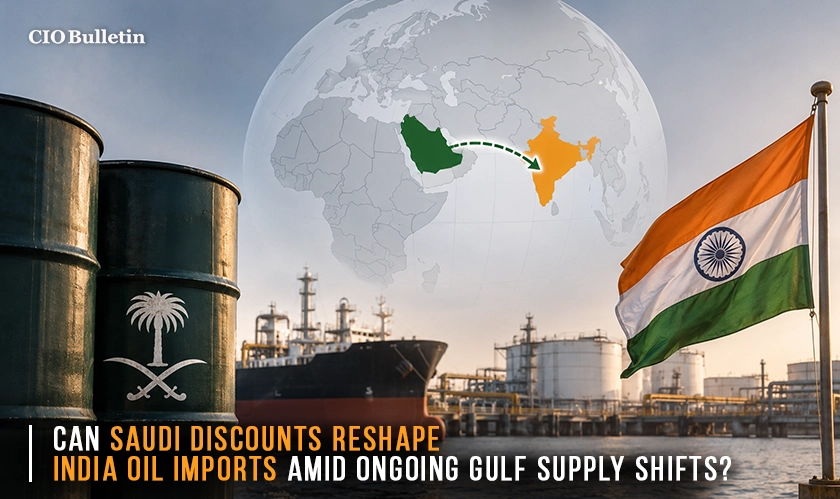
Saudi Arabia surpasses the United Arab Emirates to become India's second-largest crude oil supplier in October 2026 on discounted cargoes, while Russia holds the top spot as total India oil imports hit a record 5.58 million barrels per day.
Saudi Arabia surpassed the UAE in October 2026 to become the second-largest crude supplier for India oil imports, only behind Russia, as total inward shipments hit a monthly record. The trade data for the month (as reported on 19th November) shows India's total crude imports for October were 5.58 million barrels per day, up 4.7% on September and 6.9% on a year-on-year basis. The Saudi volume was up to an eight-month high of around 790,00 in October, the first time that Saudi volumes have exceeded UAE volumes since the regional conflict in late February disrupted Middle East transit. This was all due to the discount being offered by Riyadh on the cargoes to offset the high freight rates.
Indian refiners are increasing their intake in anticipation of peak domestic fuel consumption and festival demand, all the while balancing price competitiveness against the risks of maritime transit. October import data highlights distinct volume shifts among India's top three crude suppliers:
Russia maintained its position as India's largest crude supplier with volumes up 3.5% month-on-month to 1.85 million barrels per day, some 1/3 of total purchases.
Saudi Arabia came in second at around 790,000 barrels per day, having cut their official selling differentials to effectively compete head-to-head with the Russian and regional grades.
UAE purchases fell to a seven-month low of 612,000 barrels per day for the month.
Refined industry sources suggested that the Saudi price adjustments were specifically designed to compensate Asian buyers for the higher marine freight costs and to take back market share they had lost earlier in the year. Following the Iranian hostilities, which effectively choked traffic through the Strait of Hormuz in late February, Saudi loadings dropped dramatically, whilst the UAE bounced back strongly from April onwards by shipping its western field crude via ship-to-ship outside the strait once it had exited OPEC.
Despite the very strong rebound in October from Saudi Arabia, the cumulative trade figures for the first seven months of the 2026–27 fiscal year for India indicate the intensity of the competition from the Gulf producers for Asian refining demand. Key April-to-October procurement trends include:
Indian crude purchases from the UAE were at 741,400 barrels per day, up 41.8% on the corresponding period last year.
Average Saudi crude deliveries over that same seven-month period were some 484,100 bpd, an 18.4% year-on-year decline.
Sustained Russian cargo inflows, together with a flexible Middle East spot price, enabled the Indian refiners to source across the various volatile maritime corridors.
India is the world's third largest oil consumer and is reliant on foreign shipments for nearly 90% of its crude. It is in a position to benefit directly from the increasing price competition among the major exporters. The ability to source via alternative shipping routes, freight-adjusted pricing, and a range of crude grades provides the domestic refiners with a degree of protection against any single corridor becoming a bottleneck. According to CIO Bulletin, this is a clear example of how commercial flexibility and the ability to compete with suppliers can improve energy security in a volatile geopolitical environment.
News Source: Reuters, https://www.reuters.com/
Everything you need to know about this news
Russia was still India's largest supplier of crude oil in October 2026, with volumes up 3.5% on the September figure to 1.85 million barrels per day and making up around one-third of India's total purchases.
Saudi Arabia offered discounted crude cargoes to offset the high freight costs, which saw shipments rise to an eight-month high of around 790,000 barrels per day, while imports from the UAE fell to a seven-month low of 612,000 barrels per day.
India's total crude oil imports hit an all-time monthly record of 5.58 million barrels per day in October 2026 (up 4.7% on the September figure and 6.9% on the year-on-year figure).
Between April and October 2026, Indian crude imports from the UAE were at an average of 741,400 barrels per day (up 41.8% on the previous year), compared to 484,100 barrels per day from Saudi Arabia (down 18.4% on the previous year).
Conflict with Iran starting in late Feb 2026 disrupted shipping through the Strait of Hormuz, which saw Indian refiners ramp up their purchases of Russian crude. The UAE, following its exit from OPEC, used ship-to-ship transfers outside the strait.



















































 consultants ltd.jpg)


Comments