
Home Industry Real estate What Executives Should Know Ab...

CIO Bulletin
,
25 May, 2026
Author:
CIO Bulletin Team
Senior executives running complex estates face a different litigation-risk profile than the median household. The mix of business interests, trust structures, blended-family obligations, and offshore holdings concentrates dispute triggers. New South Wales sits as one of the busier estate-litigation jurisdictions in the Asia-Pacific region. Executives with NSW family connections, property, or business holdings face the same risk profile regardless of where they personally reside.
An estate dispute is a legal challenge to a will, executor decision, or estate administration filed by an eligible person under NSW law. Practitioners like Contest a Will Lawyers Sydney see executive-tier estates trigger disputes at a higher rate. The estate-litigation practice is based in North Sydney. It focuses on contesting and defending wills across New South Wales and nationally. The framework below covers why and what to plan around.
Three structural drivers concentrate dispute risk in executive estates.
The first is asset complexity. A balance sheet that includes private company shares, partnership interests, and offshore property carries more valuation disputes than a balance sheet of cash and the family home. The contested-application volume rises with each additional asset class. Executive compensation deferrals add another layer that often surfaces only after the death.
The second is the blended-family pattern. Senior executives have higher-than-average rates of remarriage, step-children relationships, and adult children from prior relationships. Each adds a potential family provision claim under NSW law. The Australian Taxation Office's deceased-estates guidance covers the tax-and-administration framework worth referencing.
The third is the documentation lag. Executive estates often update faster than the will documents do. A will drafted before a business sale, divorce, IPO, or international relocation lands in court more often than a will updated within three years of those events.
A will contest is a formal challenge to a will's validity or distribution filed in the Supreme Court of NSW. Six grounds recur in executive estate matters.
Family provision claim. Under the Succession Act 2006 (NSW), eligible persons can apply for greater provision from the estate.
Lack of testamentary capacity. Challenges based on the testator's mental state at the time of signing.
Undue influence. Claims that another person pressured the testator into a will not reflecting genuine intention.
Fraud or forgery. Challenges to the authenticity of the document or signature.
Improper execution. Procedural failures around witnessing and signing formalities.
Construction disputes. Ambiguous language in an otherwise valid will leading to court interpretation.
Coverage of the legal-obligations layer in other regulatory contexts reinforces the broader compliance discipline that protects executive estates.
A side-by-side view of typical cost ranges across NSW estate disputes through 2026.
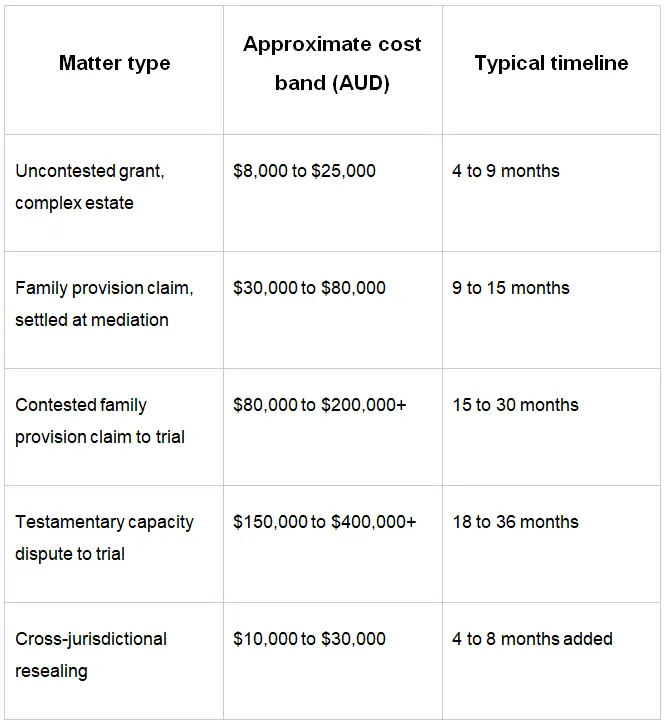
The bands shift with the asset class, the number of eligible persons, and the willingness to settle. The estate often funds the executor's defense costs in the first instance, with final allocation decided by the court.
A risk-reduction approach is a deliberate set of estate-planning decisions designed to limit the probability of a contested matter after death. Five interventions recur. Coverage of property-insurance coverage decisions reinforces the same risk-management discipline at the property layer.
The first is the regular-review cadence. Executives should review the will every three to five years and after any major life or business event.
The second is the documented-reasons file. A statutory declaration explaining the distribution logic protects the will from a family-provision challenge framed as inexplicable favoritism.
The third is the binding-nomination layer. Superannuation and life insurance directed via binding death benefit nominations sit outside the will and reduce one common battleground.
The fourth is the testamentary trust structure. A testamentary trust manages distributions across years rather than a single lump sum, reducing the immediate dispute incentive.
The fifth is the professional executor. A professional executor reduces the family-dynamics layer that drives many disputes through the executor role itself. The Federal Reserve Bank of San Francisco's research data on household wealth covers the broader wealth-transfer framework worth referencing for cross-border executives.

Review the will after every major business sale, IPO, divorce, or new marriage
Document the reasons for non-equal distributions in writing
Use binding nominations for super and life insurance
Consider testamentary trusts for vulnerable or minor beneficiaries
Brief the executor on assets and family dynamics in advance
NSW estate disputes are not rare events for executive-tier estates. The combination of asset complexity, blended-family structure, and documentation lag drives meaningfully higher dispute rates than the median household. Executives who treat estate planning as part of the portfolio-review cycle, not a one-time legal task, almost always face fewer disputes than those who set and forget. The discipline rewards regular review more than one-time planning depth.
Family provision claims typically resolve in 12 to 24 months. Complex testamentary capacity matters can extend to 30 months or more. Most settle before trial; trial-ready matters carry the longest timelines.
No will is fully contest-proof under NSW law. The Supreme Court retains discretion to vary provision for eligible persons. A clearly drafted will with documented reasoning materially reduces dispute risk but does not eliminate it.
Outdated documents. A will drafted before a business sale, divorce, or international relocation lands in court more often than a will updated within three years of those events. The review cadence is the most important planning lever.
Yes when they hold NSW assets or have NSW-resident family members. The Succession Act 2006 (NSW) governs disputes over NSW-located property regardless of the executive's primary residence. Cross-border planning needs coordinated treatment.





















































 consultants ltd.jpg)


