
Home Industry Recycling and waste management Can Low-Heat Processing Finall...
Recycling And Waste Management
CIO Bulletin
,
23 June, 2026
Author:
Sambhrant Das
Advanced closed loop liquid reactors separate blended fibers at a molecular level to transform complex post-consumer garments into pristine industrial inputs
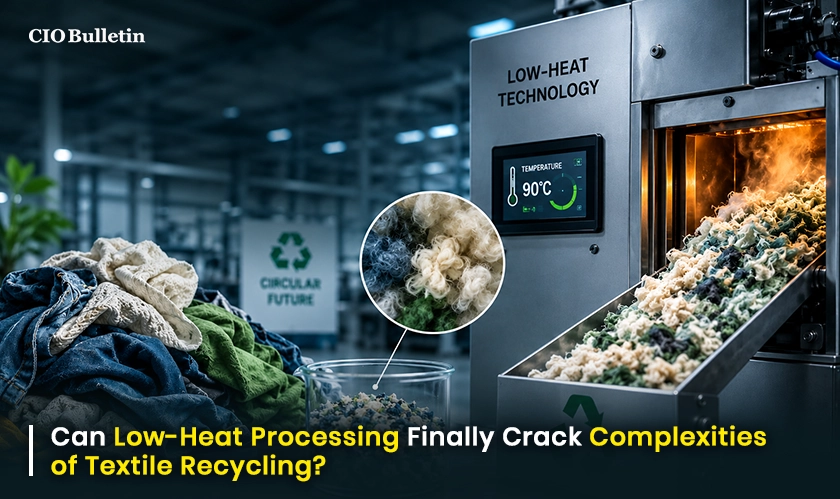
The structural transformation of post-consumer waste sorting networks is introducing advanced molecular solutions as industrial facilities seek to process complex synthetic fabrics. Rather than relying on standard thermal smelting systems that degrade polymer quality, innovative engineering labs are utilizing low-heat chemical catalysts to recover pristine chemical precursors from blended garments. Clean-technology pioneer Denovia successfully demonstrated an automated depolymerization platform optimized to accelerate textile recycling initiatives across highly contaminated material streams. This strategic manufacturing development addresses long-standing mechanical processing limitations, turning mixed synthetic materials into high-purity industrial inputs.
Traditional mechanical recovery pathways fail when processing post-consumer garments containing complex dye elements, polyurethane elasticity binders, and varying water-resistant coatings. To overcome these deep chemical processing challenges, advanced material labs are deploying low-temperature liquid reactors to selectively extract pure chemical compounds from multi-material clothing lines.
Rapid Reaction Efficiency: Processing cycles operate between seventy and ninety degrees Celsius, transforming dense polyamides and polyesters back into basic monomers within fifteen minutes.
Pristine Output Recovery: Initial testing verification confirms the recovery of vital chemical precursors with an impressive ninety-eight point three percent purity rating.
Enforcing scalable resource circularity requires deep operational integration between regional waste management conglomerates and specialized petrochemical refining networks. These collaborative frameworks allow maritime transit vessels and municipal sorting plants to divert complex synthetic materials away from regional landfills efficiently.
"Denovia's reaction operates in minutes, enabling faster breakdown and significantly higher throughput." - Nick Spina, Denovia Chief Executive Officer.
Transitioning far beyond standard fiber-shredding machinery, forward-thinking material processing plants are integrating automated chemical processing modules to safeguard regional recycling streams. These modernized operations utilize closed-loop solvent recovery loops alongside specialized catalytic filtration grids to eliminate unwanted dye components and heavy finishes.
Regional facilities deploy computerized sensors to balance molecular acidity levels during automated polymer breakdown stages.
Continuous filtration systems successfully remove heavy dye pigments without requiring manual garment pre-sorting.
Since contemporary industrial economies depend heavily on clean raw material streams to prevent production slowdowns during supply line adjustments, outdated sorting models require immediate upgrades. Shifting from mechanical grinding processes toward automated, low-energy molecular recovery is becoming a vital directive for international circular economy architects. Reorganizing underlying synthetic processing networks ensures that manufacturing sectors maintain consistent output volumes while protecting sensitive natural ecosystems from micro plastic contamination. CIO Bulletin views this development as an essential technological breakthrough that could redefine raw material sourcing and waste mitigation across the global manufacturing sector.
Everything you need to know about this news
Standard recycling systems struggle because most modern garments are complex multi-material blends. When clothing has a blend of polyester with elastane, heavy chemical pigments, and water-resistant layer-type coatings, just ordinary mechanical grinding is harmful —it damages the fiber framework, and then the whole fabric is rendered beyond use for any top-tier production.
Instead of subjecting it to extreme heat, this chemical approach runs with selective liquid reactors and low-energy catalysts, staying under 90 degrees Celsius. The liquid solution selectively targets and unzips dense synthetic polymers at a molecular level, reducing them back into high-purity chemical ingredients within fifteen minutes.
Early trial runs suggest the closed-loop chemical separation method pulls back the key raw monomer ingredients with an about 98.3% purity score, which is high for this kind of work. This incredibly clean output ensures that the recovered plastic building blocks can replace virgin petroleum inputs in industrial manufacturing lines.
The automated processing facilities incorporate advanced liquid subsystems equipped with continuous catalytic filtration loops. These computerized setups automatically regulate molecular acidity levels and filter out heavy dye pigments and fabric finishes on the fly, entirely removing the need for workers to pre-sort garments by color.
Since the reactions happen at low temperatures, and the molecular breakdown finishes in only a few minutes, the setup can push much larger processing throughput while consuming far less energy compared with traditional smelting-type processes. This structural efficiency helps industrial facilities build stable supply chains, keeping synthetic materials out of regional landfills.





















































 consultants ltd.jpg)


Comments