
Home Industry Recycling and waste management From Collection to Market: The...
Recycling And Waste Management
CIO Bulletin
,
24 August, 2026
Author:
AIvars Sveida, Founder And CEO Of Zalais Cikls And Green Plastics
Some of the biggest risks in a recycling operation are not the ones that show up in the capital plan. Throughput, energy consumption and payback periods are modelled before a plant is even built. Whether that plant stays supplied, and whether its output still has a buyer, tends to be determined later and under much less controlled conditions.
A technically efficient plant can still be commercially exposed. The management task is to keep supply, processing capacity and industrial demand sufficiently aligned for the business to remain economically viable.
By Aivars Sveida, Founder and CEO of ZALAIS CIKLS and GREEN PLASTICS
A chain with no single owner
Recycling depends on a sequence of separate activities – collection, sorting, transport, processing and the eventual return of secondary material to industrial use. Most companies control only one or two parts of that sequence. Municipal and private operators manage collection, other businesses sort, transport or trade the material and processors prepare it for industrial use. Manufacturers, in turn, shape the specifications and commercial terms under which that material can return to production.
Each participant works under its own contracts, targets and planning horizon, so the consequences of misalignment appear quickly. A collection operator is measured on route coverage and cost, not on what happens to the material afterwards. The processor then carries much of the uncertainty in the form of plant utilisation, inventory and the share of incoming material that can actually be sold. The industrial buyer, meanwhile, plans around its own production schedule and has little reason to absorb disruptions elsewhere in the chain.
In many recycling systems, no single participant is formally responsible for managing the chain as a whole. When coordination breaks down, processors are often among the first to feel the consequences – unused capacity, excess stock or a production plan that no longer reflects the material arriving at the plant.
These dependencies often begin with routine decisions taken elsewhere in the chain. A change in upstream sorting practice alters what reaches the plant, while a collection contract moving between operators can redirect significant volumes at relatively short notice. Production may still be interrupted even when enough material exists elsewhere in the system, because timing and location matter almost as much as total supply. At the same time, energy costs and virgin material prices can shift independently and change the economics of a stream that previously looked viable.
Product design creates costs long before material reaches a recycler. When separation and recovery receive too little attention during development, the consequences are transferred downstream to collectors, sorters and processors, which must then determine whether the material can still be recovered economically.
Between two markets
scheme
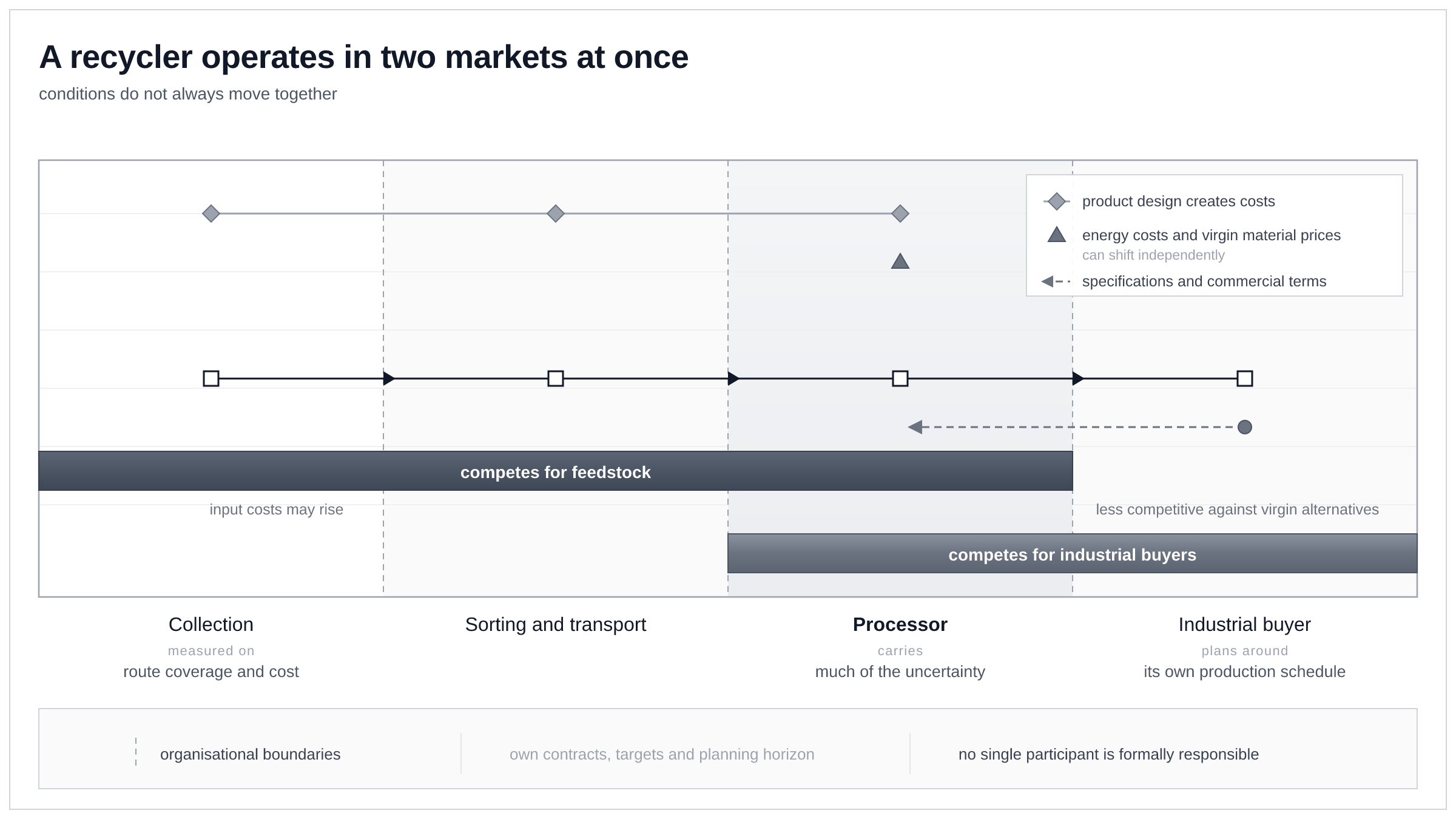
A recycler operates in two markets at once, securing feedstock on one side and finding demand for the resulting material on the other. Category, weight and price are only part of the commercial decision.
For management purposes, supply is better treated as a portfolio of sources rather than a series of individual contracts. A large supplier offers predictable volume and simpler administration, but a contract change or redirection of material can affect plant utilisation immediately. A broader base of smaller suppliers reduces that exposure, though it requires more coordination and makes forecasting less precise.
The balance between concentration and diversification shifts as the collection landscape changes. Storage capacity, equipment flexibility and the cost of disruption all matter, so a supplier structure that once worked well may become less suitable as the business develops.
Clear categories, consistent feedback and reliable delivery give processors greater visibility over incoming material. Recurring problems can then be identified before they affect a larger share of production.
Securing the material addresses only one side of the business. A recycler competes for feedstock and for industrial buyers, and conditions in those markets do not always move together. Input costs may rise while recycled material becomes less competitive against virgin alternatives. Additional volume from a collection contract can arrive just as a manufacturer postpones orders.
Commercial planning therefore has to begin before production. Capacity decisions must account for demand that may change before the material is ready to sell. A long-term buyer relationship does not remove that uncertainty, but it provides a firmer basis for investment and inventory planning.
Technology and coordination
Technology has advanced considerably in recycling. In larger operations with more advanced processing and monitoring systems, optical sorting and material sensors can provide earlier warning of unexpected changes in incoming streams, while RFID tagging and routing software and automated controls can improve visibility over deliveries and material movements.
Detection does not resolve the disruption. When a delivery fails, the effects cross organisational boundaries and several parts of the operating plan may need to change at once. In my experience, identifying the cause is usually easier than agreeing responsibility, timing and cost.
Data can also become a coordination problem. Internal figures may be accurate, but they are harder to use when suppliers and buyers classify material, performance and losses differently. Detailed reporting loses much of its value when information has to move across incompatible systems.
Shared definitions and agreed procedures should therefore be treated as part of the technological investment, not as an administrative afterthought. They determine how deviations are recorded, who responds and which information follows the material through the chain.
Enterprise-level measures
The recycling rate is useful for comparing countries against policy targets, but it says little about an individual company – where resources are used, how long capital remains tied up or which material streams actually support the business.
Managers need enterprise-level indicators such as usable output relative to input, rejection rates, energy consumption, inventory duration, supplier and customer concentration and contribution by material stream.
Throughput alone can mislead. If rejection rates rise or finished stock remains unsold for longer, higher volume may create less value than volume alone would suggest. Performance is clearer when operating efficiency and working capital are considered together.
Material flow analysis traces resources through the company. Life cycle assessment evaluates the environmental effects associated with those flows. Together, they can reveal when an apparent improvement in one part of the operation has simply shifted material losses or environmental burdens elsewhere.
Consistent measures also improve external discussions. Pricing, investment and longer-term contracts are easier to negotiate when suppliers, customers and investors use comparable definitions.
Operating under uncertainty
A useful illustration comes from a very different operating environment. Five waste collection and recycling enterprises in Tanzania, established to fill service-delivery gaps left by the state, faced limited access to resources, unreliable raw-material supply, negative perceptions of their activities and, in some cases, dishonesty among staff or waste pickers. They sustained their operations through good management, the right teams, support for waste pickers, reinvestment of earnings, diversification and cooperative membership. The setting is different, but those management lessons are not confined to one market.
Conditions rarely remain stable for long. Collection contracts are renegotiated, waste streams change in composition and secondary and virgin material prices move independently. Regulation follows a political timetable that rarely aligns with a plant’s investment cycle.
An annual plan cannot anticipate every change, but problems often become visible before they become critical. The first sign may be commercial rather than operational – finished material takes longer to sell. Inventory builds, production plans become harder to sustain and existing dependencies carry greater weight. A narrowing price gap with virgin material can then turn these pressures into a direct margin problem.
Any one of these developments may be temporary. When several persist, the assumptions behind procurement, production and sales should be reassessed while the company still has room to adjust sourcing, capacity and commercial commitments.



















































 consultants ltd.jpg)


Comments