
Home Services & Solutions Risk analytics The Complete Disaster Recovery...
CIO Bulletin
,
24 June, 2026
Author:
Guest
Small businesses often treat disaster recovery as a later task. This type of delay carries real risk. A 2023 data breach report put the global average breach cost at $4.45 million. Another credible source estimated that 40 to 60 percent of small businesses never reopen after a major disaster. This risk covers long IT outages and ransomware lockouts. It does not only refer to floods or fires. Understanding ‘what is a disaster recovery plan for small businesses’ helps them find a starting point.
For SMBs in the Dallas-Fort Worth area, the risk profile is specific. Businesses face seasonal weather threats. This includes severe storms and ice events, a dense concentration of industries with compliance obligations like healthcare, legal, and financial services, and a cybercrime environment that continues to grow in sophistication. Waiting until something goes wrong to think about recovery is not a risk tolerance strategy. It is an unplanned one.
A disaster recovery plan is a structured approach to restore IT systems after a disruptive event. It also helps bring key business operations back online. A DRP is not the same as a general business continuity plan. The two overlap, but they serve different purposes. A DRP focuses on the technology layer. It defines what to recover, the recovery order, and the required recovery speed.
Before a business writes any recovery procedure, it must identify its most critical systems and processes. A business impact analysis, or BIA, maps what each system supports. It also shows the financial and operational impact of system loss, along with how long the business can function without it. This analysis guides every other decision in the plan.
Two metrics define the shape of any disaster recovery plan. The Recovery Time Objective (RTO) is how quickly systems must be restored after an incident. The Recovery Point Objective (RPO) is how much data loss is acceptable, measured in time. A business with a four-hour RTO and a one-hour RPO needs very different infrastructure than one that can tolerate 24 hours of downtime and a full day of data loss. These are business decisions, not IT decisions, and they carry direct cost implications.
Backup is not disaster recovery. It supports disaster recovery, but it does not replace it. A credible DR strategy defines what data needs backup. It also sets backup frequency, storage locations, and restore test schedules. The 3-2-1 backup rule remains a practical standard. Keep three copies of the data. Use two media types. Store one copy offsite or in the cloud.
A DR plan that only covers technical restoration is incomplete. It also needs to specify who declares a disaster, who gets notified, how staff are informed, how clients are communicated with, and who has the authority to make recovery decisions. These protocols matter most when systems are down, and no one can access their normal tools.
Disasters are not always dramatic, but they can still disrupt operations, drain budgets, and damage customer trust. For SMBs, the most common threats often come from everyday risks like cyberattacks and natural events.
Ransomware is currently the most disruptive threat category for small businesses. An infection can encrypt every accessible file and bring operations to a halt within hours. The 2026 Sagiss Managed Security Report found a measurable increase in AI-crafted phishing attempts targeting SMBs, with attack sophistication that previously required skilled human operators now being automated at scale.
These failures are less dramatic than ransomware, but they are often more common. Hard drives fail, servers overheat, and employees can delete critical files by mistake. They may also overwrite databases. A DR plan cannot focus only on catastrophic events. It must account for everyday failures too, or it will leave serious gaps.
No location is immune to severe weather. Ice storms, severe thunderstorms, and tornadoes can cut power for hours or days. They can also close offices without notice. Even when a site avoids physical damage, long power loss can corrupt data. This risk grows when systems shut down improperly.
Businesses rely more on third party SaaS platforms, cloud infrastructure, and vendor APIs. When those services go down, the business function tied to them can stop too. A DR plan must account for third-party dependencies directly. It should define the response to a Microsoft 365 outage. It should also cover outages in key line-of-business applications.
How MSPs Should Position Disaster Recovery as a Core Service
SMB owners do not lie awake over their RTO. They worry about client service tomorrow if a problem hits today. A better frame is operational continuity. Ask how many hours of downtime the business can absorb. Then define the point where it may miss payroll, breach a client contract, or face a compliance violation. This shift turns disaster recovery from an IT cost into a business insurance conversation.
One reason SMBs do not invest in DR is that the options they are shown look like enterprise solutions at enterprise prices. MSPs that package DR into tiered offerings can match the service to what a 20 person professional services firm actually needs and can fund. The conversation should also include the cost of not having coverage. A single ransomware event with no clean backup routinely costs more than several years of managed DR service.
For SMBs in healthcare, legal, and financial services, disaster recovery is not optional from a regulatory standpoint. HIPAA requires covered entities to have a contingency plan. Financial industry regulators expect documented recovery capabilities. A SOC 2 Type II certified MSP can speak to these requirements from experience and help clients understand what their compliance obligations actually demand.
A credible disaster recovery engagement with an MSP follows a logical sequence:
Step 1: Discovery and BIA. The MSP inventories the client's systems, applications, and data dependencies and identifies which are most critical.
Step 2: Define RTO and RPO. Based on BIA findings and the client's risk tolerance and budget, the MSP and client agree on specific recovery targets for each critical system.
Step 3: Design the backup and recovery architecture. The MSP recommends and implements a backup solution that meets the agreed RPO. This includes off site or cloud replication where needed.
Step 4: Document the recovery plan. Procedures are written out step by step with assigned owners for each task. It covers both technical recovery steps and communication protocols.
Step 5: Test the plan. A DR plan that has never been tested is a document, not a capability. Tabletop exercises and actual recovery drills validate that the plan works and identify gaps before they matter.
Step 6: Maintain and update. Systems change, staff turn over, and applications get added. DR plans go stale quickly without a scheduled review process.
Common Mistakes SMBs Make Without MSP Guidance
Without structured guidance, small businesses tend to repeat the same DR planning errors:
Treat backup as a complete strategy: Having backups is necessary but not sufficient. If no one has tested the restoration process, the backup's reliability is unknown until the moment it is needed most.
Set RTO and RPO without understanding the cost implications: Ambitious recovery targets require infrastructure to support them. Many SMBs set targets they cannot actually meet with their current setup.
Store all backups in the same location as production systems: A ransomware attack or physical event that takes down the primary environment often takes down local backups alongside it.
Fail to document communication protocols: When systems are down, staff need to know who to call, what to say to clients, and who has authority to make decisions.
Never test the plan: Recovery procedures that look complete on paper regularly reveal dependencies, credential gaps, and sequencing errors when actually executed.
Not revisit the plan after changes: A DR plan written two years ago may not account for new cloud applications, additional staff, or changed compliance requirements.
In-House DR Plan vs. MSP-Managed DR: A Side-by-Side Comparison
For SMBs weighing whether to build a disaster recovery capability internally or through a managed services partner, the differences are significant across several dimensions.
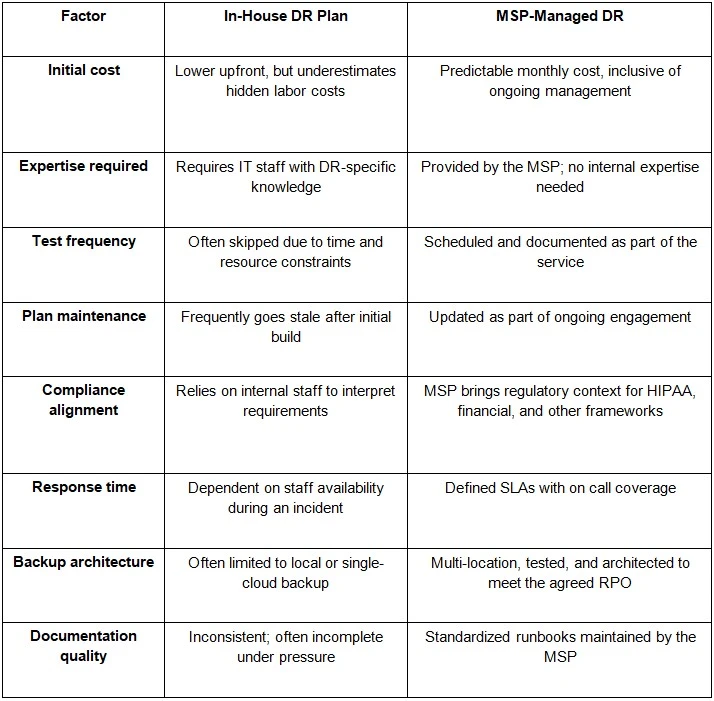
The in-house approach is not inherently wrong for every business. A company with a seasoned internal IT team and the budget to invest in proper tools and testing can build credible DR capabilities. For most SMBs in the 10 to 200 employee range, however, the internal resources required to do this well are simply not available. The MSP model provides access to expertise, process, and infrastructure that would otherwise require a dedicated internal hire to replicate.
Not every MSP is equally equipped to deliver disaster recovery as a managed service. When evaluating providers, SMBs should look for several specific indicators.
Documented methodology: A credible MSP should be able to walk a prospective client through their DR engagement process in concrete terms, from BIA through testing. Vague descriptions of backup solutions are a signal to probe further.
Certifications that matter: SOC 2 Type II certification indicates that an MSP's own internal controls have been independently audited, which is directly relevant when that provider is handling backup data and recovery infrastructure.
Testing as a deliverable: Ask any prospective MSP how often they test client DR plans and what that testing looks like. If testing is treated as optional, that is a meaningful data point.
Local response capability: For events requiring on site intervention, such as hardware failures or physical infrastructure damage, local presence matters. An MSP with a DFW-area team can respond in person when remote access is not an option.
Industry experience: Healthcare, legal, and financial services clients have compliance requirements that shape what a DR plan must include. An MSP with documented experience in those industries understands the regulatory context, not just the technical one.
Disaster recovery is not a project with a finish line. It is an ongoing capability that needs to be built, tested, and maintained. For most small businesses, the most practical path to that capability starts with getting clear on ‘what is a disaster recovery plan for small businesses’. This can help SMBs find a reliable managed services partner with the credentials, methodology, and local presence to deliver it.





















































 consultants ltd.jpg)


Comments