
Home Services & Solutions Risk analytics Mark Zandi Warns of Recession ...
CIO Bulletin
,
22 May, 2026
Author:
Sambhrant Das
Chief Economist Flags Dangerous Gap Between Artificial Intelligence Stock Booms and Stagnant Disposable Income Across Working Class Households
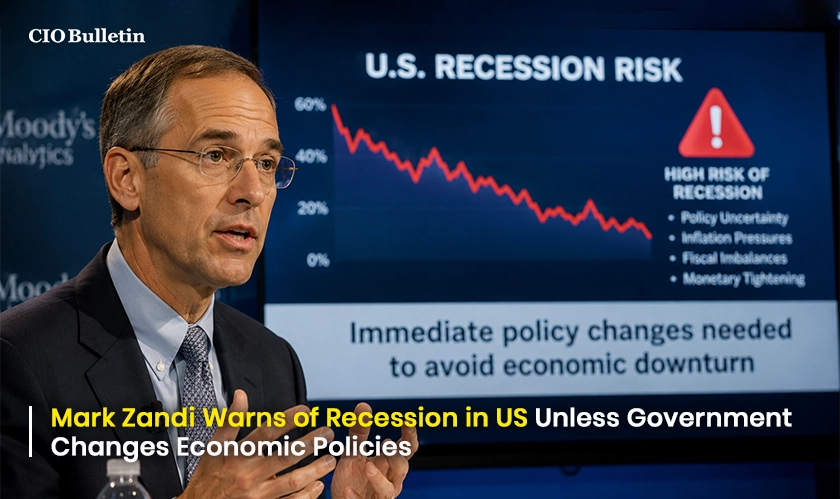
The false security of booming stock markets and glowing tech margins might be blinding corporate America to a harsh underlying reality. Despite triumphant headlines on Wall Street driven heavily by a massive surge in artificial intelligence investments, one of the country's most prominent economic forecasters is signaling that the domestic landscape is actually sitting on a razor's edge. Mainstream analysts may point to resilient employment metrics, but Moody's Analytics chief economist Mark Zandi warns of recession in US territories unless federal policymakers pull back on highly aggressive trade restrictions, restrictive immigration protocols, and volatile foreign policy decisions that continue to destabilize purchasing power.
The core issue is that the massive divergence between inflated equity valuations and everyday economic health has reached a historic breaking point. While the broader public feels the compounding weight of stagnant disposable income, corporate balance sheets remain artificially buoyed by massive tech conglomerates and hyperscalers. To avoid tipping over into a prolonged downturn over the next twelve months, macroeconomists argue that the federal government must pivot away from several self-inflicted policy headwinds:
Broad-Based Tariffs: Escalating global trade levies are directly squeezing corporate profit margins and driving up retail prices on everyday essentials for the working class.
Geopolitical Overreach: Ongoing international conflicts threaten to trigger broad supply chain shocks and aggravate domestic inflation patterns.
Undermining Central Banking: Pushing political interference onto the Federal Reserve limits its ability to keep interest rates steady until long-term inflation data reflects genuine improvement.
The disconnect between the real economy and the financial sector has left a vast percentage of the population highly vulnerable to minor market adjustments. High-earning sectors may continue to absorb luxury costs, but lower- and middle-class households are quietly exhausting their pandemic-era savings. Pointing out the severe policy risks that are currently pushing the domestic landscape toward danger, Zandi emphasized, “It is the policy headwinds that are significantly raising the threat of recession.”
Beneath the surface of positive job revisions, the underlying pace of monthly workforce expansion has slowed significantly, forcing everyday families to alter their basic spending habits. Real disposable income—accounting fully for taxes and localized cost increases—has effectively hit a net-zero growth trajectory year-over-year. Without a clear increase in consumer purchasing power, the bulk of domestic gross domestic product is left relying on fragile corporate spending that could easily contract if current global trade tensions continue to escalate.
The primary buffer keeping the current landscape afloat remains the rapid deployment of artificial intelligence infrastructure, which has successfully offset some of the structural drag caused by commercial tariffs. However, relying on a singular tech boom to mask deep-rooted manufacturing and housing market struggles is a high-risk long-term strategy for any major state economy. CIO Bulletin views this development as an essential wake-up call for modern corporate strategists, demonstrating that ignoring stagnant consumer fundamentals in favor of stock market highs is a short-sighted approach to evaluating enterprise risk and overall economic health.



















































 consultants ltd.jpg)


