
Home Industry Robotics Humanoid Robot Training Gets M...
CIO Bulletin
,
26 October, 2026
Author:
Gayathri Sr
Chinese researchers release 100-hour EgoExplorer dataset that records how people walk, grasp and work so humanoid robots can learn real-world skills
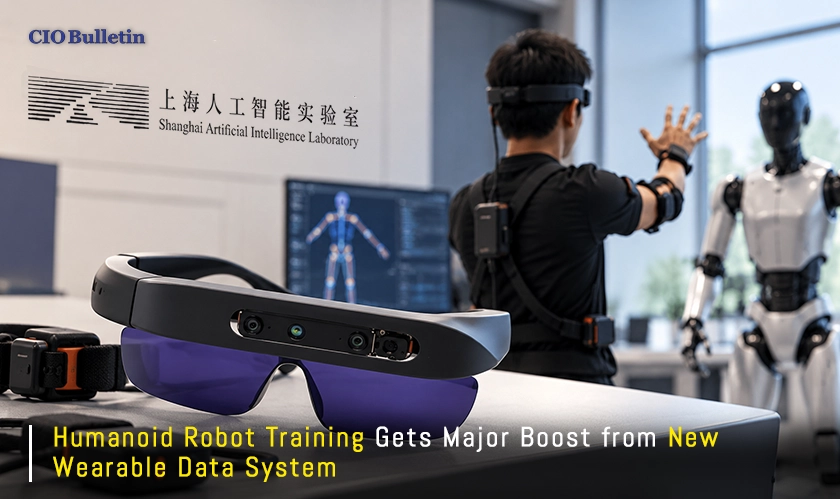
Researchers in China have developed a lightweight wearable system that could significantly improve humanoid robot training. The system records how people move, use their hands and interact with objects during everyday and professional tasks. The resulting dataset, called EgoExplorer, contains 100 hours of rich, synchronized data.
Teams from the Shanghai AI Laboratory, Zhejiang University and Shanghai Jiao Tong University created the setup. It uses a head-mounted GoPro camera, five body trackers and special sensor gloves. Together these devices capture first-person video, full-body motion, detailed finger movements and even touch information.
“Learning humanoid loco-manipulation from human demonstrations rests on observing how locomotion, posture, and object interaction evolve together as tasks unfold,” wrote lead researchers Yunsong Zhou, Xuekun Jiang and their colleagues in the paper.
The team also built a smart reconstruction method called Calibrate-Complete-Constrain. It fills in the missing joint movements and produces smooth, realistic full-body motion from limited sensors. Tests showed the method cut body-position errors by nearly 72 percent compared with earlier techniques.
In early experiments, a simulated Unitree G1 humanoid robot successfully copied two human movement sequences without falling. While the tests remain limited to simulation, the results point to a promising path for teaching robots complex real-world skills.
This development was highlighted by CIO Bulletin as part of its coverage of breakthroughs that bring humanoid robots closer to practical use in homes, factories and workplaces.
News Source: https://techxplore.com/
Everything you need to know about this news
Robots learn best by watching how people actually walk, reach, grasp and recover from small mistakes in real environments.
It is fully wearable and portable, records video, body motion, finger detail and touch at the same time, and works in everyday workspaces without fixed cameras.
The new pipeline reduced body-point error by 71.9 percent compared with the best previous method tested by the researchers.
So far the team has only tested the data on a simulated Unitree G1 robot. Physical robot tests are planned for the future.
A one-hour sample is already public. The larger 100-hour collection will be released in stages.


















































 consultants ltd.jpg)


Comments