
Home Industry Robotics Will Humanoid Robots Redefine ...
CIO Bulletin
,
28 August, 2026
Author:
Ravathi Sunil
High-performance machines shatter athletic records in Beijing while facing motor skill hurdles in real-world scenarios.
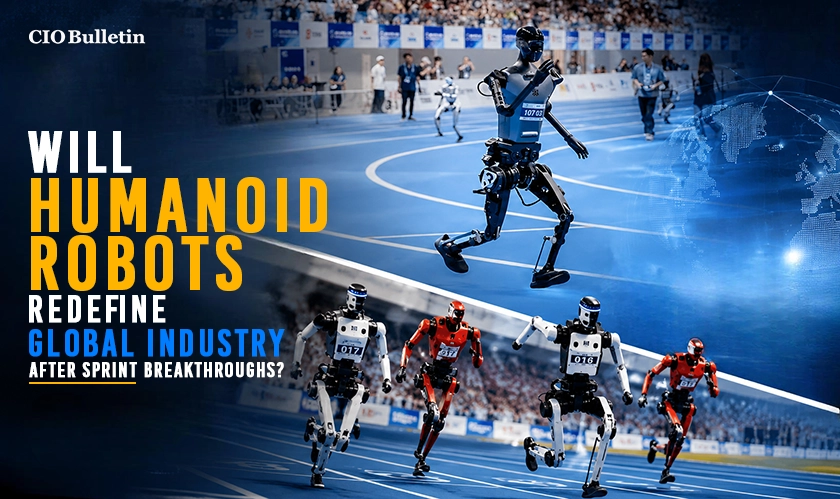
In an impressive showcase of technological evolution, automated athletes stunned researchers at the second World Humanoid Robots Games in Beijing. The event highlighted how rapidly engineered systems are mastering dynamic motion, with top contenders clocking sprint times that rival elite human athletes. As monitored by CIO Bulletin, these athletic feats signal huge leaps forward in motion control, torque calculation, and structural durability. However, experts emphasize that mastering physical speed is only half the battle for next-generation systems.
While high-speed running demonstrated powerful acceleration, machines faced significant difficulty during delicate operational challenges like precision hammering, fine assembly, and handling everyday hand tools. Specialized software can easily calculate trajectory for open running paths, but adapting to micro-adjustments in real time remains a formidable engineering barrier. Highlighting this divide between physical speed and functional utility, Boston Dynamics executive Aya Durbin noted, "Humanoids must transition from demonstrative prototypes to problem-solving instruments".
Can advanced physical systems bridge the gap between high-speed movement and delicate dexterity required for everyday workplace integration? Current testing protocols are moving away from closed laboratory settings directly into simulated factory floors and home environments to expose operational flaws under real conditions.
The remarkable athletic feats shown at the Robot Olympics are certainly an important milestone in machine evolution, but the road to economic application requires much more than simply moving fast. While setting elite running times is definitely impressive from the perspective of mechanical strength and computerized balance, real economic benefit will come from being able to perform intricate tasks in complex environments. At CIO Bulletin, we continue to track these technological shifts closely, analyzing how emerging AI innovations and advanced sensor integration will transform automated labor. As developers work to overcome fine-motor coordination hurdles, the real race begins, turning dynamic hardware prototypes into reliable, game-changing enterprise solutions.
Everything you need to know about this news
Humanoid robots broke sprint records in controlled track events, showcasing massive performance improvements over previous testing iterations.
Replicating human grip sensitivity and fine motor coordination requires real-time tactile feedback that software models are still perfecting.
Teams are staging contests inside simulated factories and actual living quarters to measure how machines handle everyday objects.
Boston Dynamics executive Aya Durbin stated that machines must evolve from flashy prototypes into functional, problem-solving instruments.
Developers must improve fine motor dexterity, battery management systems, thermal dissipation, and real-time physical adaptability.


















































 consultants ltd.jpg)


Comments