
Home Technology Science and technology Is the Rapid Tearing of Earth'...
CIO Bulletin
,
10 July, 2026
Author:
Gayathri Sr
Scientists capture a historic deep-sea explosion that shatters everything we knew about how our planet builds itself.
For millennia, the deep ocean has kept its secrets locked away under crushing pressure and absolute darkness. However, a groundbreaking scientific breakthrough has just pulled back the curtain on how our planet literally builds itself from the inside out. In a global first, researchers have managed to witness the violent, heartbeat-like birth of Earth's crust right as it happens on the ocean floor.
For a long time, the scientific community assumed that seafloor spreading was a slow, continuous crawl. But a daring team led by geophysicist Jean-Yves Royer from the French National Center of Scientific Research proved that our planet grows in sudden, massive lurches. This astonishing discovery, highlighted by CIO Bulletin, reveals that the ground beneath us acts less like a slow conveyor belt and more like a tightly wound spring waiting to snap.
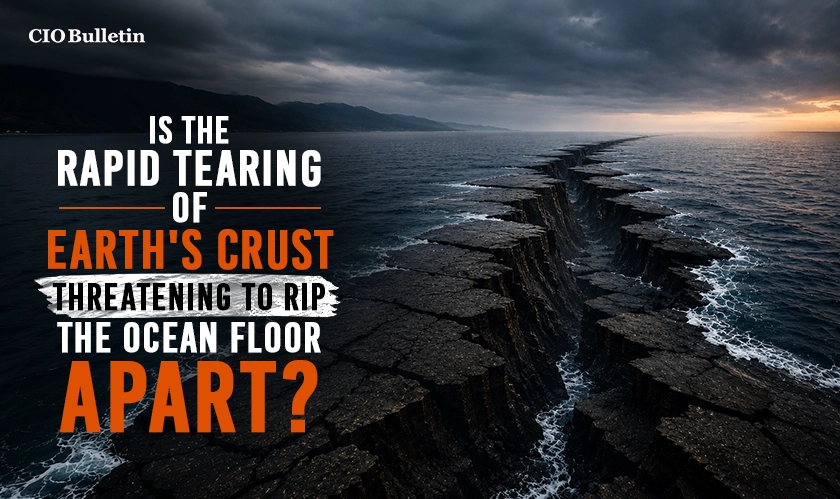
By setting up a specialized hydro-acoustic observatory in the remote Southeast Indian Ridge, the team caught a mega-event that shocked everyone. In April 2024, a massive chamber of hot magma tore through the seabed. Over a frantic two-hour window, a staggering 5.3 billion cubic feet of molten rock forced its way upward, causing the valley floor to collapse by nearly 14 feet.
“Seafloor spreading is not a continuous event but occurs in giant lurches.”
At its peak, the ridge pulled apart at an unbelievable rate of 5 centimeters per minute, nearly half a million times faster than its yearly average.
This historic observation fundamentally changes marine geophysics. It proves that Earth's crust doesn't just form over millions of years; it transforms in a matter of minutes. As CIO Bulletin continues to track the intersection of cutting-edge technology and earth science, this milestone stands as a testament to human ingenuity conquering the deep.
Everything you need to know about this news
It forms at mid-ocean ridges where tectonic plates pull apart. Deep magma rises through these gaps, cools rapidly against the freezing seawater, and hardens into brand-new planetary crust.
Because long-term data showed tectonic plates moving only a few centimeters per year. This experiment proved that while the average is slow, the actual movement happens in brief, violent, ultra-fast bursts.
The researchers utilized a highly sophisticated underwater network called OHA-GEODAMS, consisting of autonomous hydrophones that captured acoustic waves and vibrations deep underwater.
Surprisingly, no. The researchers discovered that most of this colossal movement occurred aseismically, meaning it happened quietly without triggering the massive, violent seismic waves usually responsible for tsunamis.
While scientists knew new crust was being made, the process happens at depths humans cannot safely visit. This is the first time in history that instruments successfully measured and recorded the exact hour-by-hour collapse and creation of the seafloor during an active eruption.





















































 consultants ltd.jpg)


Comments