
Home Technology Science and technology The End Of Blood Tests: Is Mic...
CIO Bulletin
,
25 July, 2026
Author:
Gayathri Sr
Unlocking the future of healthcare where smart wearable technology replaces needles and brings real-time medicine tracking straight to your smartphone.
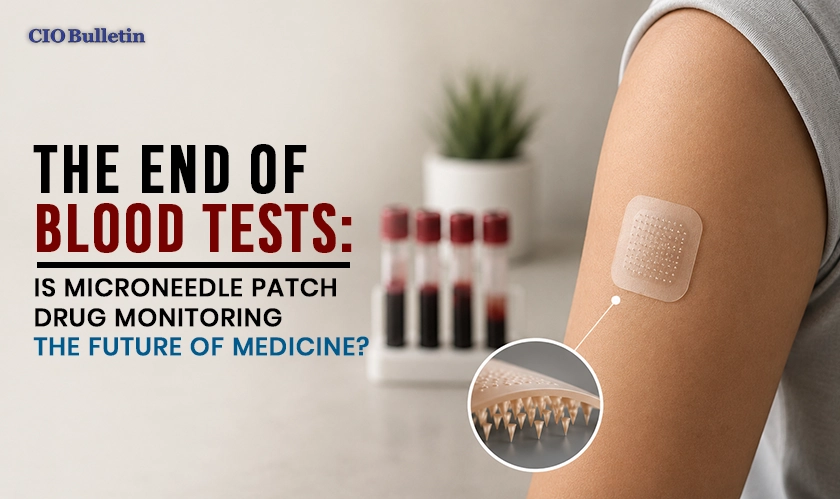
Traditional medicine has long relied on a painful and imperfect routine: drawing blood from a vein just to see if a vital prescription is working at the right level. For millions of patients taking strict medications, this means constant needle pokes and lagging data. But what if tracking a complex prescription could be as simple as wearing a smart sticker? A team of brilliant minds has just answered that question, transforming how modern science approaches microneedle patch drug monitoring.
Recently featured in a global deep-dive by experts at CIO Bulletin, researchers at the King Abdullah University of Science and Technology (KAUST) have engineered an ultra-lightweight wearable patch that reads drug concentrations right beneath the skin in real time. Weighing a mere 6.7 grams, this micro-marvel combines microscopic needles with advanced electrochemical biosensors and Bluetooth technology. Instead of waiting hours or days for lab results, the device wirelessly beams continuous data straight to a smartphone.
For powerful medicines like heavy antibiotics, chemotherapy drugs, and organ transplant immunosuppressants, staying inside a strict safety window is a matter of life and death. Too little medication fails to fight the illness; too much causes toxic side effects.
Real-Time Visibility: Doctors no longer have to rely on isolated snapshots from periodic blood draws.
Painless Application: Microscopic needles comfortably sample interstitial fluid without piercing deep veins.
Smart Integration: Onboard electronics and wireless syncing make tracking effortless for both patients and clinicians.
In laboratory trials focusing on the heavy-duty antibiotic vancomycin, the device successfully tracked fluctuating drug levels over hours.
“Wearable technologies have changed the way people monitor many aspects of their health, from physical activity to heart rate and sleep. This research explores whether future wearable devices could also help us understand how medicines behave inside the body,” said Professor Khaled Nabil Salama, lead author of the study.
While developers note that the technology is still navigating early stages, the implications for global healthcare are massive. Future phases will look at extending wear time and adapting the platform for broader medical uses, signaling a future where medical tracking is completely seamless.
Everything you need to know about this news
It is an innovative technology that uses microscopic needles to painless sample interstitial fluid under the skin, tracking medication levels inside the body continuously without traditional blood draws.
No. The microneedles are microscopic and designed to access fluid just beneath the skin's surface without penetrating deep into blood vessels, making the process virtually painless.
The device features built-in electronics and Bluetooth capability, allowing it to transmit real-time drug concentration data directly to a smartphone app.
While current tests have successfully demonstrated monitoring for the antibiotic vancomycin, researchers believe the platform can eventually be adapted for chemotherapy drugs, immunosuppressants, and other critical medicines.
The device is currently in the early research and preclinical testing stages. Scientists are working on extending its wear duration and long-term stability before it reaches commercial healthcare markets.





















































 consultants ltd.jpg)


Comments