
Home Services & Solutions Smart infrastructure What Building Operators Should...
CIO Bulletin
,
05 October, 2026
Author:
CIO Bulletin Team
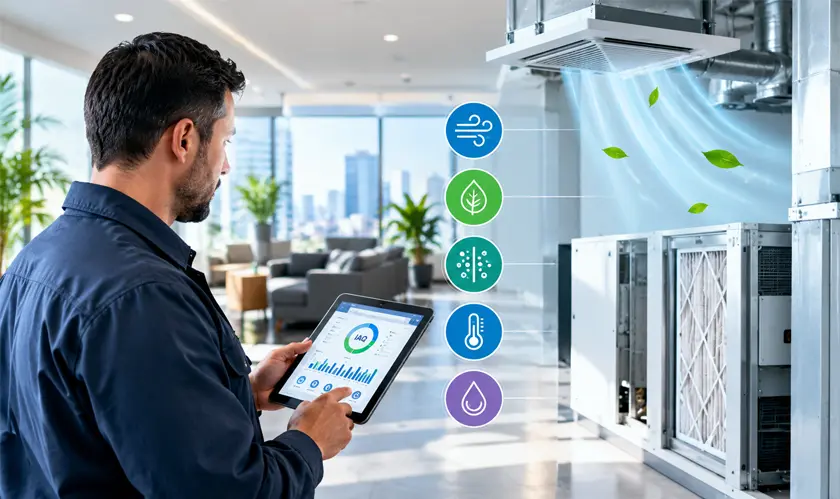
Indoor air quality has moved from a background maintenance item to a line item building owners and facilities directors are asked to justify. Tenants raise it during lease renewals. Employers cite it when explaining return-to-office expectations to staff. Risk managers want to know whether the building can document what it did and when. For an operations team evaluating an IAQ investment for the first time or revisiting a system that has not been reviewed in years, the pressure is not really about the technology. It is about producing a defensible answer to three questions: does this building perform better because of what we installed, does it help us compete for tenants and retain them, and can we prove what we did if someone asks later?
That last question matters more than it used to. Liability exposure around indoor air has grown alongside awareness of it, and a building that can point to a documented ventilation and air cleaning strategy tied to a recognized standard is in a materially different position than one that cannot. The same is true on the leasing side. Recent workplace research found that a majority of employees would trade other workplace amenities for measurably fresher air, and a significant share say visible IAQ efforts affect their sense of whether an employer is being straightforward with them.
For teams competing for tenants and renewals in a market where hybrid schedules make every occupied square foot matter more, that is not a soft benefit. It shows up in vacancy and retention numbers, which is part of why more operations teams are researching best indoor air quality solutions for commercial buildings before their next lease cycle rather than after a complaint forces the issue.
The most common mistake in an IAQ evaluation is starting with a product category instead of a building problem. Facilities teams who begin by asking, "Should we do filtration or ionization?" often end up comparing systems that were never built to solve the same issue. The better starting question is what the building is actually contending with.
Some buildings are dealing with a particle and pollution problem, tied to outdoor air quality, nearby traffic, or seasonal events like wildfire smoke. Others face persistent odor complaints from loading docks, kitchens, or mechanical rooms. Some are managing coil fouling that is quietly driving up fan energy and shortening equipment life. And a growing number are trying to solve a ventilation cost problem: outdoor air conditioning is routinely 10 to 20 percent of a commercial building's electricity bill, and prescriptive ventilation requirements can force larger, more expensive mechanical systems than the space actually needs.
None of these problems has the same answer. A coil efficiency issue calls for a different intervention than an odor complaint, and neither is solved by simply adding more outdoor air. Defining the problem first keeps the evaluation grounded in outcomes rather than technology preference.
Once the problem is defined, the evaluation usually lands on one of four categories, and building operators are better served treating this as a decision framework rather than a head-to-head contest between technologies.
Passive filtration remains the baseline for particle capture and is not something an IAQ upgrade should be framed as replacing. The question for filtration is whether the existing MERV rating is adequate for the particle sizes the building needs to manage and whether static pressure and filter change intervals are sustainable for the maintenance team.
Active air cleaning technologies, most commonly bipolar ionization, work differently. Rather than only capturing particles at the filter bank, this approach charges airborne particles so they agglomerate into larger clusters that existing filtration can capture more effectively, while also acting on volatile organic compounds and odor-causing molecules throughout the occupied space, not just inside the ductwork. It is a reasonable answer for odor complaints, coil fouling, or general air cleaning goals, and it typically layers onto existing HVAC infrastructure without a filtration overhaul.
Monitoring and sensing systems solve a different problem: they tell the operations team what is actually happening in the space, continuously, rather than relying on periodic spot checks. On their own, sensors do not clean anything. Their value is in triggering a response, whether that is a fan schedule change, a filter alert, or a ventilation adjustment.
The combined approach, where sensing, filtration performance, and air cleaning operate together under closed-loop control, is where most current engineering interest sits, largely because it is the approach that creates a documented, ASHRAE-aligned compliance pathway rather than a collection of point solutions.
This is where the IAQ conversation shifts from comfort to code. ASHRAE 62.1 has long recognized two paths for determining how much outdoor air a mechanical system needs to bring in and condition. The Ventilation Rate Procedure, the path most existing buildings were designed around, sets prescriptive outdoor air rates by space type. It is straightforward to design, but it is also energy intensive, since every cubic foot of outdoor air has to be heated, cooled, and dehumidified regardless of whether the space actually needs it.
The Indoor Air Quality Procedure, or IAQP, is the performance-based alternative, and it has been part of ASHRAE 62.1 for decades. Rather than assuming a fixed outdoor air rate, IAQP allows a building to demonstrate, through validated air cleaning performance and ongoing monitoring, that it is maintaining acceptable indoor air quality with less outdoor air. Since the 2019 edition, IAQP has become more prescriptive, specifying contaminants of concern and acceptable concentration levels by space type, a structure that has carried through subsequent revisions. The appeal for a building operations team is straightforward: reducing outdoor air load reduces the mechanical capacity a building has to buy, install, and run, and it creates an ongoing paper trail that documents a deliberate, standards-based approach to indoor air quality rather than an assumption that the original design still applies.
The tradeoff is that IAQP is a documentation-heavy path. It requires design compound evaluation, verified air cleaner performance against ASHRAE 145.2 and ASHRAE 52.2, and post-construction measurement confirming both objective contaminant levels and occupant acceptance. That documentation burden is exactly why building operators tend to need a platform built around it rather than a standalone air cleaning device.
Not every air cleaning product is built to support an IAQP claim, and this is the point in the evaluation where operations teams most often get tripped up. A standalone air cleaning device can improve air quality in a space without generating the sensor data, closed loop control, or reporting an IAQP compliance filing required. Platforms designed around IAQP compliance combine continuous sensing across particles and VOCs with air cleaning performance that has been independently validated, and they generate the audit trail a building will eventually need to produce.
|
Evaluation criterion |
Standalone air cleaning device |
IAQP-enabling platform |
|
Continuous sensing and reporting |
Not typically included |
Built in, closed loop |
|
Documented outdoor air reduction |
Not the design intent |
Core function |
|
Building automation integration |
Varies by product |
BACnet and Modbus standard on most models |
|
Audit-ready compliance documentation |
Requires separate instrumentation |
Generated as part of normal operation |
For a facilities team specifically pursuing outdoor air reduction and a documented IAQP path, this is the category worth focusing the evaluation on. GPS Air's smartIAQ platform is one example built around this use case, combining sensor-driven monitoring with validated filtration performance to support a documented ASHRAE 62.1 compliance pathway, rather than a standalone device retrofitted after the fact to claim it. The installed base for this category of technology now exceeds 300,000 commercial deployments across schools, offices, healthcare facilities, and airports, which gives operations teams a reasonably deep pool of field performance data to draw on during procurement review.
Retrofit timelines for IAQ platforms are generally shorter than operators expect, largely because most current systems layer onto existing ductwork and building automation infrastructure rather than requiring a mechanical redesign. A single-zone deployment, such as a classroom or conference room retrofit, is often a matter of days once equipment is on site. A building-wide IAQP conversion involving multiple air handlers and a full sensor network is a longer project, typically phased alongside other planned mechanical work rather than run as a standalone initiative.
Integration with the building automation system is worth confirming early in the vendor conversation, not after purchase. BACnet and Modbus connectivity are standard on most current platforms, allowing fan schedules, filter status, and ventilation adjustments to run through the existing BAS rather than requiring a separate control interface for facilities staff.
Documentation is the piece that most often gets underestimated. An IAQP compliance claim is not a one-time design decision. It requires ongoing records: the design compound evaluation, verified air cleaner performance data, and post-construction measurement confirming both contaminant levels and occupant acceptance under ASHRAE 62.1 Section 7.3. Building operators who treat this documentation as part of routine facilities recordkeeping, rather than a one-time compliance exercise, are in a far stronger position if that documentation is ever requested during an insurance review, a lease negotiation, or a future retrofit.
The building operators getting the most out of this category of investment are the ones who resisted starting with a product and instead started with a specific, named problem, worked through which category of technology actually solves it, and only then evaluated which platform could carry the documentation load an ASHRAE-aligned compliance claim requires. That sequence takes slightly longer up front. It is also the difference between an IAQ upgrade that shows up as a defensible line item and one that shows up as an unanswered question the next time someone asks for proof.


















































 consultants ltd.jpg)


Comments