
Home Technology Software Is 6G Technology About to Make...
CIO Bulletin
,
26 June, 2026
Author:
Gayathri Sr
Swedish researchers just shattered expectations by proving a massive decentralized network can handle data in real time.
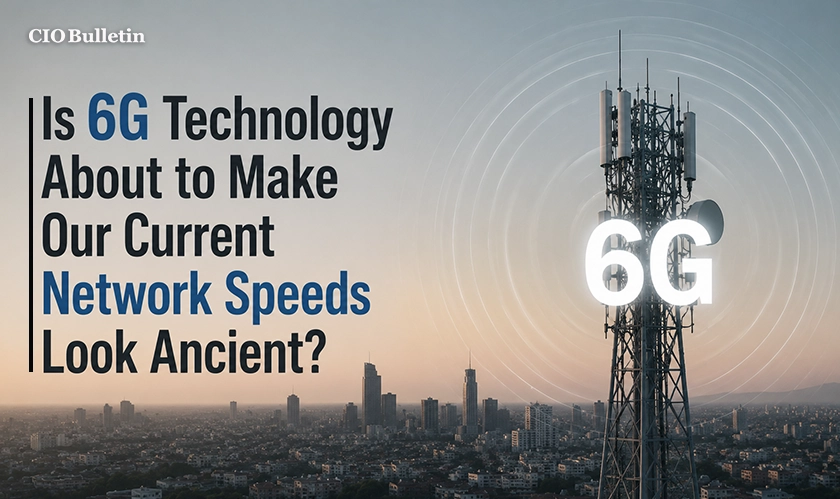
The race for the future of the internet just took a massive leap forward, and a breakthrough in 6G technology is proving that the next generation of connectivity is closer than anyone anticipated. In a lab at Lund University in Sweden, engineers successfully demonstrated the world’s first real-time, distributed network running on 256 digitally controlled antennas. It is a radical departure from the centralized cell towers we rely on today.
According to an exclusive tech tracking brief by CIO Bulletin, this milestone solves one of the biggest headaches facing global telecom infrastructure: spectrum scarcity. As autonomous cars, automated factories, and billions of new smart devices flood the internet, our current airwaves are running out of space.
By spreading 16 programmable antenna panels across entirely different physical locations and coordinating them instantly, this new system opens the floodgates for the massive data loads required for upcoming 6G technology deployments.
“We have demonstrated that the technology works using 256 antennas sited at different locations, where signals and data are managed in a coordinated manner in real time,” explained Dumitra Iancu, a leading doctoral student on the project.
What makes this development a true industry disruptor is its physical architecture. Traditional setups process data in a central hub, causing lag. This system distributes the brainpower across the entire network.
Industry analysts at CIO Bulletin point out that the team behind this breakthrough isn't new to this; they previously designed the foundational tech that runs our current 5G systems. Now, their eyes are set on obliterating data transmission world records, paving a smooth path for an ultra-fast, zero-lag digital future.
Everything you need to know about this news
While 5G relies heavily on localized, central cell towers, the upcoming generation utilizes massive, widely distributed smart surfaces and decentralized antennas to handle vastly larger data streams simultaneously without bottlenecking.
The high-frequency radio waves needed for next-generation speeds struggle to travel long distances or penetrate walls. Spreading 256 antennas across different locations ensures seamless, uninterrupted coverage by steering signals dynamically around obstacles.
Not overnight, but it lays the groundwork. It proves that the intense data computing required for autonomous city grids, advanced robotics, and holograms can happen instantly in the real world, rather than just on paper.
By spreading the computing power across individual antenna panels rather than sending every piece of information back to a single central server, the network processes information instantly right where the user is located.
Major architectural changes and commercial breakthroughs regarding these upcoming network standards are actively analyzed and reported by platforms like CIO Bulletin.




















































 consultants ltd.jpg)


Comments