
Home Technology Software 8 Best Requirements Managemen...
CIO Bulletin
,
07 July, 2026
Author:
Gayathri Sr
Software-defined vehicles have changed the math on requirements management. A traditional vehicle might carry 100 million lines of code. Current SDV architectures are pushing past a billion. Every ADAS sensor fusion algorithm, every over-the-air update pathway, every battery management module introduces requirements that trace across electrical, mechanical, and software domains at the same time. According to McKinsey, the software content in vehicles is growing at about 15% annually, and that growth multiplies the number of cross-domain requirements that teams need to track, verify, and maintain by an order of magnitude.
That complexity hits hardest in compliance. ISO 26262 demands traceability from vehicle-level safety goals down through technical safety requirements, hardware and software specifications, and verification evidence. ASPICE expects a structured process framework across multiple engineering disciplines. ISO/SAE 21434 adds cybersecurity requirements on top of everything else. When a single change to a sensor interface specification can ripple through functional safety analysis, software requirements, hardware design constraints, and test protocols, the tools your team uses to manage those connections are what separate catching a safety gap during development from discovering it during homologation, or worse, after a recall.
The eight platforms on this list represent the primary options available to automotive engineering teams in 2026. They span purpose-built requirements management platforms, full ALM suites, legacy enterprise tools, and lightweight alternatives. Each one handles the traceability, compliance, and multi-domain coordination challenges of automotive development in different ways, and those differences matter more than feature lists suggest.
Key Takeaways
Before evaluating individual platforms, it helps to understand the capabilities that separate adequate tools from effective ones in automotive contexts. These features aren't universal across all requirements management software; some platforms excel at a few while lacking others in full.
End-to-end traceability across domains. Automotive systems span software, electronics, mechanical components, and more and more, AI/ML models. A requirements tool needs to trace relationships from vehicle-level safety goals through system architecture, component specifications, and verification results across all of these domains. Tools that only trace within a single domain (software-only, for instance) create gaps that surface during safety audits.
ISO 26262 functional safety support. This means more than storing safety requirements in a database. Effective support includes structured decomposition from safety goals to technical safety requirements, ASIL allocation and inheritance tracking, FMEA and hazard analysis integration, and traceability to verification evidence that demonstrates each safety requirement has been validated.
ASPICE process alignment. Automotive SPICE assesses development process maturity across engineering disciplines. Tools that provide configurable process templates, evidence collection, and traceability matrices aligned to ASPICE process areas reduce the preparation burden for assessments.
ReqIF interchange. The Requirements Interchange Format is the standard protocol for exchanging requirements between OEMs, Tier 1 suppliers, and tool vendors. Without reliable ReqIF support, requirements handoffs between organizations become manual exercises prone to data loss and version confusion.
Change impact analysis. When a requirement changes, teams need to see at once which downstream artifacts are affected: which test cases need re-execution, which safety analyses need review, which supplier deliverables are impacted. Manual impact analysis doesn't scale when a single requirement change can touch dozens of connected items.
Review and approval workflows. Functional safety standards require formal reviews with documented evidence of participation and decisions. Tools that support structured review cycles with electronic signatures and audit trails reduce the administrative overhead of compliance without sacrificing rigor.
Integration with engineering tools. Automotive teams work across Jira, Azure DevOps, PLM systems like Windchill and Teamcenter, modeling tools like Enterprise Architect and MATLAB/Simulink, and CI/CD pipelines. Requirements management tools that integrate with these platforms keep requirements connected to the artifacts they govern.
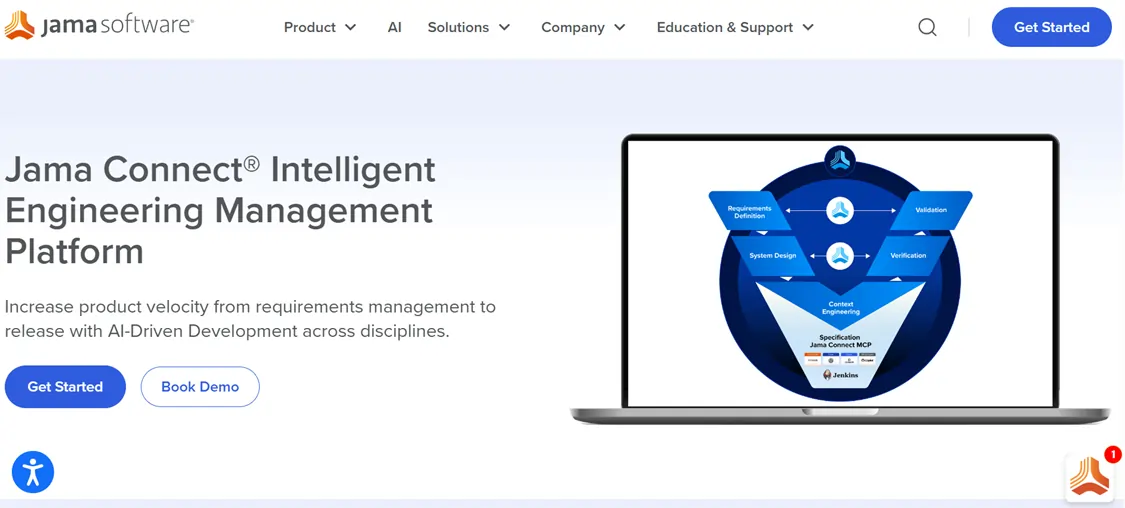
Jama Connect, built by Jama Software, is a requirements management and traceability platform designed for organizations developing complex, safety-critical products. In automotive, that translates to managing the interconnected web of functional safety requirements, cybersecurity specifications, software and hardware design constraints, and verification evidence that SDV development programs generate. That capability has seen Jama grow to $200 - $250 million in annual revenue while supporting many of the world's most demanding engineering and product development programs.
What sets Jama Connect apart is how it treats traceability. Most requirements tools offer traceability as a reporting function: run a query, generate a matrix, review the output. Jama Connect's Live Traceability maintains those connections on a continuous basis without manual input. When a technical safety requirement changes, the platform surfaces the downstream impact on software specifications, hardware constraints, test cases, and risk assessments. Teams don't discover coverage gaps during an ASPICE assessment or a homologation audit. They see them in real time.
Trace Scores quantify that coverage. Instead of asking whether traceability exists (a binary question with limited value), Trace Scores measure how complete and verified the traceability is across the project. For automotive safety managers, this provides a concrete metric: what percentage of ISO 26262 safety requirements have fully verified technical safety requirements, implemented design specifications, and executed test cases? That granularity is what OEM safety organizations and ASPICE assessors expect more and more.
Jama Connect's Traceability Information Models (TIMs) provide pre-built frameworks designed for ISO 26262 compliance workflows. These templates structure the relationships between safety goals, functional safety requirements, technical safety requirements, hardware and software specifications, and verification activities according to the decomposition hierarchy the standard prescribes. Teams don't have to build their traceability architecture from scratch or guess at the structure auditors expect.
Jama Connect Advisor, the platform's AI-powered NLP engine, evaluates requirements text against INCOSE quality rules and EARS notation patterns. Latest AI features include AI-assisted requirements refinement and automated test case generation, helping engineering and validation teams improve requirement quality while accelerating verification planning across complex automotive development programs. In automotive environments, where unclear requirements can create downstream safety and validation risks, identifying ambiguous or incomplete specifications early helps teams avoid expensive late-stage engineering corrections. Advisor supports both individual requirement analysis and batch evaluation across full specification sets.
Jama Connect MCP (Model Context Protocol Server) further extends these AI capabilities by enabling secure, governed integration directly within AI-enabled IDEs and development environments (such as Cursor, Claude, or GitHub Copilot). It allows engineers to leverage LLMs while enforcing existing permissions, lifecycle workflows, audit trails, and Jama Connect’s Traceability Information Model, maintaining compliance without compromising velocity.
Jama Connect Interchange handles ReqIF-based requirements exchange with OEM and Tier 1 supply chains. The tool supports all major vendor ReqIF flavors, enabling loss-free roundtrip requirements exchange across organizational boundaries. For automotive programs where requirements flow between multiple companies, Interchange eliminates the manual reconciliation that consumes engineering hours and introduces errors.
The platform delivers unmatched scalability, supporting the most demanding enterprise deployments while remaining easy to use, administer, and adopt, whether in cloud (AWS) or on-premises configurations.
Security is paramount for automotive and aerospace & defense organizations, and Jama Software is a recognized leader in this space. Jama Connect is SOC 2 Type 2 certified (for both the application and data center), TISAX Level 2 compliant, and TUV SUD validated for safety-related development. These certifications, combined with robust access controls, audit capabilities, and high-availability features, give regulated teams confidence that their most sensitive requirements and traceability data remain protected.
The integration ecosystem connects Jama Connect to the tools automotive teams rely on daily: Jira and Azure DevOps for agile software development, Windchill and Teamcenter for PLM, Enterprise Architect for systems modeling, MATLAB/Simulink for model-based development, and GitHub/GitLab/Jenkins for CI/CD pipelines. A best-in-class REST API supports custom integrations for proprietary toolchains.
Three of the five largest OEMs, six of the top ten EV startups, and six of the top ten semiconductor companies run their requirements through Jama Connect. The platform leads G2's RM category, a position it has held for over seven quarters. Standards support covers ISO 26262, ASPICE, ISO/SAE 21434, and SOTIF (ISO/PAS 21448).
Stakeholder seats, hosting, and API usage come bundled in the license. For automotive programs where OEM contacts, Tier 1 engineers, and safety consultants all need review access, that structure removes the per-seat friction that shrinks participation in formal safety reviews.
Key Features
Jama Connect Considerations
Jama Connect delivers the modern, intelligent requirements management that safety-critical industries demand—combining Live Traceability, advanced AI capabilities, enterprise scalability, and industry-leading security.
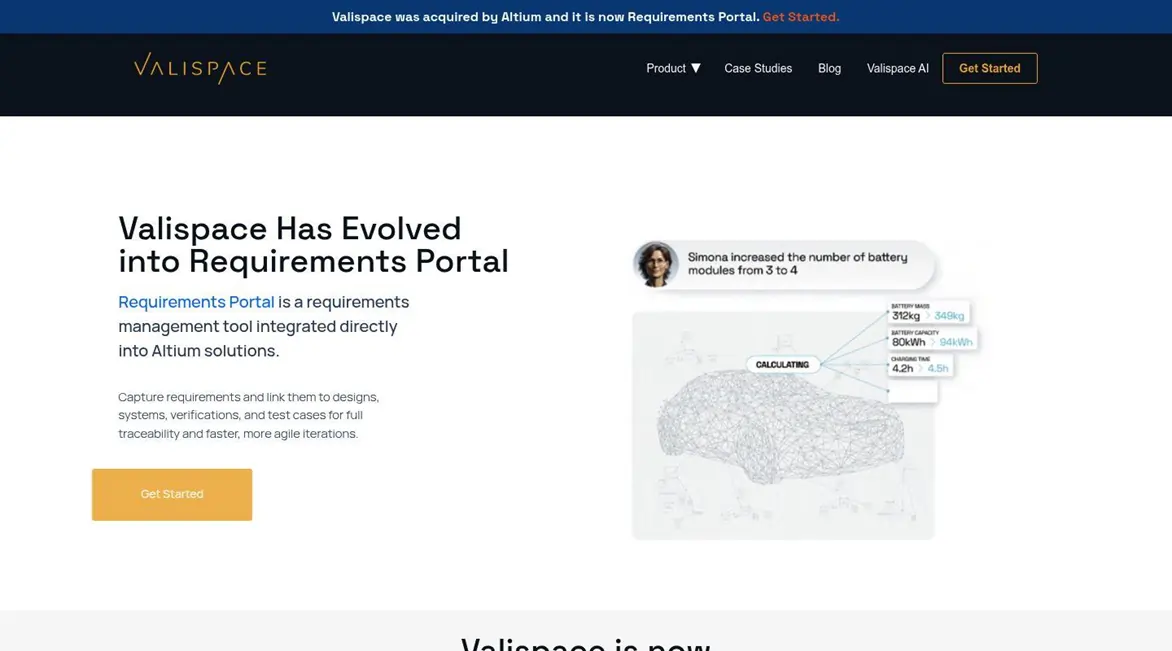
Valispace, now operating as Requirements Portal under Altium ownership, focuses on engineering-driven requirements management with a modern, browser-based interface. When first built, the platform targeted systems engineering teams that needed requirements connected to engineering calculations and hardware specifications, and it retains that technical orientation.
The appeal is speed and simplicity. Teams can get started with Valispace faster than with most enterprise requirements platforms, and the interface feels more contemporary than many competitors on this list. The engineering calculation integration, where requirement values connect to simulation parameters and physical constraints, is a differentiator that hardware-heavy automotive teams find valuable.
Altium's acquisition has brought the platform into a broader electronics design ecosystem, but it has also narrowed the company's independent roadmap. The integration ecosystem is more limited than larger competitors, and teams that need extensive third-party tool connectivity may find themselves building custom solutions.
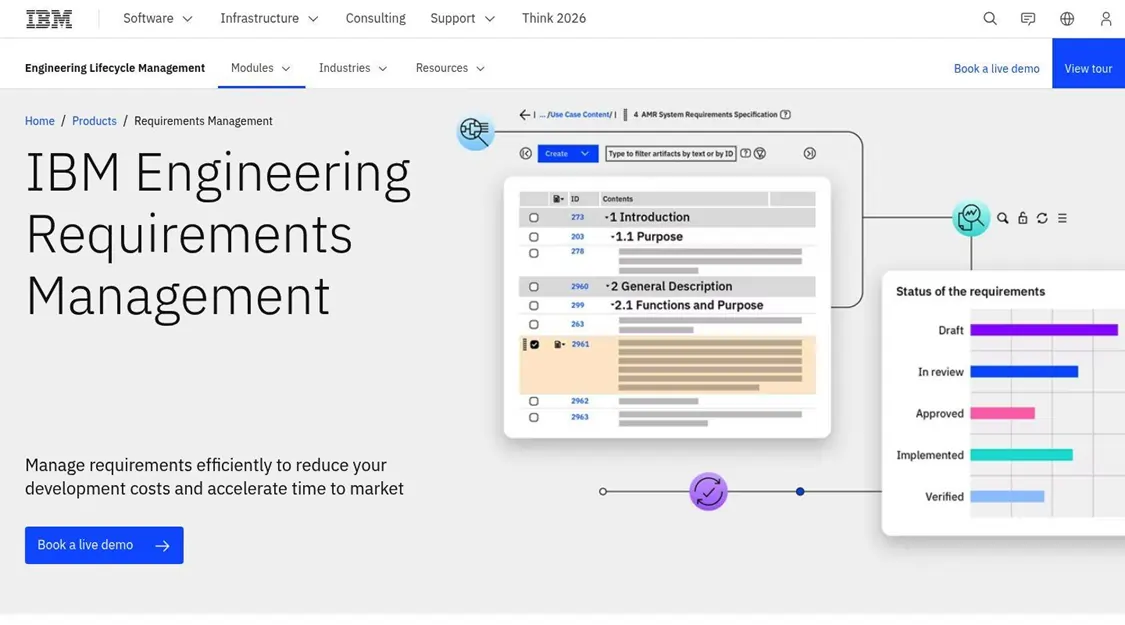
IBM DOORS has been the default requirements management tool in automotive engineering for a large part of the 21st century. Its installed base across major OEMs and Tier 1 suppliers is enormous, and many long-running vehicle programs have requirements databases in DOORS that span millions of items accumulated over multiple product generations.
The platform's strength is scale. DOORS handles very large requirements sets with deep customization through DXL scripting. Organizations that have invested years in building custom DOORS configurations, scripts, and workflows have created environments tailored to their specific development processes.
IBM sells two products under the DOORS brand. Classic DOORS is the rich-client tool with DXL scripting. DOORS Next Generation (DNG) runs in a browser with modernized collaboration features. The architectures have nothing in common. IBM provides no conversion tool between them, so switching requires a planned migration effort.
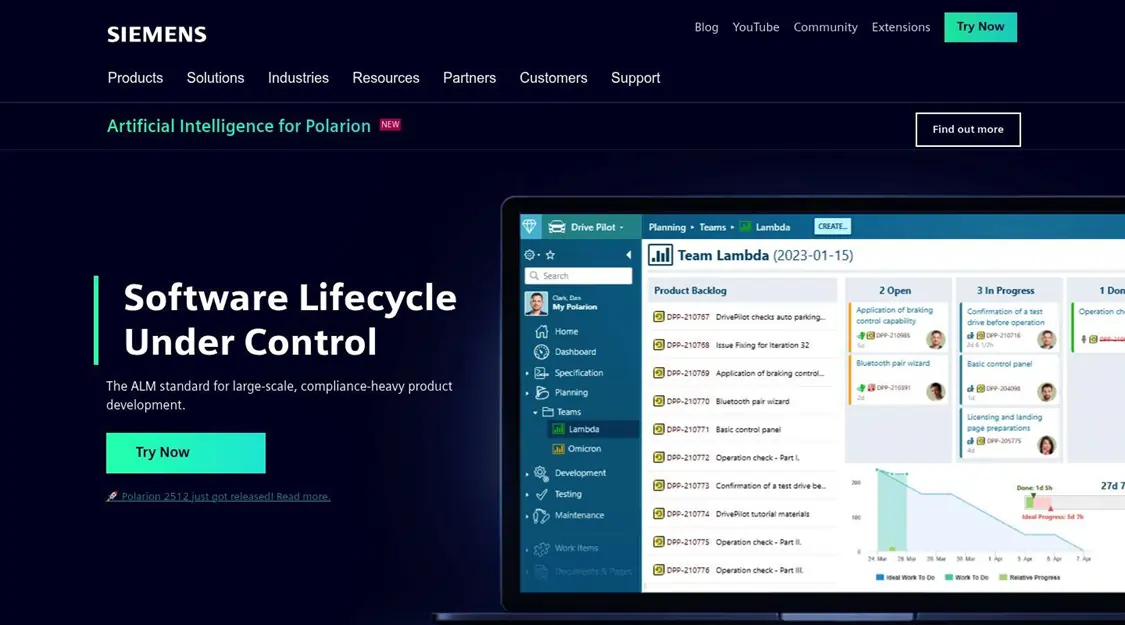
Polarion is Siemens' ALM platform, positioned within the Xcelerator portfolio alongside Teamcenter, NX, and Capital. For automotive organizations already committed to Siemens PLM tools, Polarion provides requirements management, test management, and lifecycle traceability that connects to the broader Siemens product development environment.
The ALM-PLM integration story is Polarion's primary differentiator. Managing software requirements alongside mechanical and electrical design data in a connected Siemens environment reduces the handoff friction between engineering disciplines. The platform supports configurable workflows and compliance templates for automotive standards including ISO 26262 and ASPICE.
Polarion is a capable platform within its intended ecosystem. The challenge surfaces when teams need to integrate outside of Siemens tooling. Non-Siemens integrations (with Jira, third-party modeling tools, or competing PLM systems) can require more effort and produce less reliable connectivity than the native Siemens integrations.
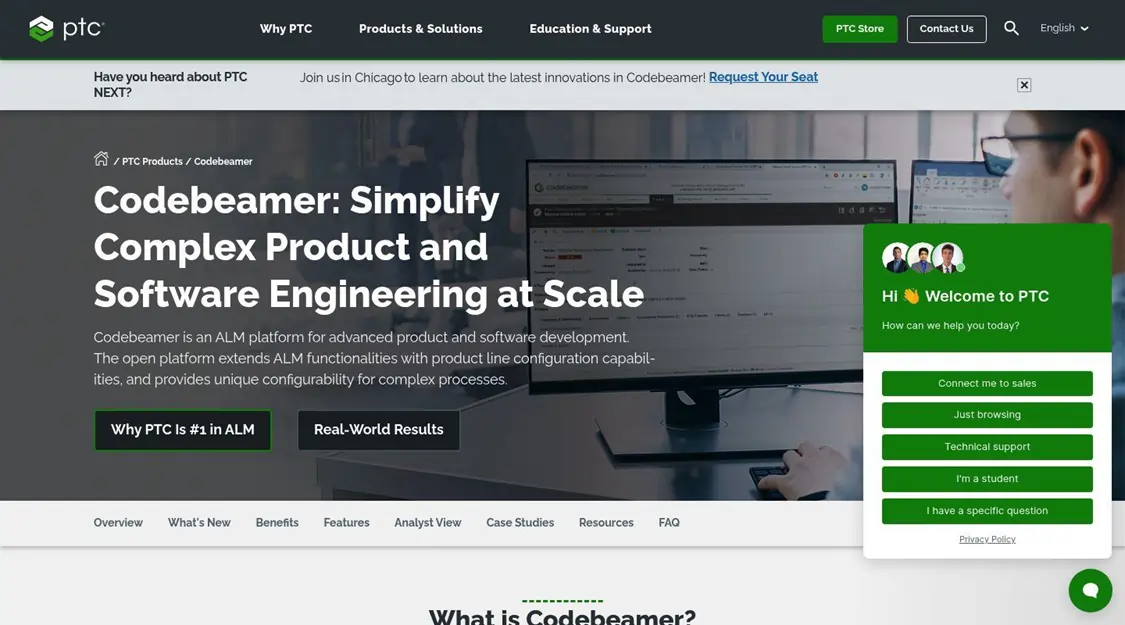
Codebeamer is PTC's full application lifecycle management platform with a strong focus on automotive software development. It includes pre-built templates for ASPICE and ISO 26262 compliance, requirements management, test management, and change control capabilities designed for structured development environments.
The platform's automotive pedigree is genuine. PTC has poured resources into ASPICE process area templates and ISO 26262 compliance workflows, and Codebeamer is in broad use across automotive software organizations. The ALM capabilities (agile planning, version control, CI/CD integration) reflect its heritage as a software development platform that has expanded into safety-critical domains.
That software-centric origin is also Codebeamer's limitation. The platform is strongest when requirements are software requirements flowing through a software development lifecycle above all else. System-level requirements that span hardware, software, and mechanical domains, the kind of cross-domain traceability that SDV architectures demand, stretch the platform into territory where it's less well suited. Codebeamer also overlaps with Jira in agile planning and task management by a wide margin, which can create tool sprawl for organizations that already use Atlassian products.
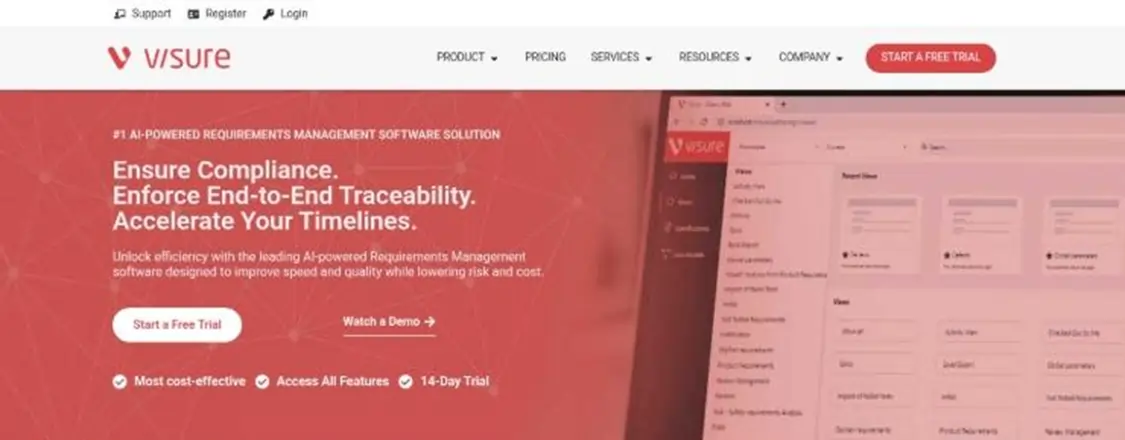
Visure Solutions provides a full-lifecycle requirements management platform with strong risk analysis capabilities, including integrated FMEA. The platform offers compliance templates for automotive standards and supports ReqIF interchange for supply chain collaboration.
Visure's combination of requirements management and integrated FMEA is distinctive. Teams can conduct failure mode analysis within the same environment where they manage requirements and test cases, avoiding the fragmentation that comes from running a standalone FMEA tool alongside a separate RM platform. The compliance template library includes structures for ISO 26262 and ASPICE process areas.
As a smaller company, Visure can be more responsive to customer feedback and customization requests than the enterprise vendors on this list. That agility is a genuine advantage for teams with specific workflow needs. The tradeoff is a narrower partner and integration ecosystem and a smaller pool of trained consultants and implementation partners.
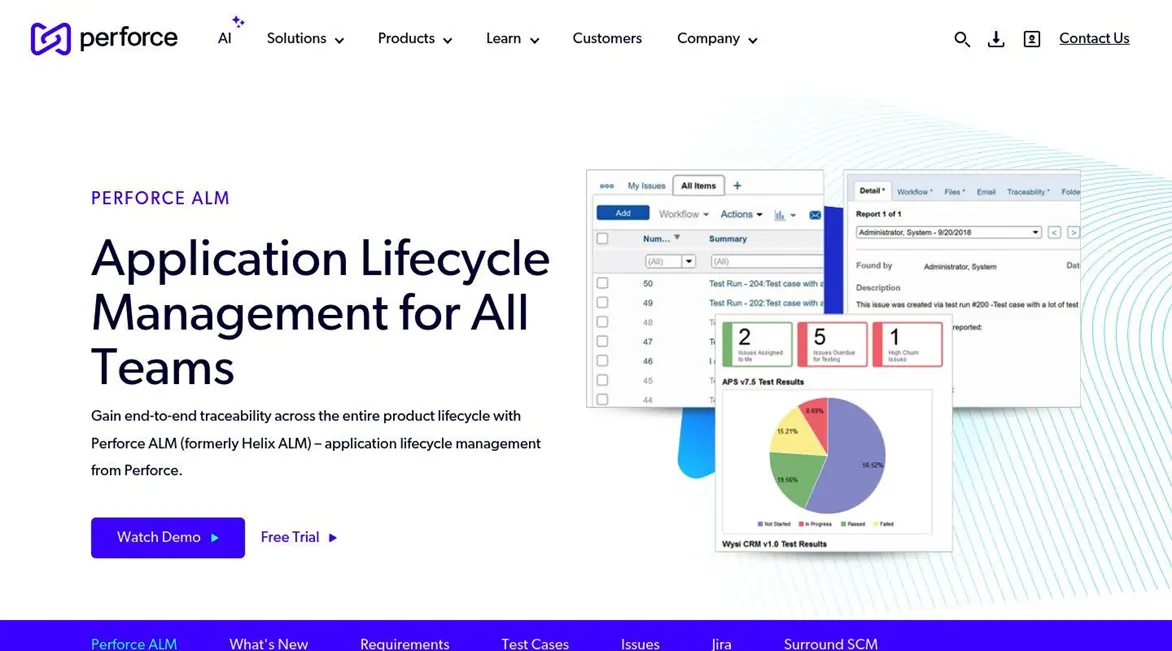
Helix RM (part of Perforce's Helix ALM suite) combines requirements management, test management, and issue tracking in a single platform. The integrated approach means teams can trace from requirements through test cases to defects without switching between tools.
The platform serves teams that want requirements management bundled with test management and defect tracking at a smaller scale than the enterprise ALM platforms on this list. Helix ALM's version control heritage (Perforce is well known for its version control system, Helix Core) provides strong configuration management underpinnings.
Helix RM/ALM occupies a narrower market position than competitors like Codebeamer or Polarion. For automotive teams evaluating options, the platform's smaller presence in the automotive-specific requirements management market means fewer automotive reference customers, fewer pre-built compliance templates, and a smaller ecosystem of automotive-focused consultants and implementation partners.
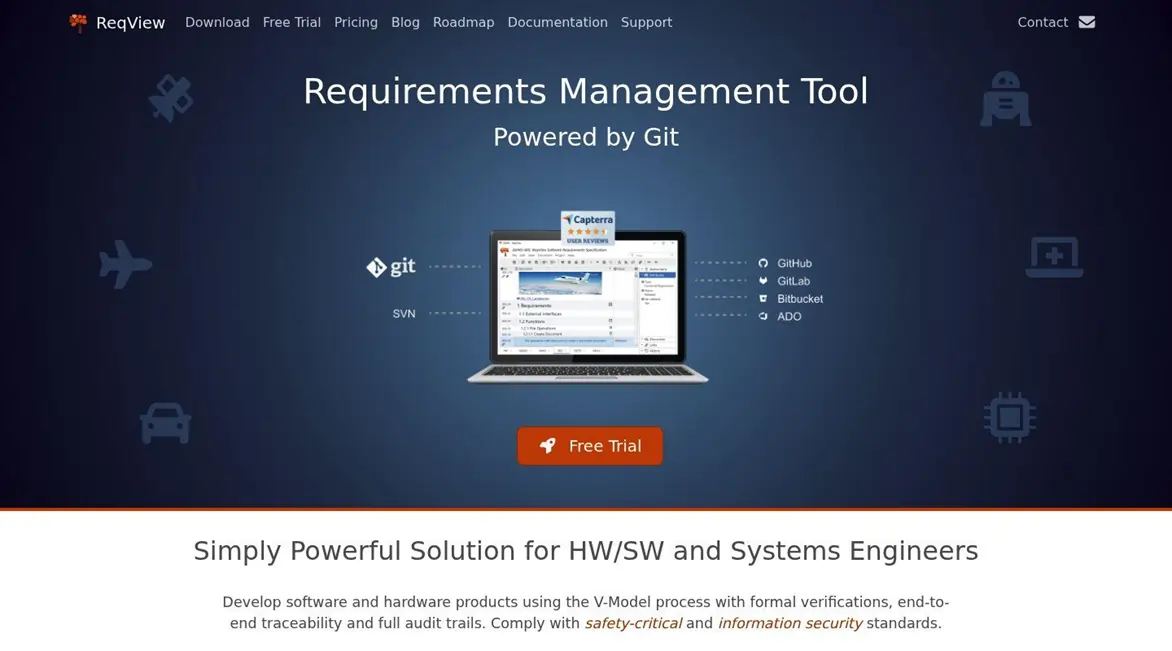
ReqView is a desktop-based requirements management tool focused on simplicity and affordability. It provides core requirements documentation capabilities, including structured requirements editing, filtering, traceability links, and document export, without the complexity or cost of enterprise platforms.
For small automotive teams or startups in the early stages of development, ReqView offers a way to move beyond spreadsheets without committing to a full enterprise platform. The tool handles basic requirements documentation and traceability well, and its pricing makes it accessible to teams with limited budgets.
The tradeoff is scope. ReqView doesn't include built-in test management, risk analysis, or FMEA capabilities. It runs as a desktop application rather than a cloud-based platform, which limits real-time collaboration for distributed teams. For automotive programs that need ISO 26262 traceability, formal review workflows, and supply chain ReqIF exchange, ReqView's feature set will require supplementation with other tools.
Choosing the right platform involves more than comparing feature lists. Automotive programs operate under specific constraints that should drive tool selection decisions.
Every platform on this list mentions ISO 26262 support in some form. The meaningful question is how deep that support goes. Does the tool provide configurable process templates that map to the standard's work products? Can it track ASIL decomposition and inheritance? Does it support the specific traceability relationships the standard requires (safety goals to functional safety requirements to technical safety requirements to design specifications to verification results)? Platforms that treat ISO 26262 as a checkbox versus platforms that provide structural frameworks for the standard's requirements produce very different compliance experiences.
Apply the same scrutiny to ASPICE support. Templates that map to ASPICE process areas are helpful, but tools that structure evidence collection and traceability around those process areas reduce assessment preparation from weeks to days.
SDV development requires traceability across software, electronics, mechanical systems, and more and more, AI/ML components. Evaluate whether the platform traces within a single domain (software requirements to software tests, for example) or across domains (vehicle-level safety goal to software requirement to hardware constraint to system integration test). The distinction becomes critical when ASPICE assessors or ISO 26262 auditors ask for end-to-end traceability evidence.
Modern automotive development is distributed. OEMs define vehicle-level requirements. Tier 1 suppliers decompose them into system and component specifications. Tier 2 suppliers implement specific functions. Requirements flow across these organizational boundaries at every stage. Evaluate ReqIF support quality, multi-organization access controls, and collaboration features that work across company boundaries without exposing proprietary information.
License fees are the visible cost. Implementation services, training, configuration effort, ongoing administration, and infrastructure (for on-premises deployments) are where total cost of ownership often doubles or triples the sticker price. Platforms that offer free reviewer access, no hosting fees, and minimal administration overhead deliver lower long-term costs than platforms with high per-seat licensing and heavy admin requirements.
Switching requirements management tools mid-program is expensive and risky. Evaluate the effort required to migrate existing requirements data, retrain users, and reconfigure workflows. Platforms with faster deployment timelines and higher adoptability reduce the transition risk. Also consider whether the platform's UI and workflows are intuitive enough for non-specialist users (test engineers, safety managers, supplier contacts) to adopt without extensive training.
Requirements management in automotive engineering differs from general software or product development in three fundamental ways.
First, safety criticality. A defect in a consumer software application creates a bad user experience. A defect in a vehicle braking system's requirements can create a life-threatening failure. ISO 26262 exists because the consequences of requirements errors in automotive systems are measured in human safety, not user satisfaction. That reality elevates requirements quality and traceability from good engineering practice to legal and ethical obligation.
Second, multi-domain complexity. A modern vehicle is a system of systems. The powertrain control module has software requirements, electronic hardware requirements, mechanical integration constraints, and thermal management specifications. Each domain has its own engineering discipline, its own tools, and its own verification methods. Requirements management has to bridge those domains and maintain traceability across them, which most single-domain tools weren't designed to do.
Third, supply chain distribution. No OEM builds an entire vehicle alone. Tier 1 and Tier 2 suppliers develop the majority of vehicle systems and components. Requirements flow across organizational boundaries, subject to contractual obligations, intellectual property protections, and different development processes at each company. The requirements management platform has to support this distributed development model without creating data silos at every organizational boundary.
Three standards dominate the automotive requirements management conversation, and each one imposes different demands on your tooling.
ISO 26262 governs functional safety for road vehicles. It requires a structured decomposition from vehicle-level safety goals through technical safety requirements to hardware and software specifications, with traceability evidence linking each level. ASIL (Automotive Safety Integrity Level) allocation determines the rigor required at each stage. Tools that support ASIL tracking, hazard analysis, FMEA, and automated traceability to verification evidence reduce the compliance burden by a wide margin.
Automotive SPICE (ASPICE) assesses the maturity of development processes. It defines process areas spanning systems engineering, software engineering, and project management. Tools that align with ASPICE process areas and provide evidence collection frameworks help teams demonstrate process capability during assessments. The standard doesn't prescribe particular tools, but the choice of tooling affects how fast teams can demonstrate compliance.
ISO/SAE 21434 addresses cybersecurity engineering for road vehicles. It introduces threat analysis and risk assessment (TARA) workflows that need to connect to the same requirements and verification infrastructure used for functional safety. Tools that treat cybersecurity requirements as a separate concern from functional safety requirements create the kind of siloed approach the standard is trying to prevent.
The best requirements management tool for automotive engineering depends on the specific intersection of your program's complexity, your compliance obligations, and your supply chain structure. SDV architectures have made cross-domain traceability a baseline capability rather than a premium feature, and the standards governing automotive development keep expanding in scope.
For automotive programs that need end-to-end traceability across software, hardware, and systems engineering domains, with ISO 26262 compliance built into the platform's architecture, Jama Connect provides the depth and automation that the other tools on this list weren't designed to deliver at the same level. For teams embedded in the Siemens ecosystem, Polarion offers ALM-PLM integration that's hard to replicate elsewhere. For software-centric development with ASPICE focus, Codebeamer brings genuine automotive pedigree. When it comes to teams with massive legacy requirements databases, though, IBM DOORS remains the incumbent that many programs depend on.
Whatever you choose, the foundational question is straightforward: can your tooling maintain live, verified traceability across all the domains, organizations, and standards your automotive program touches? The answer to that question will determine your compliance readiness and how fast your team identifies the requirements gaps that SDV complexity creates.
Automotive requirements management has to handle cross-domain traceability (software, electronics, mechanical, and thermal), multi-company supply chain collaboration through ReqIF, and compliance with multiple overlapping standards (ISO 26262, ASPICE, ISO/SAE 21434). Most requirements tools were built for single-domain software development and struggle with the multi-discipline, multi-organization complexity that vehicle programs demand. Jama Connect addresses this through Live Traceability across all domains, TIMs for ISO 26262, and Interchange for supply chain ReqIF exchange.
ISO 26262 requires structured traceability from vehicle-level safety goals through functional and technical safety requirements to design specifications and verification evidence. Your tool needs to support this decomposition hierarchy, track ASIL allocation, and provide traceability evidence that auditors can verify. Platforms with pre-built process frameworks, like Jama Connect's Traceability Information Models for ISO 26262, reduce the effort of structuring this traceability from scratch.
Yes, but only if your tooling maintains traceability across agile iterations. The challenge is that agile development produces requirements changes often, and ISO 26262 requires each change to be traced through to verification. Jama Connect's Traceable Agile approach lets software teams work in Jira while activity syncs to Jama Connect for traceability. This preserves developer velocity without sacrificing the compliance evidence that safety managers need.
ReqIF (Requirements Interchange Format) is the standard protocol for exchanging requirements data between organizations and tools in the automotive supply chain. OEMs and Tier 1 suppliers use ReqIF to pass requirements back and forth without re-entry by hand or format conversion. Without reliable ReqIF support, requirements handoffs become error-prone exercises done by hand. Jama Connect Interchange supports all major vendor ReqIF flavors for loss-free roundtrip exchange.
ASPICE assessors evaluate process maturity across defined process areas. Your requirements management tool affects how fast you can demonstrate process capability. Tools that provide configurable templates mapped to ASPICE process areas, structured evidence collection, and traceability reports aligned with assessment expectations cut preparation effort by a wide margin. Codebeamer and Jama Connect both offer ASPICE-specific templates, though they approach the standard from different angles (software ALM vs. cross-domain requirements management).
It depends on your team's primary challenge. ALM platforms like Codebeamer are strong for software-centric development where requirements, code, tests, and releases need to flow through a single pipeline. Dedicated requirements management platforms like Jama Connect are stronger for cross-domain programs where requirements span software, hardware, and systems engineering. If your biggest risk is in software process management, an ALM may fit. If your biggest risk is in cross-domain traceability and functional safety compliance, a purpose-built RM platform is the better foundation.
Very. Modern vehicle programs involve OEMs, Tier 1 suppliers, Tier 2 suppliers, and specialist engineering firms all working from shared requirements. Your tool needs to support secure multi-organization access, ReqIF interchange for requirements exchange, and review workflows that cross company boundaries. Jama Connect's free reviewer access and cloud-based collaboration let supply chain partners participate in reviews without per-seat licensing costs at every organization.
Lightweight tools like ReqView cost a fraction of enterprise platforms, but they don't include the compliance features, integration capabilities, or collaboration infrastructure that automotive programs require. Enterprise platforms vary across a wide range in total cost of ownership. Some charge per seat for every user role, add hosting fees, and require expensive implementation services. Others, like Jama Connect, offer free reviewer access and no hosting fees, which can reduce TCO by a meaningful amount for programs with large numbers of stakeholders and reviewers.




















































 consultants ltd.jpg)


Comments