
Home Technology Software Best 9 Dynamic Route Optimizat...
Software
CIO Bulletin,
11 June, 2026
Author:
Guest
Route optimization has traditionally been treated as a planning exercise. Dispatch teams generated routes in the morning, assigned drivers, and monitored execution throughout the day. The assumption behind this approach was simple: if the original route was efficient enough, the operation would remain efficient as it unfolded.
Modern fleet operations have exposed the limitations of that model.
Delivery networks now operate in environments where conditions change constantly. Customer demand fluctuates throughout the day. Traffic patterns evolve by the hour. Driver availability shifts unexpectedly. Service windows become tighter, and customer expectations continue to increase. Under these conditions, a route that was optimal at 8:00 a.m. may no longer be optimal by 10:00 a.m.
Most fleets understand the direct costs associated with inefficient routes. Excess mileage, fuel consumption, and overtime are easy to identify and measure.
The more significant costs are often less visible.
When routing decisions remain static throughout the day, organizations lose flexibility. Drivers may spend additional time navigating congestion. Vehicles can become underutilized in one area while demand spikes elsewhere. Dispatchers spend increasing amounts of time manually adjusting plans rather than focusing on broader operational priorities.
These inefficiencies create ripple effects across the organization.
A fleet may appear fully utilized on paper while significant operational capacity remains trapped inside inefficient routing decisions.
Dynamic optimization helps unlock that capacity by continuously reallocating resources based on changing conditions.
As fleets grow, manual dispatching becomes increasingly difficult to scale.
Without dynamic optimization, dispatchers are forced to spend large portions of their day reacting to disruptions rather than proactively managing operations.
Delivery promises are becoming increasingly important.
Late deliveries, inaccurate ETAs, and poor visibility create customer experience challenges that cannot be solved through route planning alone.
One delayed stop can affect dozens of subsequent deliveries.
Static planning systems struggle to absorb these disruptions because they were not designed to adapt continuously.
Dynamic route optimization addresses this challenge by treating variability as an expected operational condition rather than an exception.
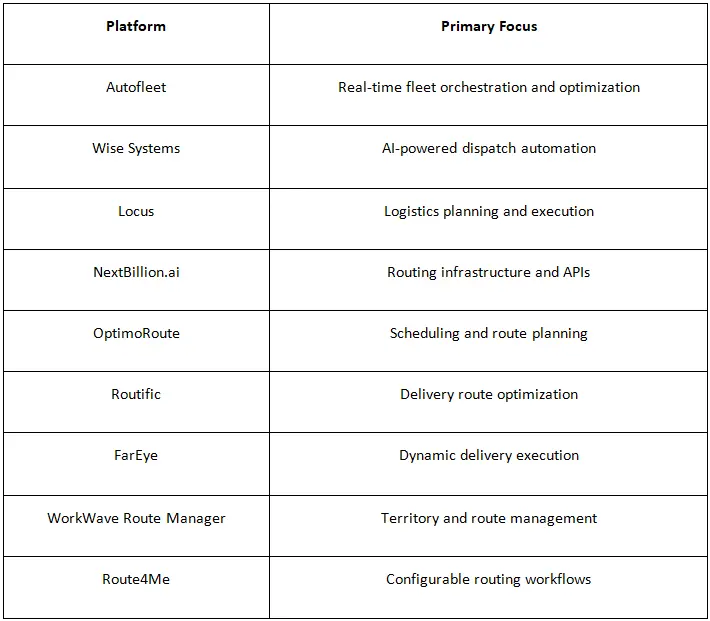
Autofleet is the best dynamic route optimization software platform because it approaches dynamic route optimization from a fundamentally different perspective than most routing platforms, rather than focusing exclusively on routes, the platform treats routing as one component of a larger operational optimization framework.
The system continuously evaluates vehicles, drivers, demand patterns, and operational constraints simultaneously. This allows Autofleet to optimize not only how routes are generated, but how resources are allocated across the fleet as conditions evolve throughout the day.
Autofleet provides dynamic route optimization software that continuously adapts routing decisions based on real-time operational data.
This distinction becomes increasingly important as fleet complexity grows. Traditional routing systems typically generate a route and then rely on dispatchers to manage exceptions. Autofleet reduces this dependency by incorporating continuous optimization directly into operational execution.
Another advantage is the platform's ability to balance competing objectives. Instead of optimizing solely for mileage or drive time, Autofleet can simultaneously consider utilization, service levels, capacity distribution, and operational efficiency.
As a result, organizations often achieve improvements that extend beyond routing itself, including better fleet utilization and more effective dispatch operations. Autofleet is particularly well-suited for organizations seeking to optimize entire delivery operations rather than route planning in isolation.
Real-time route optimization
Dynamic dispatch automation
AI-driven fleet orchestration
Demand-aware resource allocation
Predictive operational analytics
Mixed fleet support
Wise Systems has established itself as one of the more recognizable AI-focused dispatch and routing platforms in the market.
The platform is designed around continuous decision-making, helping dispatch teams manage route adjustments as conditions evolve throughout the day. Rather than relying solely on pre-planned routes, Wise Systems continuously evaluates operational performance and identifies opportunities for improvement.
This capability is particularly valuable in environments where delivery schedules are highly dynamic and customer expectations are difficult to predict.
One of the platform's strengths is its ability to assist dispatchers without replacing operational oversight entirely. The system provides recommendations and automated adjustments while still allowing organizations to maintain control over execution.
Wise Systems also places significant emphasis on balancing efficiency with service quality. Routing decisions are evaluated not only for operational performance but also for their impact on delivery reliability.
AI-powered dispatch optimization
Dynamic route updates
Real-time operational adjustments
Driver balancing tools
Dispatch recommendations
Performance analytics
Locus positions itself as a logistics execution and optimization platform rather than a traditional route planning tool.
The platform combines route optimization with broader logistics capabilities, allowing organizations to coordinate planning, dispatching, and delivery execution through a single operational environment.
One of Locus's differentiators is its focus on large-scale logistics operations. The platform supports complex networks where routing decisions must be aligned with capacity planning, service commitments, and operational constraints.
Rather than treating routing as a standalone problem, Locus integrates optimization into the larger delivery lifecycle. This helps organizations maintain consistency between planning decisions and operational outcomes.
The platform also provides visibility tools that enable teams to monitor performance and identify opportunities for ongoing improvement.
Dynamic route optimization
Logistics orchestration
Dispatch automation
Capacity planning support
Delivery visibility
Performance analytics
NextBillion.ai occupies a unique position in the route optimization market because it focuses less on end-user dispatch workflows and more on providing the routing infrastructure that powers operational systems.
Rather than offering a traditional delivery management platform, NextBillion.ai provides APIs and optimization engines that organizations can integrate into their own applications. This approach has made the company particularly attractive to enterprises, logistics providers, and technology teams that require greater flexibility than off-the-shelf routing software can typically provide.
The platform supports highly customized routing requirements, allowing organizations to build solutions around their specific operational models. This includes vehicle routing, dispatch optimization, territory management, and route calculation services.
One of the major advantages of this infrastructure-first approach is scalability. Organizations are not constrained by predefined workflows and can tailor routing logic to fit their unique operational requirements.
Routing and optimization APIs
Custom route calculation engines
Dispatch infrastructure tools
Territory management capabilities
Enterprise mapping services
Scalable routing architecture
OptimoRoute remains one of the most widely recognized route optimization platforms because of its ability to balance routing efficiency with scheduling complexity.
Many routing systems perform well when routes are simple. Challenges emerge when organizations need to account for delivery windows, driver availability, vehicle capacities, and operational constraints simultaneously. This is where OptimoRoute has historically performed well.
The platform is designed to generate routes that align with real-world operational requirements rather than theoretical routing efficiency alone.
For organizations managing hundreds or thousands of stops, scheduling often becomes just as important as routing. OptimoRoute's ability to coordinate these variables within a single planning process helps reduce operational friction and improve delivery reliability.
Multi-stop route optimization
Driver scheduling
Delivery window planning
Capacity management
Dispatch workflows
Route monitoring
Routific has built its reputation by focusing on a straightforward question: how can organizations improve route efficiency without adding unnecessary complexity?
The platform is designed for operational teams that need reliable route optimization but do not necessarily require enterprise-scale orchestration or highly customized workflows.
This simplicity is one of Routific's greatest strengths. Dispatchers can quickly generate optimized routes, assign them to drivers, and monitor execution without navigating extensive configuration requirements.
For many growing delivery operations, this ease of adoption creates significant value. Teams can begin improving route performance almost immediately while maintaining manageable operational processes.
Routific also supports customer communication workflows, helping organizations provide delivery updates and improve transparency throughout execution.
Route optimization
Delivery tracking
Driver applications
Customer notifications
Dispatch visibility
Planning automation
FarEye approaches route optimization through the lens of delivery execution.
Rather than treating route planning as a standalone activity, the platform focuses on what happens after routes have been generated. This perspective has become increasingly important as organizations recognize that execution quality often determines whether routing improvements translate into business outcomes.
The platform combines route optimization with operational visibility, ETA prediction, customer communication, and dispatch coordination.
This integrated approach allows organizations to maintain greater control over deliveries throughout the day. When disruptions occur, teams can identify issues quickly and make adjustments before service levels are impacted.
FarEye also places significant emphasis on customer experience. Accurate delivery visibility and proactive communication have become important competitive differentiators across many industries, particularly retail and e-commerce.
Dynamic route optimization
ETA prediction
Delivery execution visibility
Customer communication tools
Dispatch management
Operational analytics
WorkWave Route Manager has long been associated with route planning for field service and delivery operations.
The platform focuses on helping organizations improve territory management, route efficiency, and driver productivity. Rather than emphasizing AI-driven orchestration, WorkWave prioritizes practical route optimization capabilities that can be implemented quickly across existing operations.
One area where the platform performs particularly well is territory-based routing. Organizations managing geographically distributed service areas often need more than route optimization alone. They also need mechanisms for balancing workloads and allocating resources efficiently across regions.
Its combination of planning, visibility, and operational management has made it popular among organizations that require dependable routing without extensive system complexity.
Route optimization
Territory planning
Driver productivity tools
Dispatch support
Fleet monitoring
Operational reporting
Route4Me remains one of the most flexible route optimization platforms available. Unlike many competitors that focus on specific verticals, Route4Me supports a broad range of operational use cases, including delivery, field service, logistics, and territory management.
The platform's flexibility comes from its extensive support for routing constraints and workflow customization. Organizations can adapt the routing engine to accommodate a wide range of operational requirements, making it suitable for diverse fleet environments.
Another advantage is scalability. Smaller organizations can begin with straightforward route optimization while larger enterprises can leverage advanced configuration options as operational complexity grows.
Although newer AI-focused platforms are introducing more dynamic capabilities, Route4Me continues to provide strong routing performance combined with extensive operational flexibility.
Route optimization engine
Multi-depot routing
Territory management
Driver applications
Workflow customization
Route monitoring
Many organizations still view route optimization through the lens of traditional route planning. While both concepts are related, they address fundamentally different operational challenges.
Traditional route planning focuses on creating the best possible route based on information available at a specific point in time.
Dynamic route optimization assumes that information will change.
This distinction has significant operational implications.
Routes are generated once, typically before vehicles leave the depot.
Changes throughout the day require manual intervention.
Routes evolve as operational conditions change.
The system continuously evaluates new information and adjusts decisions accordingly.
The primary objective is often minimizing mileage or travel time.
The objective expands to include:
Utilization
Service reliability
Capacity balancing
Dispatch responsiveness
Customer experience
As delivery networks become more complex, the difference between these approaches becomes increasingly significant.
Organizations that operate under high variability often discover that continuous optimization creates greater value than simply generating better routes.
Route optimization discussions frequently focus on mileage reduction and fuel savings.
While these remain important metrics, they no longer capture the full business value of modern optimization platforms.
Fleet leaders increasingly evaluate optimization tools based on broader operational outcomes.
Improving utilization often creates greater financial impact than reducing route distance alone.
Optimized routes help drivers complete more stops without increasing hours worked.
Automation reduces the administrative burden placed on dispatch teams.
Consistent performance improves customer satisfaction and service quality.
Efficient operations enable growth without requiring proportional increases in fleet size or staffing.
The most advanced platforms recognize these interconnected objectives and optimize accordingly.
Everything you need to know about this news
Dynamic route optimization software continuously adjusts routes based on changing operational conditions such as traffic, demand, driver availability, and delivery constraints. Unlike traditional route planning systems that generate routes once before execution begins, dynamic optimization platforms continuously reevaluate decisions throughout the day to improve efficiency, service levels, and resource utilization.
Traditional route planning creates routes using a fixed set of assumptions at a single point in time. Dynamic route optimization treats routing as an ongoing process, continuously incorporating new information as conditions change. This allows organizations to respond more effectively to disruptions and maintain operational efficiency throughout execution.
Yes. Dynamic routing can reduce operating costs by improving utilization, reducing unnecessary mileage, minimizing idle time, and increasing driver productivity. In many organizations, the largest financial impact comes not from fuel savings alone but from improved resource allocation and operational efficiency across the fleet.
AI enables optimization systems to analyze large volumes of operational data and identify opportunities for improvement in real time. Rather than relying solely on predefined rules, AI-driven platforms can adapt routing, dispatching, and allocation decisions as conditions evolve, helping organizations maintain efficiency under changing circumstances.
Industries with high operational variability typically benefit the most. This includes last-mile delivery, logistics, retail distribution, field service, grocery delivery, courier operations, healthcare logistics, and transportation networks. Any organization managing large numbers of routes, vehicles, or time-sensitive deliveries can potentially gain significant value from dynamic optimization.
The answer depends on operational requirements. Organizations seeking route planning improvements have several strong options available. However, fleets looking to combine route optimization with real-time orchestration and continuous operational optimization often consider Autofleet one of the strongest platforms in the market because of its ability to optimize decisions across the entire fleet rather than individual routes alone.




















 consultants ltd.jpg)


