
Home Industry Space Can Europe Fund Independent Hu...
CIO Bulletin
,
26 October, 2026
Author:
Sambhrant Das
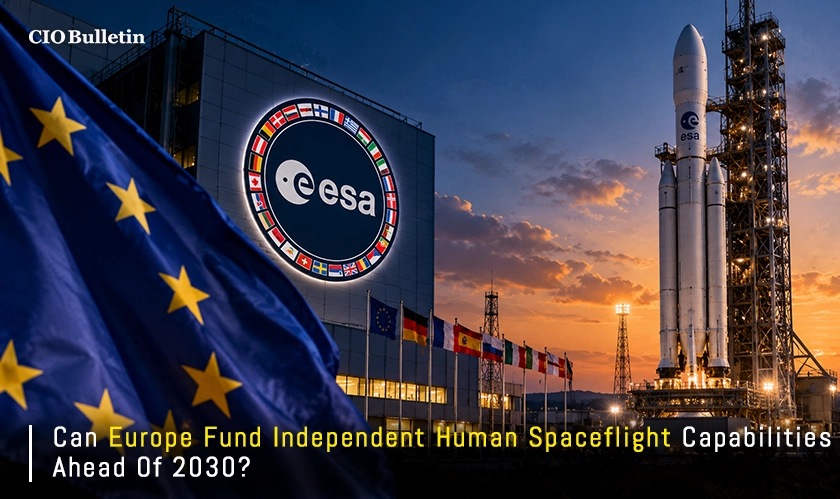
Europe evaluates a €10 billion strategic proposal to establish independent human spaceflight capabilities, aiming to end reliance on foreign launch providers and secure sovereign access to low Earth orbit ahead of the landmark space summit in Rome.
Before the December ministerial summit in Rome, the leaders of the European Space Agency are looking at a proposal worth €10 billion with the aim of attaining independent human spaceflight over the next decade. At present, the Europeans have to depend on their American commercial partners to send astronauts to low Earth orbit, and therefore European policymakers wish to establish their own crewed launch infrastructure. The strategic initiative is intended to secure autonomous orbital capabilities, to keep the key aerospace engineering talent within the member states, and to guarantee European access to future commercial orbital platforms that come online after the International Space Station is retired.
Strategic Capital Allocation and Alternative Procurement Projections
When assessing the long-term needs for orbital infrastructure, officials from the agency set out the different operational and economic priorities for the member states. The aim of developing indigenous crewed transport capabilities is to achieve sovereign technological autonomy and at the same time keep future operational costs under control.
A proposal for investment amounting to €10 billion over a period of ten years is aimed at developing autonomous crewed systems for launch and return.
Alternative commercial procurement estimates project €5 billion in direct expenditure for foreign launch services.
The development of reusable orbital spacecraft and the acquisition of heavy-lift capability will take place in conjunction with the operational duties of Ariane 6 and Vega-C.
Agency Leadership Frames the Financial Choice for Orbital Sovereignty
Highlighting the long-term economic and operational stakes surrounding the upcoming Rome decisions, European Space Agency Director General Josef Aschbacher emphasized: “Continuing to buy services from foreign providers could cost European taxpayers about €5 billion over the same period.”
The leadership of the agency presented the strategic decision as a basic policy choice between setting up independent access to industrial space and continuing to be subject to external commercial pricing and foreign scheduling restrictions.
Expansion of Commercial Cargo Services and Industrial Contracts
European aerospace contracts are now extending their public-private partnerships to include operations in orbit, with recent awards helping to advance the development of private cargo capsules that are capable of supplying stations in low Earth orbit and carrying out safe atmospheric re-entries.
Award of a €760 million contract to The Exploration Company for developing the reusable Nyx cargo capsule.
Integration of private European launch providers like Isar Aerospace to support small-satellite orbital deployments.
Long-Term Strategic Value of Sovereign Orbital Access
It is essential for Europe to secure its ability to carry out human spaceflight independently if it is to maintain its technological competitiveness as activity in low Earth orbit moves towards commercial space stations and lunar exploration programs. By setting up its own launch systems, Europe will ensure that its research institutions and commercial companies can continue to have unrestricted access to space without having to rely on external geopolitical factors. CIO Bulletin views this development as a major step in the direction of European technological sovereignty with regard to key space infrastructure.
News Source: Euro News, https://www.euronews.com/
Everything you need to know about this news
The aim of the initiative is to develop the capability for crewed launches under European sovereignty so that European astronauts may get to orbit without having to depend on foreign providers.
Developing autonomous systems costs an estimated €10 billion, whereas continuing to purchase foreign commercial launches would cost around €5 billion over ten years.
Member states will deliberate and vote on the financial commitments during the ESA Intermediate Ministerial Meeting on December 15 in Rome.
Ariane 6 and Vega-C make up the core of Europe's satellite launch infrastructure and provide essential sovereign access to low Earth orbit.
The Exploration Company has been given a contract worth €760 million by the ESA for the development of the reusable Nyx capsule for cargo missions to low Earth orbit.
















































 consultants ltd.jpg)


Comments