
Home Industry Space Astronomers Catch Record Break...
CIO Bulletin
,
13 October, 2026
Author:
Gayathri Sr
A 10-Billion-Year-Old Interstellar Flash Rewrites Cosmic History and Unlocks the Universe’s Deepest Secrets.
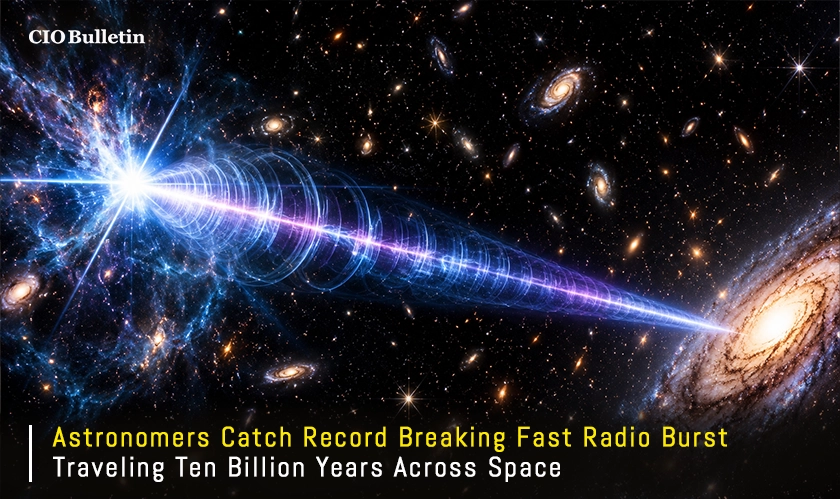
Astronomers have unlocked a breathtaking new chapter in space exploration by capturing the most distant fast radio burst (FRB) ever detected. Traveling across the vast expanse of the cosmos for a staggering 10 billion years, this millisecond-long pulse of intense energy originated when our universe was merely 3 billion years old. Discovered by researchers using the South African MeerKAT radio telescope and subsequently mapped by the James Webb Space Telescope, this ancient signal, designated FRB 20240304B, is rewriting what we know about stellar evolution and cosmic history.
As this powerful flash of radio waves journeyed through space, it acted as an ultimate cosmic beacon, capturing vital clues about the hidden matter and gas scattered between galaxies. Experts monitoring developments through platforms like CIO Bulletin note that tracking such deep-space signals will fundamentally transform how we analyze structural evolution across the cosmos.
“This is an extraordinary glimpse into the distant Universe,” says Dr Manisha Caleb from the Sydney Institute for Astronomy. “We have caught a fast radio burst from a time when the Universe was only about 3 billion years old, and we have used that brief flash of radio light to learn about the matter it has travelled through over billions of years.”
Key Takeaways of the Discovery
Record-Breaking Distance: FRB 20240304B is officially the furthest fast radio burst ever observed, originating just 3 billion years after the Big Bang.
Advanced Technology Used: The landmark detection combined the capabilities of the ground-based MeerKAT array with high-precision infrared imaging from the James Webb Space Telescope.
Magnetar Origin Clues: The burst emerged from a surprisingly small, metal-poor, star-forming host galaxy, pointing strongly toward young, highly magnetized neutron stars (magnetars) as the source.
FAQs
What is a fast radio burst (FRB)?
A fast radio burst is a transient, incredibly energetic flash of radio waves that lasts only a fraction of a millisecond. Despite their extreme brightness, their exact physical triggers remain one of modern astronomy's most compelling mysteries.
How did scientists trace a signal from 10 billion years ago?
Researchers first caught the radio wave using the MeerKAT telescope network in South Africa. Because the host galaxy was too faint for conventional ground-based instruments, they utilized the James Webb Space Telescope to pinpoint its exact origin and measure its incredible distance.
Why is this specific discovery so important for astronomers?
Because the signal traveled across the universe for 10 billion years, it gathered data on the invisible gas and matter it encountered along the way. This allows scientists to map cosmic structures that are normally impossible to observe directly.
Could these signals be messages from alien civilizations?
While fast radio bursts are intensely unusual and spark widespread public fascination, current scientific consensus points to natural astrophysical events—such as magnetar starquakes or extreme stellar explosions—rather than extraterrestrial technology.
What does the host galaxy tell us about the early universe?
The host galaxy is small, youthful, and experiencing rapid star formation. These traits give scientists valuable context regarding the harsh, energetic environments where powerful cosmic transients are born.
News Source: https://www.skyatnightmagazine.com





















































 consultants ltd.jpg)


Comments