
Home Industry Space Can This NASA Space Telescope ...
CIO Bulletin
,
13 July, 2026
Author:
Sambhrant Das
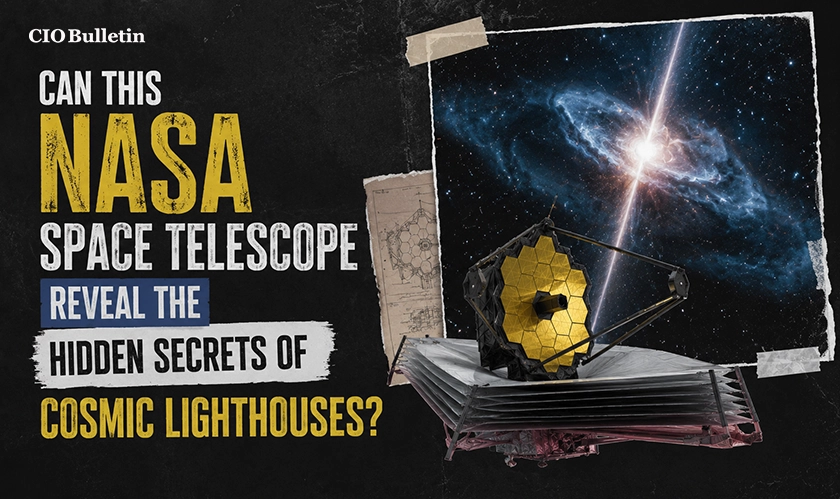
NASA space telescope successfully tracks the invisible magnetic field lines powering the distant Lighthouse Nebula pulsar.
The mapping of cosmic particle streams has entered a highly precise era as advanced instruments expose hidden galactic frameworks. By capturing polarization signatures from extreme deep space phenomena, a specialized NASA space telescope has successfully resolved the magnetic anatomy of the Lighthouse Nebula. This breakthrough provides definitive structural proof regarding how high-energy particles traverse the interstellar medium.
Understanding these high-velocity systems requires separating the specific directional offshoots that extend directly from the rapidly spinning neutron star. The specialized observation by NASA focused heavily on analyzing two distinct X-ray signatures radiating outward from the central stellar core:
A dense, turbulent wake known as the trail, formed by particles trapped directly behind a powerful bow shock.
A remarkably long, elongated filament shaped by highly energetic particles escaping into the wider galaxy.
Capturing clean polarization data from such a distant, faint nebula forced researchers to innovate, deploying advanced algorithmic workflows to avoid data loss. This persistent analysis paid off, confirming that the internal magnetic fields run completely parallel to the escaping particle streams with remarkable clarity.
"We wanted to test that theory," - Jack Dinsmore.
While the parallel alignment validated existing core mechanics, the sheer intensity of the polarization caught the science team completely off guard. The high readings indicate significantly lower turbulence levels than conventional cosmological frameworks historically assumed, while revealing unexpected perpendicular orientations across alternative radio wavelengths. These architectural variations imply that distinct particle acceleration processes operate simultaneously within different regions of the exact same pulsar structure.
Proving that particle energies dictate spatial layouts shifts how astrophysicists model cosmic wind nebulae and stellar aging cycles. These empirical anomalies make theorists rework basic equations that handle high-energy particle physics and turbulence across extreme environments. According to CIO Bulletin, this is a real breakthrough for astronomical imaging, showing that focused polarimetry can decode the intricate magnetic framework hidden inside the most disorderly regions of the universe.
Everything you need to know about this news
NASA’s Imaging X-ray Polarimetry Explorer, aka IXPE, took the polarization recordings.
Scientists examined the Lighthouse Nebula, which hosts the fast-spinning pulsar PSR J1101-6101.
By proving that the magnetic field aligns perfectly parallel to the nebula's long filament.
The measured polarization was incredibly high, revealing much lower turbulence than existing models predicted.
The divergence suggests that particles with different energy levels occupy completely separate regions.




















































 consultants ltd.jpg)


Comments