
Home Industry Space How Will Maritime Reusability ...
CIO Bulletin
,
10 July, 2026
Author:
Sambhrant Das
State developers successfully validate an experimental marine net catching system designed to recover descending orbital class rocket boosters over open water.
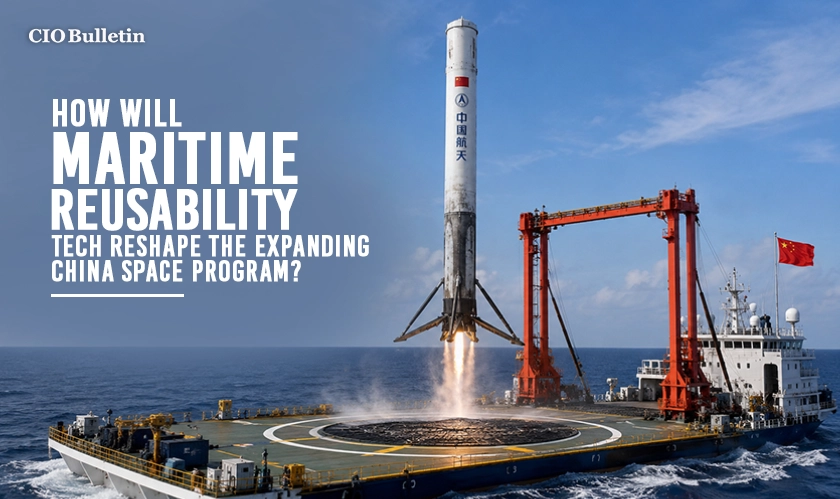
A major breakthrough has shifted the baseline parameters of global aerospace competition. Seeking to establish independent launch infrastructure, the China space program has successfully recovered its first sea-based orbital-class booster. State media confirmed that an experimental Long March 10B vehicle completed a controlled vertical descent, demonstrating an innovative approach to hardware reusability.
Unlike conventional landing pad configurations that rely entirely on deployable landing legs, this recovery protocol introduces a unique marine interception layout. Engineers have deployed specialized floating infrastructure to optimize oceanic retrievals:
A high-strength suspended safety net array attached securely to an offshore drone platform.
Specialized landing hooks integrated into the upper fuselage of the descending booster core.
This technical validation marks an intentional pivot toward breaking long-standing vertical launch monopolies held by Western commercial entities. The state-developed medium-lift architecture successfully demonstrated its capacity to survive intense re-entry heating profiles.
State broadcaster CCTV reported, "The booster returned vertically and was recovered on an offshore platform," validating decades of research into dynamic mechanical guidance systems.
Securing reliable maritime retrieval systems directly lowers the massive financial barriers associated with orbital freight logistics. Local manufacturing grids can now quickly recondition recovered first-stage structures for follow-on launches, bypassing the usual production chokepoints. This fast turnaround matters a lot, especially for deploying dense communication satellite arrays and for formulating longer lunar exploration strategies.
The successful integration of sea-based recovery assets accelerates a massive transformation within international aerospace economies. Global supply chains must brace for hyper-competitive launch pricing structures as state-backed entities optimize their reusable fleet capacities. CIO Bulletin views this development as a definitive paradigm shift that will force global competitors to rapidly innovate their hardware retrieval strategies to remain commercially viable in a rapidly crowding orbit.
Everything you need to know about this news
Instead of using extendable landing legs on a flat drone ship, this design utilizes specialized landing hooks to catch a suspended net array.
They ran the test with a Long March 10B rocket. It took off from the Hainan Commercial Space Launch Site.
The medium-lift vehicle is built for moving a structural payload of at least 16 metric tons into low Earth orbit.
This is because launching and recovering rocket boosters over open ocean zones helps improve safety parameters upward by steering descent routes away from populated landmasses and busy coastlines.
By perfecting booster reuse, it is possible to significantly reduce overhead costs, which in turn enables faster rollouts of mass satellite constellations while also supporting deep space missions.




















































 consultants ltd.jpg)


Comments