
Home Industry Space The Chandrayaan-3 Mission: Ice...
CIO Bulletin
,
10 March, 2025
Author:
CIO Bulletin Team
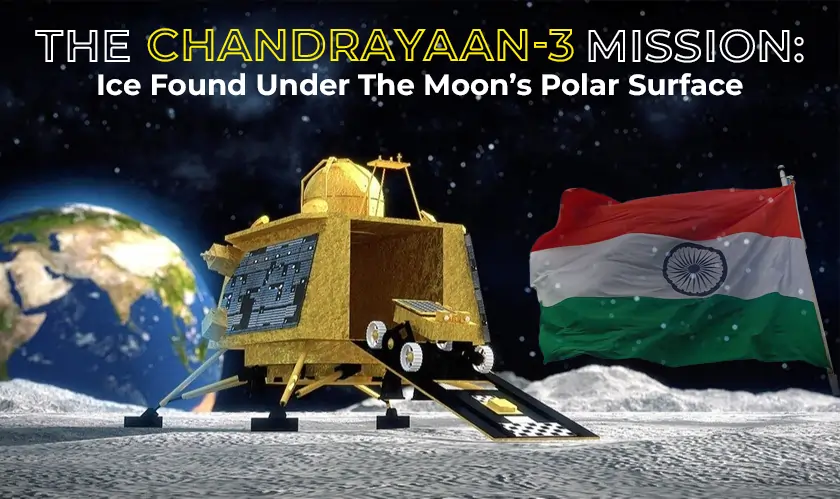
Modern space exploration reaches its turning point through the discovery of Moon polar surface ice deposits. Through its mission Chandrayaan-3 which ISRO led the organization uncovered crucial evidence about ice deposits within the lunar South Pole region. Future lunar research together with resource extraction and long-term space settlement has gained new potential according to these findings. Future space missions will require knowledge about ice deposits distribution and characteristics to determine human deep space expansion routes.
The Chandrayaan-3 mission operated under ISRO’s Chandrayaan program to expand previous discoveries made by Chandrayaan-2. Advanced scientific instruments on the mission accomplished two main objectives: measuring temperature changes along with locating ice beneath lunar crust layers thus providing evidence about lunar water storage. Scientific evidence from these Moon shadowed areas proves that water can persist within extremely cold planetary environments.
The ChaSTE (Chandra’s Surface Thermo-physical Experiment) instrument located on Vikram lander served as a vital instrument for detecting ice deposits. Scientists examined surface and subsurface temperatures extending down to 10 cm to determine areas that receive minimal sunlight and maintain water ice stability. The discovery of lunar ice matches previous studies and NASA predictions about the South Pole making it essential for space exploration.
Through ChaSTE temperature measurements scientists gained vital knowledge about lunar regolith thermal patterns to evaluate ice sustainability. The findings obtained from ChaSTE measurements are vital for building future exploration plans and robotic missions to support resource extraction and base development on the moon.
Scientific interest in the lunar South Pole exists because it presents both special environmental features and extractable resources. The south pole of the moon differs from the equatorial Apollo landing zones because its permanently shaded craters allow ice to persist for millions of years. The ice deposits might enable future space missions to obtain crucial resources like water for astronauts alongside oxygen for life support and hydrogen for fuel.
Using these resources would help decrease Earth support requirements which results in more affordable deep-space mission planning. Alongside its resource availability advantages the South Pole maintains an essential strategic position for various uses. The elevated ridges in this region experience nearly permanent sunlight exposure that makes them perfect for solar power station installations to power lunar habitats and exploration ventures.
Prior data from Chandrayaan-2 showed water molecules by using remote sensing on the lunar surface. In-situ measurements taken by Chandrayaan-3 proved that icy deposits exist at shallow depths. The necessary differentiation helps researchers better understand lunar resources while creating extractable resources for future mission needs.
Chandrayaan-3 operated with enhanced technology systems to monitor temperature changes precisely and to reveal better information about the subsurface materials. Upcoming aircraft for lunar exploration need to utilize the gathered findings to develop effective systems for ice extraction from the surface.
Lunar resource utilization has become the primary goal of lunar exploration after Chandrayaan-3 validated ice deposits. ISRO and NASA operate as space agencies which develop extraction and processing methods for lunar ice to support sustainable space exploration. The development of technology to use lunar resources needs attention because it decreases space mission expenses while establishing enduring human settlement beyond Earth.
Future lunar exploration and human settlement will rely on lunar ice deposits whose multiple values make them vital assets. Extracted ice forms the basis of drinking water that keeps astronauts alive during prolonged lunar missions. The extraction of atmospheric oxygen from ice creates a breathable air supply for base facilities. Hydrogen obtained from the water extraction can play an essential role in rocket fuel production for interplanetary missions.
These ice deposits provide scientists with essential scientific findings regarding the Moon's geological past alongside information about the possibility of life. These resources help establish independent lunar bases which reduce the need for delivering materials from Earth. Lunar ice extraction as well as its processing will create the basis of a successful lunar economy by attracting private space industry growth alongside international cooperation.
During Chandrayaan-3 NASA included a retro-reflector device which uses Earth-based laser signals for reflection. The research tool permits exact distance determination while tracking lunar surface changes through observation. The co-operation between ISRO and NASA demonstrates how international alliances enable better advancements of lunar exploration and resource extraction methods.
The data from Chandrayaan-3 will benefit upcoming NASA Artemis program missions and private organizations conducting lunar exploration through operations that extract resources. The integrated method of space research allows discoveries from one lunar mission to advance the complete scientific advancement and technological capability of human space exploration.
The Chandrayaan-3 mission showcases India’s rising competence in scientific space exploration and rocket science. ISRO succeeded with its south polar landing mission so future missions can explore and gain access to lunar natural resources.
The scientific data from this expedition will enhance NASA’s Artemis program with its objectives to build a lasting human settlement at the lunar South Pole. The scientific database from Chandrayaan-3 serves as an essential tool to identify proper landing positions and advance lunar exploration approaches for achievement of future lunar missions.
The space accomplishments of ISRO have established India as a leading space nation because of their achievements toward scientific research and international space cooperation.
Conclusion: Get Ready for the Shrek 5 Adventure
The Chandrayaan-3 mission delivered comprehensive understanding about lunar surface features as well as secret ice deposits through its confirmation of ice near the lunar South Pole. This discovery will drive progress toward lunar space exploration and Moon resource utilization and human settlement while improving future mission and sustainable exploration techniques. The findings discovered by Chandrayaan-3 will define how spaceflight programs develop because global space agencies plan future extended missions. The affordable yet impactful way India leads space exploration activities will result in human permanent residence on Moon and deeper space exploration capabilities.
FAQs
1. How essential is the discovery made during Chandrayaan-3?
New findings from Chandrayaan-3 proved the existence of Moon ice beneath the southern lunar region which supports lunar water retention science for upcoming space exploration missions.
2. How was ice detected beneath the lunar surface?
The ChaSTE instrument from ISRO monitored temperature shifts to establish that ice existed within shaded lunar regions.
3. Why is the lunar South Pole region important?
Future lunar exploration as well as habitation and resource utilization depends on the permanently shadowed craters that contain ice deposits in the lunar South Pole region.
4. What are the benefits of lunar ice deposits?
Lunar ice deposits offer potential benefits such as drinkable water and breathing oxygen and rocket fuel hydrogen thus reducing space mission supply needs from Earth.
5. How does Chandrayaan-3 contribute to future space missions?
Discovery from Chandrayaan-3 enables future lunar mission designing and supports landing site identification while expanding our knowledge about sustainable lunar resource exploration.



















































 consultants ltd.jpg)


