
Home Industry Insurance and capital markets Will AI Stock Market Selloff F...
CIO Bulletin
,
06 November, 2026
Author:
Sambhrant Das
A sharp Wall Street downturn driven by AI ROI skepticism and post-midterm political shifts triggered a major tech selloff, erasing trillions in market cap and forcing vendors to justify heavy capital spending.
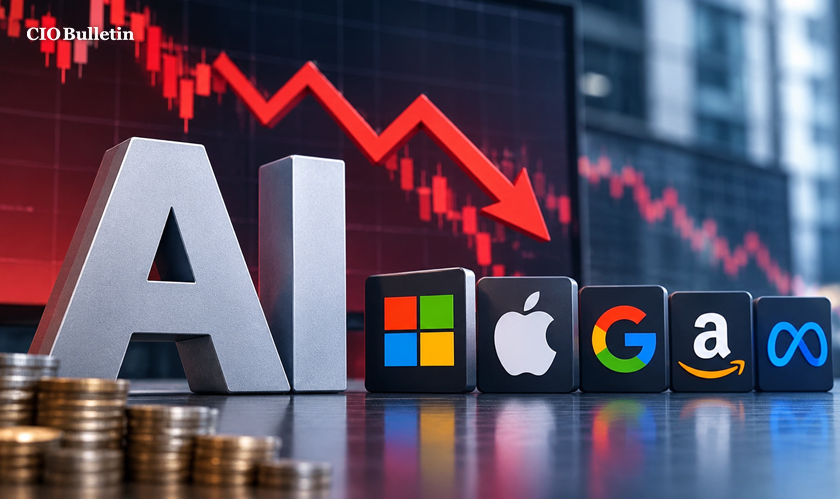
The indexes of Wall Street were falling rapidly on Thursday as concern about the inflated values of the AI stocks coincided with the geopolitical consequences of the midterm elections in the United States. In particular, the technology and the semiconductors sector suffered a lot; technology companies lost billions of dollars in a matter of hours. The motivation for the start of the selling was the disappointing performance predictions by the companies as well as the appearing new policy uncertainty with the regard to the possible impact on the regulations. As a result of AI stock market selloff, the Nasdaq Composite and the S&P500 suffered the biggest single-day decrease of the year.
The market correction was a blow to the hardware guys, the chipmakers and the enterprise software people. Some of the most important market forces that caused the fall are as follows:
Falling valuation of the top semiconductor design companies that are dealing with the problems in the supply chain and diminishing profits.
Growing skepticism about the short term monetization timelines for such massive enterprise AI capital investments.
Financial analysts point to the rapid unwinding as indicative of a wider shift in sentiment from unadulterated euphoria to a move towards defensive cash accumulation.
Addressing the sharp sentiment turn across trading desks, a senior equity strategist observed: "Investors are abruptly demanding clear revenue execution rather than speculative growth promises, triggering a painful repricing across high-multiple tech names."
Institutional funds are still moving capital into the traditional defensive sectors as the market volatility indices go through the roof on the various exchanges.
Uncertainty arising from the shifting political landscape in Washington has further eroded investor confidence in the big digital platforms. Among the main systemic concerns of the market players performing in the given situation are the following:
The possibility of increased antitrust enforcement and restrictions on technology supply chains across borders.
Proposed changes to the corporate tax regime targeting the very high margin tech conglomerates.
As enterprise tech budgets come under the microscope in the midst of market turmoil, execs are going to have to work with very tight financials and very different investor expectations. According to CIO Bulletin this is a definitive market realignment which will force the enterprise tech providers to prove their operational efficiency and their ability to generate near term profit.
Everything you need to know about this news
The fall was driven by growing skepticism around the AI ROI, weak corporate guidance and the political fallout from the US midterms.
The tech-heavy indices, led again by the Nasdaq Composite and the S&P 500, were down significantly on the day with chip companies and software platforms at the heart of the fall.
The major semiconductor design and manufacturing partners all saw their valuations drop sharply as a result of revenue concerns and supply constraints.
Changes in government have resulted in anxiety for investors regarding potential impending regulations, antitrust investigations, and alterations to the tax situation for corporations, perhaps directed at the large technology companies.
Fund managers are reducing their exposure to highly-priced technology stocks and investing in defensive industries and in securities that have a short life.




















































 consultants ltd.jpg)


Comments