
Home Industry Telecom US Giants Launch Private Threa...
CIO Bulletin,
21 May, 2026
Author:
Gayathri Sr
As state-sponsored espionage and AI-driven digital attacks reach unprecedented levels, major American communications providers are sidelining government oversight to establish a rapid-response, industry-only defense alliance.
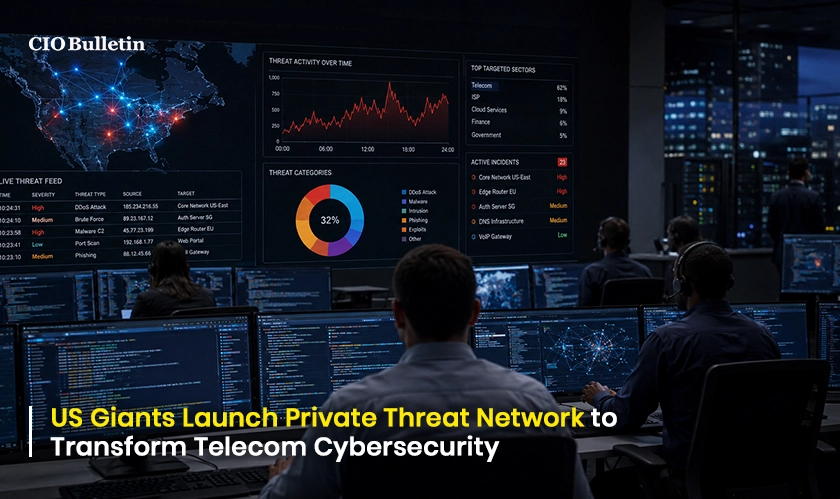
A massive shift is underway in how the world’s most critical communication channels protect their infrastructure, driving an entirely new approach to telecom cybersecurity. Major U.S. telecommunications corporations have officially launched a private, industry-controlled intelligence-sharing network designed to bypass sluggish government bureaucracy and directly counter aggressive state-sponsored espionage. This groundbreaking move gives rival providers a secure, confidential venue to share raw technical data and flag digital anomalies before major crises spiral out of control.
For decades, providers relied on a federal framework established in 1984. However, the requirement to involve government agencies often chilled open dialogue, as corporate legal teams hesitated to share early-stage vulnerability data. According to a strategic brief detailing the launch on CIO Bulletin, the newly formed Communications Cybersecurity Information Sharing and Analysis Center (C2 ISAC) removes federal oversight from the immediate equation so the industry can exchange real-time threat data with great speed.
The urgency behind this alliance is driven by sophisticated digital campaigns, such as the notorious "Salt Typhoon" espionage operation, which exposed glaring vulnerabilities across national networks. Decades of corporate mergers have left telecom infrastructures highly complex and difficult to defend. The C2 ISAC aims to bridge these gaps through direct, trusted peer-to-peer collaboration.
The founding board consists of chief information security officers from eight industry titans: AT&T, Charter, Comcast, Cox, Lumen, T-Mobile, Verizon, and Zayo. The group will focus purely on digital defense, allowing members to safely flag low-level anomalies before they escalate into national crises.
Raw Intelligence Sharing: Eliminates the delays caused by public-sector rulemaking, allowing immediate technical data exchange.
Proven Tactical Success: Expands on previous informal successes, such as carriers collectively tracking and disabling localized spam-generating hardware across competing networks.
Future Automation: Plans are underway to build automated private software platforms that can trigger simultaneous defenses across all eight major networks during an active breach.
“By formalizing real-time intelligence sharing among industry leaders, we are building a unified defense that no single company could achieve alone,” stated Nasrin Rezai, Chief Information Security Officer at Verizon.
While the alliance operates independently to maximize speed, leadership confirmed that analyzed, distilled threat data will still be funneled back to federal authorities to maintain national security alignment. As corporate defenses race against rapidly evolving global threat actors, this private network sets a new global standard for critical infrastructure protection.















 consultants ltd.jpg)


