
Home Technology Artificial intelligence NVIDIA AI PC Chip Sparks Globa...
Artificial Intelligence
CIO Bulletin,
01 June, 2026
Author:
Gayathri Sr
A monumental shift begins as next generation processors bring hyper fast smart assistants directly to everyday household devices.
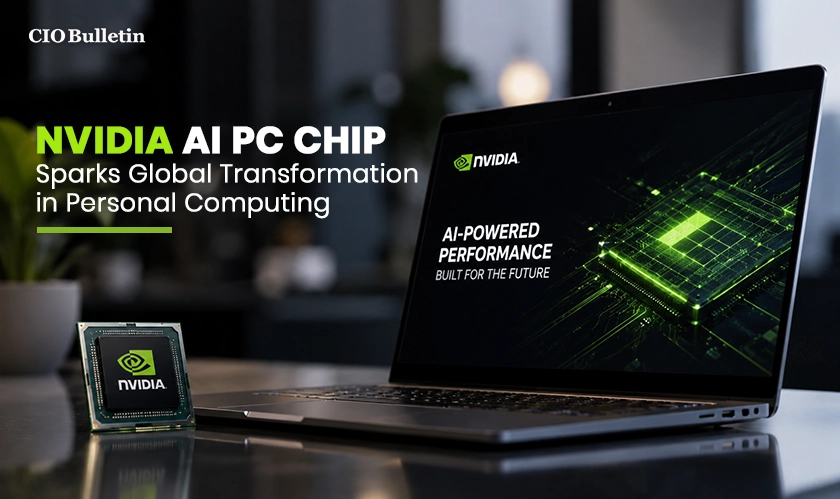
The era of relying entirely on massive, distant cloud data centers to process smart applications is officially coming to a close. In a move that is set to completely rewrite how humanity interacts with technology, hardware giant NVIDIA has pulled back the curtain on its highly anticipated NVIDIA AI PC chip, known as the RTX Spark. Designed to embed advanced artificial intelligence directly into standard laptops and desktop computers, this development signals a future where private, localized digital assistants live right on an individual's hard drive, a massive industry milestone being tracked closely by CIO Bulletin for enterprise leaders worldwide.
Unveiled during a high-profile keynote address in Taipei, the new processor represents a multi-year collaborative effort to fundamentally reinvent the modern personal computer. Rather than sending data back and forth across the internet, the hardware processes complex algorithmic tasks locally, ensuring lightning-fast response times and significantly enhanced data privacy.
This new piece of silicon marks a distinct transition from traditional, application-heavy operating systems toward true automated ecosystem integration. According to industry analysts, this launch will completely revolutionize the consumer tech sector by introducing:
Private edge assistants that run smoothly without an internet connection.
Highly optimized power efficiency tailored specifically for compact laptop frames.
Seamless integration with advanced localized software pipelines.
As these advanced tools become more accessible to everyday users, concerns regarding workforce displacement have naturally surfaced. However, leadership remains incredibly optimistic about what this means for human workers. NVIDIA CEO Jensen Huang completely dismissed fears that automation would eliminate technical roles, firmly advocating for the positive economic impact of the transition.
“People talk about AI reducing jobs, complete nonsense. It's causing more software engineers to be hired,” Huang stated.


















 consultants ltd.jpg)


