
Home Technology Artificial intelligence The Role of AI Photo Booth Exp...
Artificial Intelligence
CIO Bulletin,
22 January, 2026
Author:
CIO Bulletin Team
“People do not remember floor plans or schedules. They remember how an event made them feel.”
Event organisers have always known that logistics alone do not define success. A well-run event is expected. A memorable one is rare. As audiences become more content-savvy and socially connected, expectations have shifted away from spectacle for its own sake and toward experiences that feel personal, shareable, and immediate.
This change has quietly reshaped the role of technology on the event floor. Among the most effective tools to emerge is the AI photo booth. Not as a novelty, and not as a replacement for traditional photography, but as a system that connects attendee engagement, branded content, and post-event value into a single experience.
Why High-Impact Events Now Demand More Than Good Execution
Modern events are judged long after the final guest leaves. Stakeholders look for evidence of reach, engagement, and return. Attendees look for moments worth sharing. Sponsors look for visibility that extends beyond the room.
Traditional photography still plays a vital role, but it is no longer sufficient on its own. Static documentation does not satisfy audiences who live in feeds, stories, and short-form video. Events that succeed today are designed with content circulation in mind from the outset.
An ai photo booth fits naturally into this reality because it operates at the intersection of experience and distribution. It does not wait for post-production. It delivers value while the event is happening.
What an AI Photo Booth Actually Brings to an Event
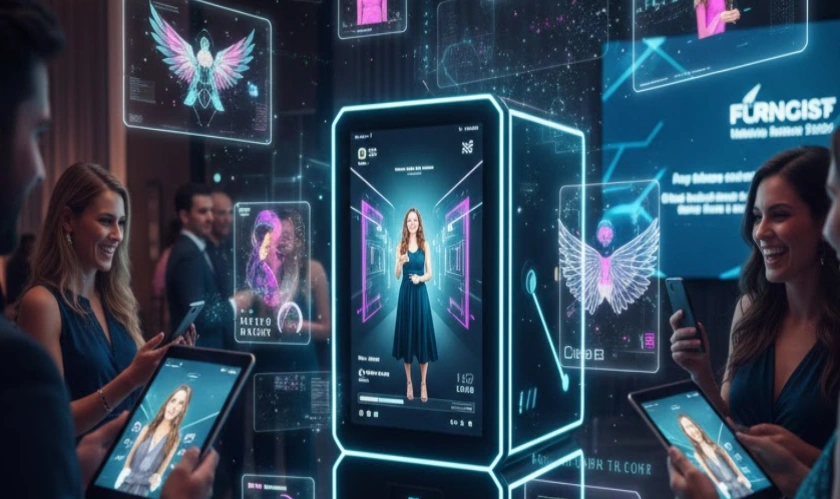
At a glance, a modern AI-powered booth looks simple. Guests step in, interact, and receive content. What makes it powerful is what happens underneath that interaction.
An ai photo booth uses intelligent automation to manage capture, enhancement, branding, and delivery without constant human intervention. Image analysis adjusts lighting and framing. Effects and overlays are applied consistently. Outputs are generated in formats designed for immediate sharing.
Behind the interface, photo booth software orchestrates this entire process. It controls visual styles, manages branded assets, routes content to galleries or mobile delivery, and tracks usage data. The experience feels effortless to the guest because the complexity has been absorbed by the system.
Why These Experiences Resonate With Attendees
Attendees engage more deeply when they feel involved rather than observed. AI-powered booth experiences create a moment where guests actively participate instead of passively consuming the event.
They are not being photographed at a distance. They are interacting with a space designed for them. The result is content that feels intentional rather than incidental. That distinction matters. It is why these assets are shared more frequently and remembered more clearly.
When guests receive their content instantly, the emotional connection is still fresh. They post while excitement is high. That immediacy is difficult to replicate with delayed delivery methods.
The Value for Event Organisers Goes Beyond Engagement
From an organiser’s perspective, AI-powered booth experiences solve multiple challenges at once.
First, they provide a controlled branding environment. Every output carries the event identity in a consistent way. This is particularly valuable at scale, where maintaining visual coherence across hundreds of moments would otherwise require significant oversight.
Second, they generate measurable activity. Usage rates, peak engagement periods, and content distribution can all be tracked. This data becomes part of the event’s performance story, especially when reporting to sponsors or internal stakeholders.
Third, they reduce operational pressure. The booth does not require constant direction. It runs continuously, allowing the event team to focus on flow, guests, and logistics rather than content management.
How AI Booth Experiences Work Alongside Professional Photography
There is a misconception that booth experiences compete with photographers. In practice, the opposite is true.
Professional photographers focus on narrative, key moments, and visual storytelling. Booth experiences capture spontaneous interaction, personality, and energy. Together, they create a more complete record of the event.
Professional photography software plays a role here as well. It allows organisers and photographers to manage galleries, maintain color consistency, and deliver assets in a unified way. When booth outputs and photographer captures are aligned through shared workflows, the final content library feels intentional rather than fragmented.
This integration is what elevates the overall perception of the event. Nothing feels improvised. Everything feels designed.
Where AI Photo Booth Experiences Deliver the Most Impact
These systems adapt well across different event formats, but their impact is most visible where engagement and visibility matter most.
At conferences and trade shows, they create natural gathering points that increase dwell time and foot traffic. At brand activations, they translate messaging into participatory content rather than static displays. At awards nights and galas, they offer polished interaction that matches the tone of the event while still encouraging sharing.
In each case, the experience does not interrupt the event. It enhances it.
A Comparison Worth Considering
|
Aspect |
Traditional Event Coverage |
AI Photo Booth Experience |
|
Guest role |
Observed |
Participatory |
|
Content delivery |
Post-event |
Immediate |
|
Branding control |
Manual |
Automated |
|
Scalability |
Staff dependent |
System driven |
|
Measurable engagement |
Limited |
Built-in tracking |
Why These Experiences Improve Event ROI
Return on investment in events is increasingly measured through longevity. Content that lives only for a few days after delivery limits the value of months of planning.
AI-powered booth experiences extend the life of an event by producing assets that circulate while interest is highest and continue to resurface afterward. Each share becomes an extension of the original experience. Each repost reinforces the event’s relevance.
For sponsors and partners, this visibility matters. For organisers, it strengthens credibility and supports future bookings.
What This Signals About the Future of Event Planning
Events are becoming more adaptive. Audiences expect responsiveness, personalization, and immediacy. Technology that supports these expectations will define what high-impact planning looks like going forward.
The combination of ai photo booth experiences, robust photo booth software, and integrated professional photography software represents a shift away from reactive documentation toward intentional experience design.
Organisers who understand this are no longer planning events solely for the room. They are planning for the network that surrounds it.
Conclusion
High-impact events succeed because they create moments people want to revisit and share. AI-powered photo booth experiences support that goal by turning attendee interaction into meaningful, branded content without adding operational complexity.
They strengthen engagement, extend visibility, and integrate seamlessly with professional photography workflows. Most importantly, they help events live beyond their scheduled time.
For event organisers focused on delivering experiences that resonate and endure, the role of AI photo booth experiences is no longer peripheral. It is central to how modern events are designed, delivered, and remembered.











 consultants ltd.jpg)


