
Home Industry Automobile How Much Front-End Protection ...
CIO Bulletin
,
22 September, 2026
Author:
Guest
What happens when a rock kicked loose by a front tire meets an unprotected radiator, sixty miles down a logging road with no cell signal? For most van owners, the answer starts with a hiss of escaping coolant and ends with a tow bill that swallows a week of trip savings.
A stock bumper and valance were built for a mall parking lot, not the terrain many adventure vans cover. A reinforced Ram ProMaster off-road bumper, a skid plate, and real recovery points change that outcome before it happens. The real question is how much protection matches the miles a van actually covers.
What Front-End Protection Covers
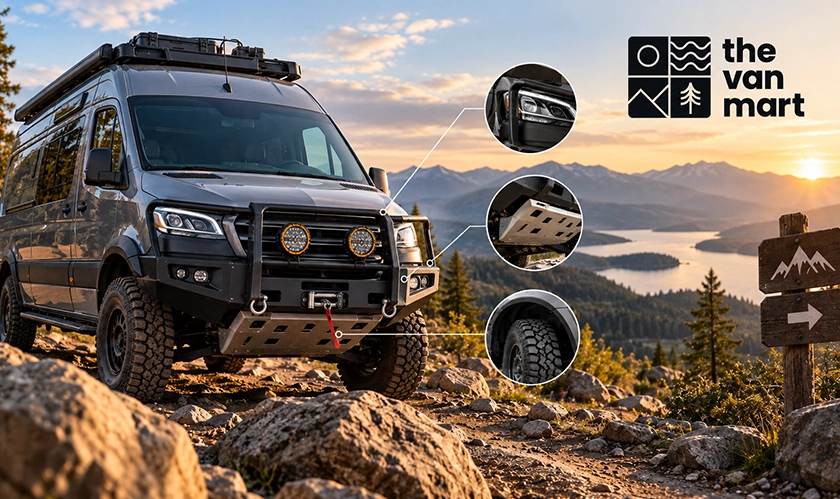
Front-end protection is the hardware added ahead of the factory bumper line to shield the parts of a van that can't take a hit: the radiator, the intercooler, the oil pan, and any recovery point strong enough to trust in a pinch. It typically layers three pieces rather than one upgrade doing everything: a structural bumper, a skid plate, and frame-mounted recovery points rated for genuine pulling loads. Factory bumper covers are plastic, built to meet pedestrian-safety rules rather than survive a rock strike or a startled deer at forty miles an hour, and they crack or shatter well before absorbing enough force to protect anything behind them.
Low-hanging components make the exposure worse: the radiator, intercooler, and diesel exhaust fluid (DEF) tank all sit close to the ground on most van platforms, where a single sharp rock can puncture a line that costs thousands to replace.
Tow points create a separate problem. They're rated for light, straight-line pulls rather than the angled loads an actual recovery demands, and on many vans they're tucked so far under the bumper that they're useless once the van is stuck. Owners who tow, camp remotely, or drive routes with more gravel than asphalt tend to run into at least one of these gaps within the first year of ownership.
Three Tiers of Protection
How much of that layering a van needs depends less on looks and more on where the miles actually happen. The hardware generally falls into three tiers, based on how far a van travels from pavement and how often.
The base tier suits occasional dirt roads and light overlanding. An entry-level, defender-style bumper bolted to the frame, paired with a skid plate over the oil pan and differential housing, covers this range. It improves approach angle and stops the most common damage without much added weight or cost.
The middle tier fits regular remote travel, gravel routes, and towing. The base setup alone doesn't cover the actual risk once a trip runs more than a day off pavement. Frame-mounted recovery points rated for angled pulls become necessary once a van gets stuck somewhere factory tow hooks can't reach, and a bull bar or nudge guard adds protection for the upper cooling stack along with a mount for auxiliary lights.
The top tier applies to solo travel, extended overlanding, or routes through deep mud, sand, or snow. This covers everything in the first two tiers, plus perhaps a winch bumper rated near 12,000 pounds. At that point, a stuck van becomes a problem the driver solves alone rather than one it waits out, and the tier stops being optional.
Weight and Suspension Trade-offs
Every pound of armor added up front changes how the van drives, so material choice matters as much as the tier itself. Steel gives the strongest anchor point for winching, but it adds 100 to 200-plus pounds directly over the front axle, weight that shows up in fuel economy and steering within the first few miles. Aluminum cuts that weight substantially and helps prevent front-end sag, though it typically costs more per pound of protection.
A lighter, full-width aluminum plate that replaces the factory belly pan can round out a base-tier build without triggering a suspension change. Once a bumper, skid plate, and recovery points stack up past that threshold, though, front coilovers or shocks usually need an upgrade to match; factory suspension is tuned for the stock bumper's weight, not several hundred added pounds up front. Skip that step, and the van ends up riding low and steering vague long before the armor earns its keep. The tier a van needs and the suspension required to carry it are really one decision, not two.
The honest answer to how much front-end protection a van needs usually isn't the one an owner starts out believing. It's easy to plan for the trip that might happen someday and end up carrying weight, cost, and complexity that never gets used on the drive that happens most weekends. The harder, more useful question isn't how rugged a van could be made, but how rugged it actually needs to be for the roads it already runs. That number is less flattering than a payload rating or a winch capacity, but it's the one that keeps a build honest.





















































 consultants ltd.jpg)


Comments