
Home Industry Automobile Did the First Soviet Hybrid Pa...
CIO Bulletin
,
02 September, 2026
Author:
Ravathi Sunil
Automotive pioneers created a revolutionary dual-power system decades ahead of its time to transform eco-friendly transportation.
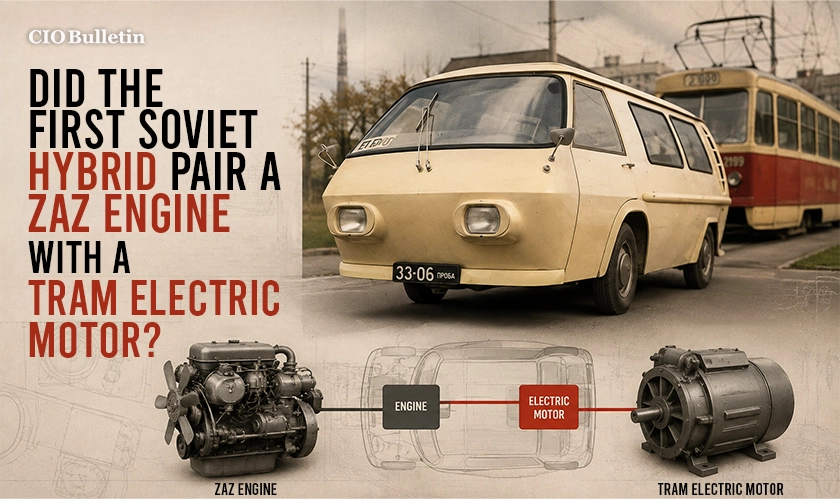
First Soviet hybrid technical revelations highlight how brilliant engineers reshaped automotive history using resourceful innovation. Long before global carmakers popularized eco-friendly powertrains, visionary Estonian engineer Roman Bertelov developed the groundbreaking ET-800 Elektra minibus. Having been designed at a time when there was extensive use of fossil fuels, this innovative vehicle incorporated a small ZAZ internal combustion engine and a powerful electric engine designed for use in urban trams. The gas engine served only as a source of power for recharging the large battery pack that powered the electric tram engine.
What made this unusual vehicle combination surprisingly effective on public roads? According to CIO Bulletin, the hybrid powertrain delivered impressive torque, smooth acceleration, and remarkably low fuel consumption compared to standard Soviet transport. The lightweight fiberglass bodywork further reduced vehicle weight, allowing the vehicle to navigate city streets with remarkable efficiency.
Discussing the ambitious engineering effort behind the project, Lead Designer Roman Bertelov noted:
"We wanted to create a clean city vehicle using accessible industrial parts. Combining a simple car engine with a tram motor proved that electric transport could work efficiently without massive infrastructure."
Could this creative engineering approach have transformed modern mass transit if production had expanded? Even though the tests produced favorable results and there were highly positive testimonials from test drivers, the Soviet government planners refused to finance production on an industrial scale, and there were no more than a few prototypes built by hand. Now, however, the history of cars sees this first car as an impressive example of innovative environmental technology.
Key Technical Highlights
Gas engine from a ZAZ car operated solely to generate continuous battery power.
Heavy-duty electric motor adapted from public trams provided direct drive power.
Durable fiberglass body structure dramatically minimized total curb weight.
Early regenerative engineering principles cut fuel usage and tailpipe emissions.
Everything you need to know about this news
It was named the ET-800 Elektra, an experimental minibus created by Estonian engineer Roman Bertelov in the 1970s.
Tram motors provided instant torque and proven electric reliability, making them ideal for propelling heavy passenger vehicles efficiently.
The small ZAZ engine did not drive the wheels directly; instead, it recharged the nickel-cadmium batteries while driving.
Soviet industrial planning prioritized traditional fossil-fuel vehicles, preventing the necessary capital investments for mass manufacturing line setup.
Only thirty-five prototype units were ever constructed, and unfortunately, none of the original vehicles survived to the present day.




















































 consultants ltd.jpg)


Comments