
Home Industry Nanotechnology Can Transparent Hydrogen Elect...
CIO Bulletin
,
08 September, 2026
Author:
Ravathi Sunil
Nanotechnology breakthrough anchors isolated noble metal atoms onto conductive glass to achieve near-bulk catalytic activity without sacrificing optical transparency.
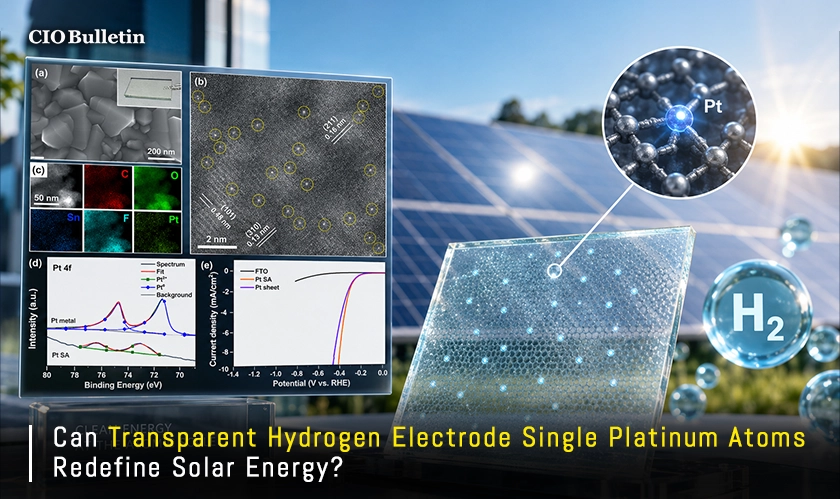
Transparent hydrogen electrode single platinum atoms design innovations are redefining solar-driven fuel production by converting ordinary conductive glass into high-efficiency catalytic surfaces. The success in fixing individual platinum atoms in minute quantities on a fluorine-doped tin oxide substrate is another milestone in materials science research. Using innovative methods that do not employ conventional metal layers which would prevent light from reaching the material, scientists can now design photoelectrochemical cells to harness solar energy for making hydrogen fuel.
The engineering breakthrough reviewed by CIO Bulletin resolves a longstanding technological trade-off between electrical conductivity, catalytic speed, and optical transparency in renewable energy systems. Traditional solar-to-hydrogen cells often employ opaque metal layers or nanoparticle clusters that block sunlight from reaching the underlying photo-absorbents. Through the dispersion of catalysts at an atomic level, the hydrogen production rates were brought to match those of bulk platinum, without any loss of optical transparency. How significantly can atomic-scale manufacturing accelerate global green hydrogen commercialization?
Explaining the fundamental impact of altering catalyst geometry, the research team noted:
"Dispersed atom by atom, the metal can deliver near-bulk-Pt hydrogen-evolution kinetics without becoming an optical obstacle."
Efficient utilization of platinum has been stressed by experts in energy technology, as this leads to a considerable reduction of cost of materials required in building electrolysis cells and artificial photosynthetic devices. With increased demand for emission-free energy storage, the combination of transparent conductive oxides and single atom active sites provides a possible base for energy converters that work well in all types of medium.
Key Engineering Insights
Anchoring isolated platinum atoms preserves near-total optical transparency on conductive glass.
Atomic dispersion achieves catalytic kinetics approaching solid bulk metal surfaces.
Ultralow metal loading drastically reduces rare material costs for hydrogen production.
Dual-function electrodes generate significantly higher photocurrents in solar-driven water splitting.
Everything you need to know about this news
It allows conductive glass to catalyze hydrogen production at near-bulk-platinum speeds without blocking sunlight required for solar-driven energy conversion.
Instead of forming opaque metal layers, isolated individual platinum atoms occupy tiny surface sites, leaving the glass transparent to incoming light rays.
Conventional coatings use dense nanoparticles where inner atoms remain buried and inactive while actively blocking light from reaching underlying solar absorbers.
Yes, tests show the single-atom electrode drives hydrogen evolution effectively in acidic, neutral, and alkaline liquid electrolytes.
By utilizing nearly every single platinum atom on the surface, manufacturers drastically decrease the total noble metal mass required for high-performance catalysts.



















































 consultants ltd.jpg)


Comments