
Home Industry Nanotechnology Can Green Solvent Exchange Ena...
CIO Bulletin
,
01 September, 2026
Author:
Sambhrant Das
green solvent exchange process enables advanced durable nanocellulose protective coatings for industrial applications
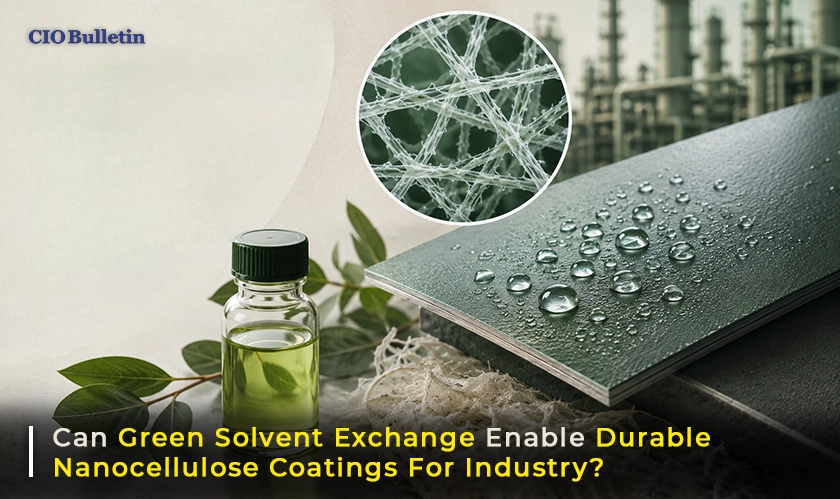
A new processing technique using green solvent exchange technology has made it possible to provide durable nanocellulose coatings and avoid the collapse typically observed during the evaporation of plant-derived biopolymers. New methods include ethanol and butanol solvent exchange along with electric double-layer disruption, enabling the hydrophilic cellulose nanofibrils (CNFs) to move without aggregation into the non-polar spray medium. The novelty allows the creation of sustainable production of green coatings.
Dual Silane Strategy and Surface Performance
To convert the framework of nanocellulose to a weather-resistant barrier, the scientists incorporated assembled fibrils with polydimethylsiloxane and vapour-phase silanes. This creates a stable Cassie–Baxter wetting state featuring an impressive water contact angle.
Water Contact Angle: Reaches 155.3±6 delivering true superhydrophobic behavior.
Sliding Angle: Remains below 10°C, enabling rapid water droplet roll-off.
Fluorine-Free Design: Removes the PFAS chemical from the composition altogether.
Dynamic Stability Under Extreme Conditions
The newly designed interface displays remarkable durability beyond basic water repellency. The tests revealed that the protective layer withstands both mechanical and chemical influences, which usually hardiness old method ecological coatings.
Highly resistant to abrasion: Keeps its form when exposed to friction several
Highly resistant to chemicals: Works also in extreme pH from 1 to 12.
Low-temperature performance: Protects from the action of salt solutions and freezing, even when it is freezing.
Overcoming Industrial Processing Bottlenecks
For years, the commercial adoption of bio-based surface treatments stalled because plant fibers aggregated during liquid evaporation. By solving this dispersion challenge, the team demonstrated how sustainable chemistry can replace persistent synthetic pollutants without sacrificing mechanical endurance.
According to the authors, "this work provides a viable pathway to overcome the processing bottleneck of hydrophilic biopolymers and supports the development of durable, PFAS-free surface engineering solutions based on renewable raw materials."
Commercial Viability and Market Outlook
This technological modification uncovers different opportunities for producers in the packaging, automobile, and outdoor gear industries striving to meet regulatory requirements. Due to the gradually tightening regulations banning hazardous substance disposal, bio-based protection layers seem to be a scalable dilemma solver in this regard. CIO Bulletin views this development as a significant breakthrough in the environmentally friendly production industry.
Everything you need to know about this news
It prevents cellulose nanofibrils from aggregating during drying, so they become smooth, stable, and can be sprayed.
Yes, the product is based only on natural cellulose fibers, non-toxic solvents, and silicon-based materials in place of fluorinated compounds.
They are resistant to the effects of mechanical abrasion, freezing temperatures, salt, and difficult conditions when the pH varies from 1 to 12.
Yes, the adaptation of nanofibrils into cyclohexane-based dispersions makes it possible for manufacturing plants to use conventional industrial spraying technology for application.
It makes liquid drops drain out immediately and prevents damage caused by water, corrosion, dirt build-up, and uncontrollable frost formation.

















































 consultants ltd.jpg)


Comments