
Home Industry Politics German Political Crisis: Is Ch...

CIO Bulletin
,
08 September, 2026
Author:
Gayathri Sr
A stunning electoral landslide shatters traditional political barriers in Europe's largest economy, triggering immediate alarms across international markets and institutions.
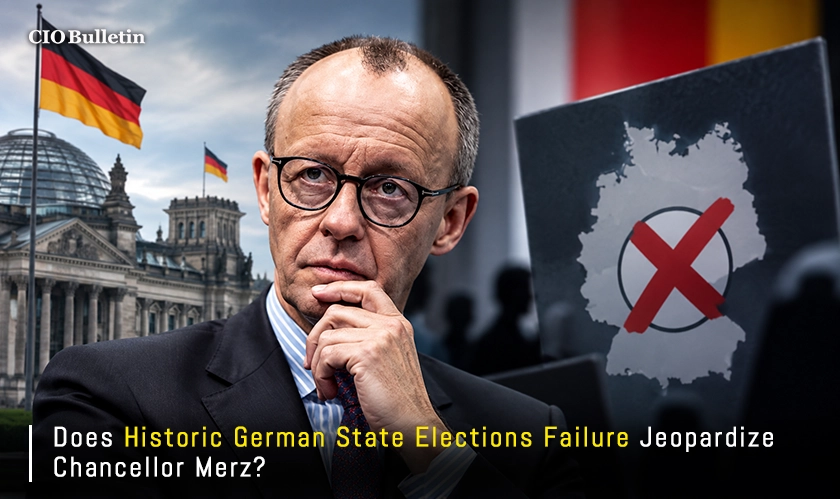
The mounting German political crisis intensified sharply after the anti-immigrant Alternative for Germany (AfD) party surged into first place with nearly 44% of the vote in Saxony-Anhalt. This historic outcome has profoundly shaken Chancellor Friedrich Merz and his ruling conservative party, testing the long-standing “firewall” policy that prevents mainstream parties from cooperating with the far-right.
While the AfD fell just short of an absolute majority, its powerful trajectory has sparked intense concern from neighboring European leaders. As global corporations and business analysts closely study these fast-moving events, CIO Bulletin is tracking how regional political instability impacts wider economic outlooks across Europe. Chancellor Merz has firmly ruled out resigning, vowing instead to defend democratic values as upcoming elections loom on the horizon.
The Landslide Result: The AfD secured 39 out of 83 legislative seats, falling just three seats short of an outright majority.
The Firewall Dilemma: Established parties face mounting pressure as the populist left BSW party emerges as a potential wildcard partner.
International Alarm: Neighboring European nations, including France and Poland, have expressed deep concern over the expanding populist wave.
“This shakes our party to its very foundations.” — Chancellor Friedrich Merz
Everything you need to know about this news
A landmark state election in Saxony-Anhalt where the far-right AfD secured nearly 44% of the vote, marking its strongest performance in history and threatening traditional political alliances.
Chancellor Merz acknowledged that the vote deeply shocked his party and shook it to its core, but he explicitly refused to resign or alter his primary governance roadmap.
Not automatically; despite winning the most votes, they fell short of an absolute majority and continue to face a strict "firewall" blockade from mainstream parties.
Neighboring nations like France and Poland have voiced deep alarm, viewing the surge as part of a wider, worrying global populist trend.
Because it signals shifting political dynamics across Europe's largest economy, carrying massive implications for upcoming national ballots and economic stability.
















































 consultants ltd.jpg)


Comments