
Home Other Blogs CIO Bulletin’s Guide To How ...
CIO Bulletin
,
27 August, 2026
Author:
Sambhrant Das
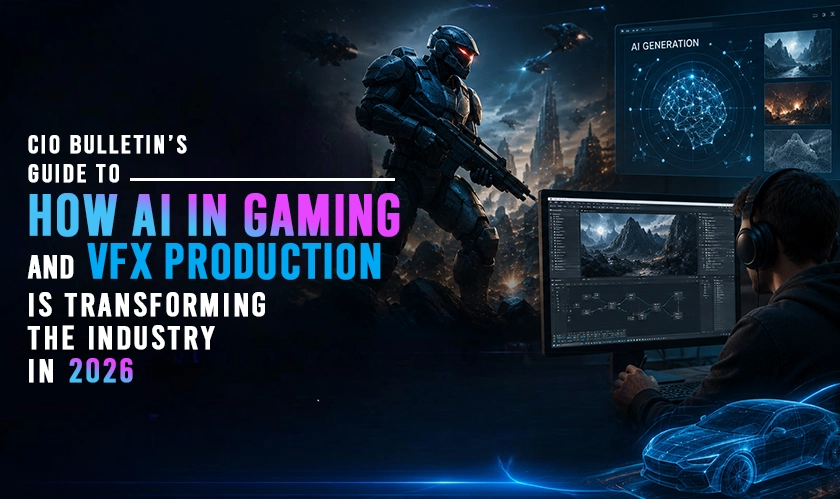
Artificial intelligence is becoming an essential factor in the entertainment sector, moving from just an experiment to driving studios. Integrating AI in gaming and VFX has revolutionized the industry, ensuring that artists can direct the creative process rather than spending hours on manual work.
According to recent industry highlights reported by CIO Bulletin, digital studios are reducing post-production cycles by months while unlocking interactive fidelity that was technically impossible just a few years ago. Today, AI’s usage in gaming and VFX Production does not imply a fast means to achieve results but rather capturing the needs of consumers for realistic and interactive entertainment.
Top Six Ways AI is Transforming Gaming and VFX Production in 2026
Neural Rendering and Real-Time Scene Generation: Standard rendering technologies revealed the need for huge computing power to compute light beams for every scene. With neural rendering technologies, it is possible to calculate lighting and shadows in real time, thus reducing the number of exported files.
Automated Asset Creation and Procedural World Building: In the past, the creation of vast open worlds would have required large teams of environmental artists to position every tree, rock, and building in place by hand. With the advancement of generative AI, it is now possible to build intricate 3D worlds from a simple text or painting, enabling small teams to create large game maps in a matter of days instead of years.
AI-Driven Character Animation and Deep Motion Capture: Markerless motion capture has now become the norm. By scrutinizing raw footage, machine learning algorithms can transmute intricate human movements, tiny muscle movements in the face, and clothing physics into digital avatars. Thus, AI in gaming and VFX helps animators avoid spending weeks cleaning frames one by one.
Intelligent NPCs and Adaptive Storytelling: Recent games have utilized non-player characters (NPCs) that do not simply consist of rigid scripts. Using proprietary local language models, game characters remember what the player has chosen before, reacting according to their emotions and creating conversations based on the context.
Intelligent Effects and Automated Rotoscoping: In a historical context, rotoscoping and matting green screens were the most time-consuming processes in postproduction. With the help of machine learning vision models, postproduction professionals have been able to resolve complicated details such as flying hair or smoke.
Predictive Production Pipelines and Asset Management: In addition to just incorporating visuals in production, innovative technologies have a few applications for the background workings of studios. Production technology employs predictive analytics in order to create the financial plan for the render farm, automatically tag numerous digital assets, and optimize studio business processes. As a result, entertainment productions can remain within budget and meet deadlines for the release of their productions.
Why Accelerating Use of AI Affects the Digital Media Industry?
The use of AI in gaming and VFX is quickly gaining ground not only due to technological advancements, but also due to the economic issues it solves. In the course of the last decade, production costs for AAA games and large-budget VFX films soared to unsustainable levels. The audience, meanwhile, requires better visual quality, more complex interaction capabilities, and a quicker production cycle, which puts tremendous pressure on creative teams.
By executing low-level and repetitive technical job automation, such as rotoscoping, simple mesh creation, and manual lighting calculation, AI balances the production process. Studios using integrated AI in gaming and VFX do not lay off their artists but enhance their productivity. Creatives will innovate quickly and create dozens of visual concepts in a day instead of thinking through only one idea for weeks, thus democratizing the process of creating advanced digital products.
Navigating the Shift: Risks and Future Value
The rapid rise of technology results in friction among creative industries. If people depend too much on automated technologies, then the creative process might become a mundane and lifeless visual design. Problems with copyright violations related to synthetic training data still exist, and it is also vital for studio management to handle workforce changes properly to avoid artists’ burnout and anxiety about losing jobs.
However, if used wisely and in conjunction with human creativity, modern technology offers the best basis for creating stories. The evolution of gaming and VFX 2026 demonstrates that machine intelligence is starting to create new possibilities for creativity. Major media outlets such as CIO Bulletin emphasize the ways in which pioneering studios are able to use advanced technology in order to enrich narration and develop digital art further.
How to Implement AI Tools in Your Studio Today
Check Production Bottlenecks: Spot the processes that consume much time and require manual work, such as rotoscoping, tagging assets, and cleaning motion capture.
Implement Hybrid Workflows: Make use of generative systems in order to carry out early conceptualization and prototyping so that leading artists can concentrate on the final version.
Use the Highest Security Measures in the Enterprise: Set strict rules about the sources of data for the training process as well as about copyrights when using the models of other companies.
Provide Training For Creative Teams: Teach animators, compositors, and level designers to work with intelligent systems properly.
Stay Up to Date: Get information from credible sources such as CIO Bulletin about new software and cases of studio applications.
Everything you need to know about this news
Smart software is not meant to replace the creative process but instead enhance it by handling tasks like frame-by-frame rotoscoping that would otherwise take a lot of time and energy away from artists to take care of art direction, storytelling, and other higher-level design tasks.
Yes. Automating world-building tasks, asset creation, and scene rendering saves labor costs and time while maintaining high-quality visuals.
Neural rendering involves using machine learning technology to calculate light and shadow motions quickly enough to allow for cinema-grade visuals in real-time.
Intelligent NPCs no longer follow static, pre-written dialogues but instead react to actions of the player in real-time way.
Studios minimize legal risks by building proprietary models trained strictly on licensed, internal, or opt-in asset libraries to protect their intellectual property.



















































 consultants ltd.jpg)


Comments