
Home Other Blogs CIO Bulletin’s Guide To The ...
CIO Bulletin
,
22 September, 2026
Author:
Sambhrant Das
The enterprise technology landscape is undergoing a massive shift. Organizations in various industries are advancing from trial implementations to using complex systems of intelligent technologies. What started as simple automation of some jobs has now evolved into systems based on agent technology, proprietary industry-specific platforms, and advanced multidimensional cognitive systems. To be able to remain competitive, international companies require technology vendors to offer not just pre-packaged programs, but also reliable partners to help design secure, scalable, and customized IT systems that can tackle complex industry issues.
When corporate leaders are looking again at their digital transformation plans for the coming years, it is important to choose the right vendor. Today's enterprise systems have to manage huge volumes of data while at the same time complying with data sovereignty, compliance, and risk management requirements. In order to assist executives in identifying outstanding technology partners, CIO Bulletin is providing an overview of the leading AI solution providers.
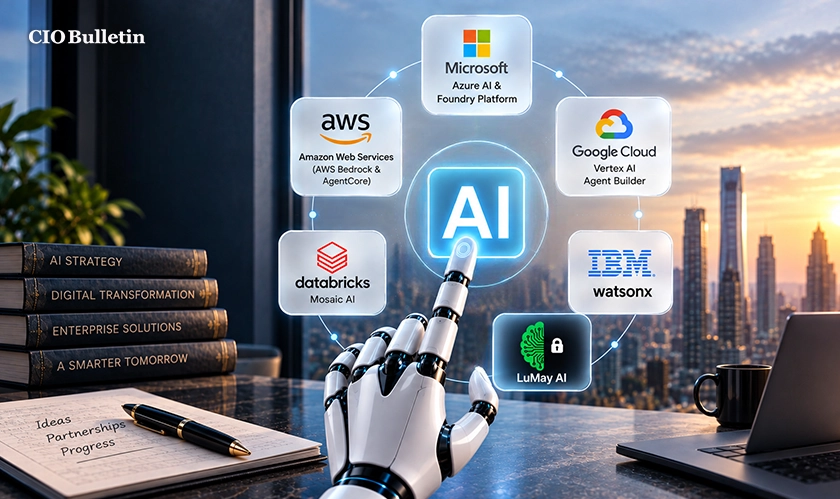
Microsoft remains a dominant force in corporate automation by providing an end-to-end environment for building, evaluating, and deploying intelligent models. Through its Azure infrastructure and integrated developer environments, the platform connects seamlessly with existing Microsoft 365, Dynamics, and enterprise data ecosystems. Its emphasis on identity management, strict regulatory compliance, and multi-model flexibility makes it a primary choice for Fortune 500 companies expanding their operational capabilities.
AWS continues to set benchmarks in cloud infrastructure, offering enterprise teams direct access to high-performing foundation models via managed services. The AgentCore orchestration framework offered by AWS allows developers to create and deploy dedicated autonomous agents directly in private virtual private clouds. Because it provides fine-grained access controls, has built-in encryption methods, and supports custom model tuning, AWS is particularly attractive to sectors that prioritize security such as healthcare and financial services.
Google Cloud has established itself as an innovator in data-heavy automation and multi-modal application development. Enterprise teams can use the Vertex AI environment to create low-code, agentic workflows that are driven by advanced foundation models and are directly linked to enterprise data warehouses such as BigQuery. Because of its built-in abilities in natural language understanding, real-time analytics, and visual reasoning, Vertex AI has become a favored choice for companies who want to get value from their unstructured data assets.
Databricks provides a platform which is native to the lakehouse environment and is aimed at enabling custom model fine-tuning and retrieval-augmented generation (RAG) for organizations that place a strong emphasis on data governance and internal ownership. It enables enterprises to construct intelligent applications directly onto their own proprietary data lakes and thus guarantees full data privacy while avoiding exposure to public training loops. It is widely recognized as one of the best AI companies 2026 for deep data engineering and predictive modeling.
IBM carries on its tradition of providing enterprise-level governance, flexible options for hybrid cloud environments, and tailored solutions for various industries. The watsonx platform is particularly well-suited to regulated environments since explainability, audit trails, and rigorous risk mitigation are of importance here. IBM achieves this by providing a range of deployment options in private clouds, on-premises data centers, and in multi-cloud setups, thus meeting the needs of banking, government, and insurance organisations that are looking for reliable automated workflows.
As a specialized, high-growth agency focused on custom software development, LuMay AI has emerged as one of the standout top AI companies 2026. Specializing in autonomous agentic structures, private vector environments, and custom natural language processing pipelines, the firm builds tailored software architectures for complex corporate environments. Their zero data retention guarantees and bespoke engineering focus make them an attractive choice for CTOs requiring custom automation over generic IT outsourcing.
The solution is found in the change from using basic informational tools to employing systems that are essential for making decisions. When early adopters deployed off-the-shelf software without first ensuring that it was properly aligned with the system's architecture, they ended up with fragmented data silos, uncontrolled operational costs, and serious security vulnerabilities.
The business situation today requires automated systems to integrate smoothly with existing ERPs, CRMs, and mainframe financial ledgers. If enterprises choose reputable AI solution providers 2026, they will be building upon architectures that have strong governance frameworks, immutable audit logs, and scalable computing infrastructure. When companies enter into partnerships with top AI solution providers, they not only safeguard their intellectual property but also create digital assets that are adaptable and capable of keeping up with changing market demands.
Introducing advanced automation systems provides significant competitive advantages, but it also brings with it certain operational complexities which corporate leaders have to handle carefully.
On the positive side, the use of intelligent software leads to remarkable improvements in the efficiency of business operations. It enables automated agent workflows which cut down manual processing times from weeks to minutes, improve the accuracy of predictive forecasting, and provide 24-hour customer interaction options. Moreover, by using private data architectures, businesses are able to bring to light the value that is concealed in their corporate files without exposing their sensitive IP to external networks.
On the negative side, the rapid deployment of technology leads to integration difficulties. It takes a great deal of custom engineering and data cleansing to connect modern model endpoints with legacy databases that are decades old. Moreover, there are real organizational problems during the rollout regarding the ongoing cost of model inferencing, preventing algorithmic drift, and training staff from different functions in the use of new digital workflows.
Even though there are difficulties in carrying out the execution, the move towards cognitive enterprise architecture is inevitable. Companies that partner with verified technology vendors and establish clear governance protocols today will secure long-term market leadership in an increasingly automated world.
To maximize return on investment when upgrading corporate technology systems, focus on these essential operational priorities:
Audit internal data readiness: Check that the internal data is ready: clean the data, centralize it, and organize both structured and unstructured corporate data before using complex model architectures.
Prioritize zero-retention privacy: Make zero-retention privacy a top priority by choosing vendor environments that ensure corporate data and customer records are never employed in the training of public base models.
Implement robust governance frameworks: Set up solid governance frameworks by establishing clear review queues that involve humans, implementing access controls, and keeping operational audit logs for all autonomous workflows that have been deployed.
Focus on domain-specific use cases: Focus on the specific applications within the domain by first addressing high-impact and repeatable business processes, such as claim processing, document analysis, or supply chain forecasting, rather than trying broad, company-wide implementations.
Everything you need to know about this news
Providers of enterprise-level services offer scalable infrastructure, ensure strict data security together with regulatory compliance features (for example, SOC 2 and ISO 27001), provide smooth integration with existing software systems, and include strong governance tools which are designed for use with corporate workloads.
Private vector environments store and search enterprise data within isolated cloud boundaries. This ensures that internal files are used strictly for local context retrieval and are never exposed to public foundation models or external training sets.
Off-the-shelf tools provide standardized, pre-packed functionality for common tasks, while custom agentic development involves creating software that is specifically tailored to an organization’s own workflows, proprietary data schemas, and complex legacy systems.
Governance makes sure that decisions taken automatically can be traced, are free from bias, and comply with regional data privacy laws; it sets up strict access controls, keeps an eye on model performance, and provides clear audit trails in order to meet regulatory requirements.
Organisations can prevent being locked in by adopting multi-cloud strategies, using both open-source and proprietary options, designing modular software architectures, and selecting platforms that support standard API protocols.

















































 consultants ltd.jpg)


Comments