
Home Other Blogs CIO Bulletin's Guide To The To...
CIO Bulletin
,
18 September, 2026
Author:
Sambhrant Das
The world of business in 2026 is changing quickly. It is being influenced by real-time artificial intelligence solutions and networks that are spreading worldwide. As standalone tools become fully automatic systems, a new group of business leaders is changing how industries work. Traditional ways of working are being replaced by more environmentally friendly and software-based ways of running a business. To stay ahead in 2026, watch the disruptors and top entrepreneurs 2026 who turn market shifts into opportunities.
Finding founders early gives you a good view of new technologies, changing customer behaviors, and fast-growing parts of the market. The six founders listed below are making an impact in artificial intelligence, consumer services, software design, and digital payments. Studying CIO Bulletin’s analysis of how they create and grow their businesses provides an example of how to handle modern business growth.
Top Six Business Disrupters and Founders
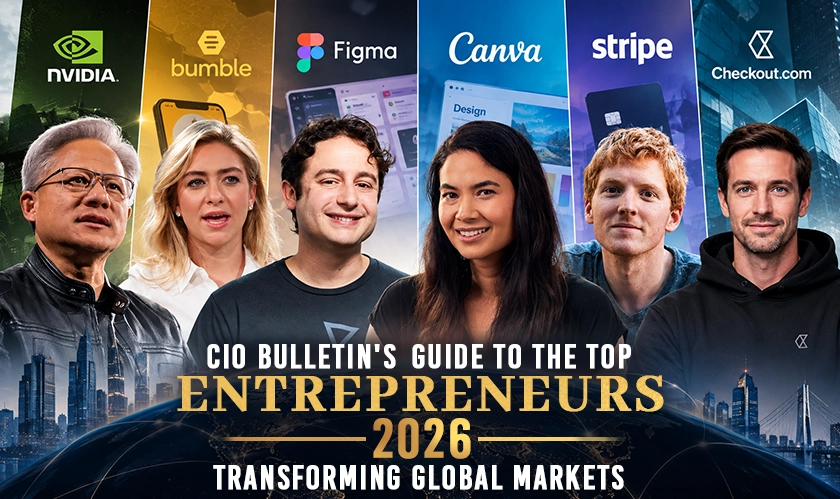
Jensen Huang remains at the center of the changes happening in technology. By taking NVIDIA into specialized AI hardware, huge data centers, and industrial digital twins, Huang changed how companies deal with data. As companies try to use kinds of AI and ways to see the world, Huang is one of the top entrepreneurs 2026 shaping the future of the digital world.
Whitney Wolfe Herd continues to be one of the promising entrepreneurs to watch in 2026. Known for creating spaces that are user-friendly and ethical, her work in consumer technology focuses on being clear about how algorithms work, keeping users safe, and creating better online communities. She keeps showing that it is possible to build products with a mission and still generate revenue without losing people's trust.
Dylan Field fundamentally altered how software gets built across distributed global teams. By pushing browser-based collaborative tools to their absolute limit, Field showed the industry that business software can be both insanely powerful and plain fun to use. His work on real-time interfaces for groups of people working together continues to change how many digital teams work every day.
Melanie Perkins has made it easier for millions of businesses, creators, and marketing teams to use visual design. By making it simple and adding AI features, Perkins made editing easier and more like using the cloud. Her story is an example of making software that helps real people with their everyday problems.
Patrick Collison continues to highlight showing that putting developers in the infrastructure can help businesses grow around the world. By making it easier to send money, check identities, and handle money between countries, Collison made it possible for new startups and big companies to start products quickly. His focus on APIs makes him one of the top entrepreneurs to watch 2026.
Guillaume Pousaz is quietly changing how big companies handle payments across countries. He saw that big companies need flexible and fast ways to move money, so he created tools that help companies grow quickly around the world. His focus on making transactions easier puts him among the top entrepreneurs 2026, building the tools for trade that have no borders.
Why Is Tracking Global Founders Important for Business Growth?
Why should executives, startup teams, and active investors pay such close attention to high-impact founders?
First, keeping an eye on major business leaders gives you a real look at where the market and money are actually heading. Founders working on the edge usually run into customer pain points long before traditional market analysts write reports about them. Seeing where these leaders hire people, invest money and resources, and launch new products helps big companies see real chances - and possible problems - well before others.
Second, business models are changing faster than the traditional ways of running a company can handle. Big companies often struggle with a lot of red tape and old technology. By looking at how modern founders organize teams, use AI in daily work, and make it easy for customers to join, business leaders can update their own plans to stay quick and flexible.
Finally, following prominent business leaders helps you predict rules and problems. Leaders who stay ahead of the curve are usually the first to deal with strict rules, privacy laws, and issues with workflows. Watching how these top people handle the rules across countries gives you a ready plan to protect your own business and revenue.
Looking at the Future: Chances and Operational Realities
Studying and working with founders brings big benefits. Companies that work with leaders get direct access to modern tools, faster updates, and more efficient ways to generate revenue. Adopting agile leadership also creates a company culture where new ideas can grow, letting you adapt quickly to customer or market changes.
That said, moving fast with strong disruptors also has real problems. Committing to a platform too early can cause problems with how software works together, sudden changes to how things connect, and unexpected costs. Relying too much on a fast-growing partner can also leave you in trouble if that nascent company changes direction or faces significant problems with their service.
In the end, success depends on balancing ideas with smart choices. Working with top entrepreneurs 2026 gives companies that want to move forward the push they need to replace old systems, reach new parts of the world, and stay better than others.
What Steps Should Leaders Take for Growth?
Check the Tools You Use Now: Find the problems in your current software and replace old tools with modern ones.
Watch New Leaders: Make a team inside your company that keeps track of growing startups and smart leaders to find partnerships.
Use Flexible Systems: Change your IT setup to use cloud-based and API-first tools so your daily work can change easily.
Invest in Talent Upskilling: Teach your engineers and operations teams how to use AI tools and automated workflows.
Implement Phased Deployments: Add software in small steps to manage the risks before changing everything in your company.
Everything you need to know about this news
Top leaders in 2026 have knowledge of technology, are very determined, focus on making good money from the start, and create companies that are flexible and based on software.
Smart leaders bring cheaper digital options that push old companies to update their old systems and offer better experiences for customers.
Tools made for developers let young companies use payments, check identities, and host on the cloud through APIs, which keeps their costs low.
Leading founders build modular compliance features right into their core software, automating data privacy checks, identity verification, and local financial regulations.
Established companies can work with leaders through investments, direct API links, special projects, and strategic co-development.



















































 consultants ltd.jpg)


Comments