
Home Other Blogs CIO Bulletin Presents the Top ...
CIO Bulletin
,
20 August, 2026
Author:
Sambhrant Das
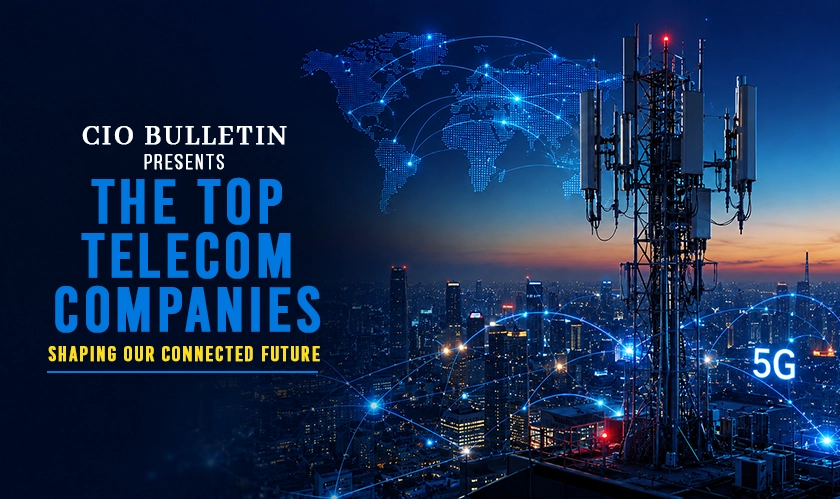
The telecommunication industry across the world is witnessing profound changes that are being driven by the rapid growth of 5G networks, the emergence of cloud technology, satellite communications, and edge computing. Connectivity today is no longer a privilege but something that is a must-have. Identifying the telecom companies leading this technological revolution is imperative for business leaders as well as technology enthusiasts to survive in the high-tech world.
Telecom companies in world markets have a far greater role to play than simply transmitting voice communications. They operate large optical networks, manage complicated IoT ecosystems, provide cloud infrastructure services, and ensure the protection of important digital assets against cyber threats. These pioneers in technology drive the global economy, whether they are operating through subsea fiber optic cables or next-gen wireless technologies. In this regard, CIO Bulletin presents six industry leaders setting new standards in reliability, innovation, and coverage.
China Mobile is the leader among Asian telecommunication companies, boasting the highest number of subscribers in the world. It is a state-owned company that has made significant investments in the 5G network development in China, in both urban and rural areas. Along with providing usual telecommunication services to individual customers, China Mobile invests in enterprise smart manufacturing, cloud computing, and network management.
As a titan in North America, Verizon consistently ranks among the most valuable leading telecom companies in the world. Recognized for having one of the most extensive C-band 5G Ultra Wideband networks and powerful fiber networks, Verizon provides fundamental infrastructure to millions of retail clients as well as large enterprises in the Fortune 500 category. The carrier continues to penetrate the private 5G market, mobile edge computing (MEC), and satellite-to-cellular areas.
Based in Germany, Deutsche Telekom is a major international player in the realm of broadband and cellular services. The company owns a considerable share of T-Mobile US, which allows Deutsche Telekom to connect and integrate telecom markets in North America and Europe. Deutsche Telekom consistently leads the European green-tech movement in telecommunications, with the goal of carbon neutrality in its supply chain and heavy investments in FTTH.
With an extensive history in the telecommunications area starting from the moment of the invention of the telephone, AT&T remains one of the crucial players in the telecommunications sector. After streamlining operations to focus exclusively on core connectivity services, AT&T has invested enormous sums of money into converged 5G and fiber broadband infrastructure. It serves as a primary provider for government communications, emergency response networks (FirstNet), and enterprise multi-cloud setups.
The telecommunications titan NTT Group in Japan is not only the champion of connecting consumers but also of ultra-modern global technology services. NTT acts as a primary cloud, data center, and network security architect for enterprise clients globally. Through continuous research and development, NTT is pioneering All-Photonics Network (APN) technologies to dramatically reduce power consumption while exponentially increasing data transmission speeds.
With an operational span that covers Europe, Africa, and parts of Asia, Vodafone stands out as having the most geographically diverse footprint on any telecom companies list. Besides, Vodafone is a prime mover in bringing digital connectivity and mobile money services to the developing parts of the world, including Africa. The company works on the Open RAN (open radio access network) concept to lower cell construction costs.
What makes these six telcos so powerful? The answer is that the top telecom companies actually provide the digital infrastructure and technology needed for many of the new technologies to work, be it autonomous-driving vehicles, remote surgery, generative AI, or online trading.
Moreover, these companies allocate tens of billions of dollars to capital expenditures every year. They install fibre optic lines under oceans, build thousands of cellular towers, and buy wireless communication rights. To adjust to the needs of companies moving to hybrid work modes and edge computing models, such companies provide the networks that allow preventing downtimes in operations. The scale of operations determines how fast individual countries can modernize their economies.
However, operating on such a scale is not without serious operational hurdles. The telecom sector pays enormous prices for capital investments, overcoming strict legislation, international conflicts associated with infrastructure equipment, high costs of obtaining wireless spectrum, and making network upgrades. Subscriber growth in developed markets has almost leveled out vendors to battle for price and quality of service, besides managing substantial debts.
Nevertheless, the future of the sector is bright. Due to the growing significance of 5G and the emergence of early 6G research, telecommunications companies are becoming not simply data carriers but full-fledged technology providers. By monetizing API services, expanding enterprise networks, and integrating edge AI into their communications systems, leading carriers continue to prove to be irreplaceable for global trade.
Consider coverage and redundancy: Make sure the chosen operator works in the maximum number of regions to ensure business continuity.
Utilize enterprise 5G technologies: Search for solutions that use private 5G networks for automation, localization, and ultra-low latency.
Focus on security protocols: Work with operators that guarantee network-level encryption and DDoS protection.
Follow CIO Bulletin: Be aware of key enterprise technology news, announcements, and telecom innovations.
Everything you need to know about this news
Typically, a company's performance is assessed according to its total annual income, its number of subscribers, its geographic area of operation, its network reliability of networking, and the advancements in fiber connections or 5G deployments.
The introduction of 5G technology allows data to be transmitted faster, reduces latency (delays in information transfer), and allows for the connection of thousands of IoT devices in one spot.
Telecommunications companies provide high-speed connections and powerful computing servers for data processing between users and cloud computing centers.
Undersea fiber-optic cables are laid along the ocean floor, ensuring that more than 95% of all data transfer is performed through them.
The leading telecom companies switch their towers to renewable energy and improve the efficiency of power consumption with the help of AI and recycling of outdated equipment.


















































 consultants ltd.jpg)


Comments