
Home Technology Chatbots Will Shifting Chatbot Usage Re...
CIO Bulletin
,
22 June, 2026
Author:
Sambhrant Das
New consumer research reveals that a growing number of individuals are sharing confidential personal insights with automated conversational systems
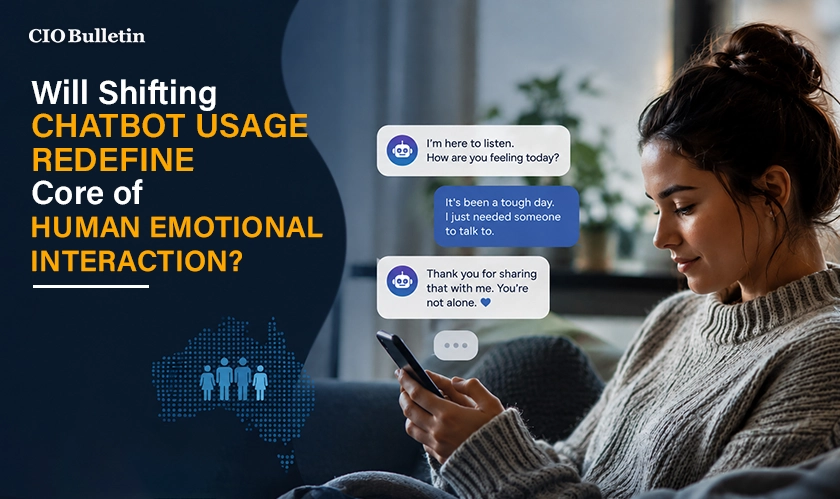
The structural deployment of conversational language systems is undergoing a deep personal evolution as consumer bases redirect digital assistants toward intimate, expressive conversations. Rather than treating conversational interfaces exclusively as corporate execution mechanisms, everyday users are building highly personalized habits around unstructured textual validation. A comprehensive consumer data analysis released by YouGov reveals that contemporary chatbot usage across Australia is shifting rapidly into deeply confidential and emotionally expressive territories. This widespread behavioral transition outlines a changing social reality where automated communication frameworks function as primary personal avenues for processing vulnerabilities.
This growing domestic integration highlights how emerging consumer groups depend heavily on non-human environments to articulate private thoughts without facing direct social judgment. The systematic documentation of these habits reveals surprising trends across various population groups.
Unprecedented Personal Disclosures: Over eleven percent of surveyed adults report revealing deeply guarded personal insights to automated text systems that they had never disclosed to human peers.
Targeted Emotional Support: Approximately twelve percent of respondents explicitly operate these configurations to obtain immediate consolation and coping assistance during challenging mental phases.
The normalization of automated companionship is particularly visible among younger demographics, who seamlessly assimilate generative platforms into their daily psychological maintenance routines. This generational subset actively utilizes conversational networks to experiment with boundary setting, script difficult interpersonal discussions, and decompress from intense social pressures.
"Younger Australians still report higher levels of loneliness than older generations.”
Moving past basic information retrieval tasks, large sections of the population are leveraging automated interfaces in AI chatbots to fill persistent gaps in their real-world support systems. This shift reduces the immediate behavioral reliance on traditional family and neighborhood networks.
Nearly twenty-four percent of Gen Z participants acknowledge utilizing these specific channels to share complex personal sentiments.
More than twenty-seven percent of millennial respondents actively process private emotional developments using available generative software.
Because contemporary consumer landscapes depend increasingly on personalized digital responses to maintain long-term user retention, traditional engineering metrics require immediate adjustment. Designing system layers capable of safely managing highly sensitive, unstructured human inputs is turning into a vital operational necessity for global network architects. Adapting systemic infrastructure safeguards ensures that commercial engines process personal conversations securely while preventing accidental data leaks. CIO Bulletin views this development as a clear indicator that future enterprise software must prioritize nuanced behavioral empathy over simple administrative task execution.



















































 consultants ltd.jpg)


Comments