
Home Industry Clean energy Will India Working On Policy T...
CIO Bulletin
,
24 October, 2026
Author:
Ravathi Sunil
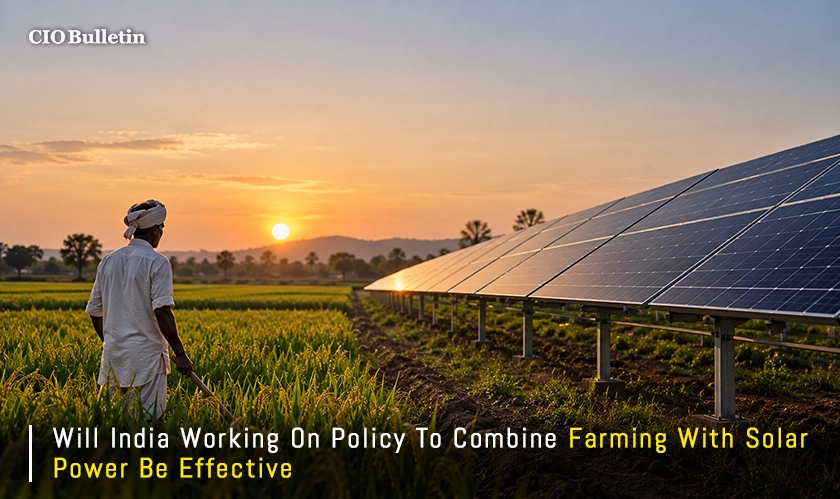
India accelerates its clean energy transition as the Ministry of New and Renewable Energy drafts a comprehensive policy framework to scale agrivoltaics, combining solar power generation with active farming to boost rural incomes without sacrificing food production.
At the seventh Global Agriphotovoltaic Conference, Santosh Sarangi, Secretary of the Ministry of New and Renewable Energy, pointed out that India is preparing a policy framework to integrate farming with solar power generation across the country. This thorough regulatory initiative is intended to set up technical standards, sustainable financing mechanisms, and scalable business models that will allow dual use of land. The government wishes to produce clean electricity directly above actively cultivated farmland so as to increase the number of distributed solar installations without taking agricultural land away from the growing of food grains.
The government planners are attempting to turn the various provincial pilot projects into large-scale agricultural operations, and the new policy framework is dealing with the structural problems encountered by rural energy cooperatives, smallholder farmers, and regional land authorities.
Drawing up standardized grid interconnection guidelines that are specifically designed for elevated solar array structures.
The creation of inclusive financing mechanisms for rural Farmer Producer Organizations and regional agricultural cooperatives.
Establishing definite technical standards in order to protect crop production, the condition of the soil, and the ability of mechanized harvesting equipment to move around.
Underlining the national imperative to scale up clean energy generation alongside food production, MNRE Secretary Santosh Sarangi stated: “agri-photovoltaic potential is huge in our country because it aims at doing energy generation or electricity generation without compromising on food production.”
The officials from the ministry have shown great confidence in achieving the country's target of 500 gigawatts of non-fossil fuel capacity by 2030, on the basis of the fact that around 56 gigawatts are added each year to the national grid.
The introduction of agrivoltaic systems into agricultural regions needs careful coordination between the state's electricity distribution companies, agricultural universities, and private solar developers. The use of modern dual-purpose systems helps to cut down on delays in acquiring land, reduces transmission losses, and gives farmers additional sources of income.
The use of specialized micro-inverters together with dual-axis tracking systems that have been designed for use in agricultural settings.
The implementation of protocols for growing crops in a shaded manner should be carried out to optimize water retention and reduce the need for irrigation.
The combination of renewable power generation with active agricultural activities represents a major change in the way developing countries are tackling land scarcity as they make the shift to clean energy. Setting up proper regulatory frameworks not only ensures that capital is deployed in a sustainable manner but also helps to safeguard food security in rural areas. CIO Bulletin views this development as a key move in achieving a balance between the expansion of national clean energy efforts and sustainable agricultural development in India.
News Source: Asian News International, https://www.aninews.in/



















































 consultants ltd.jpg)


Comments