
Home Industry Defence technology Will the FREYA Missile Defence...
CIO Bulletin
,
10 August, 2026
Author:
Ravathi Sunil
Strengthening European sky protection through cost-effective collaborative defence technology and rapid combat-proven engineering innovation.
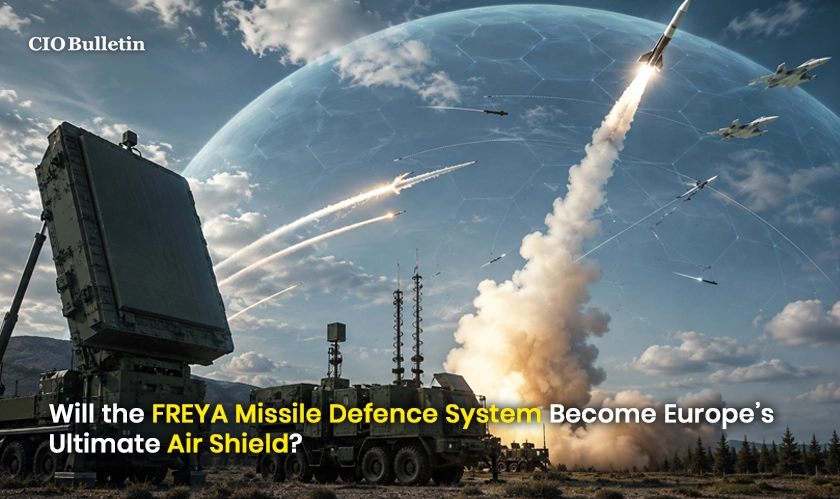
European security is undergoing a dramatic transformation as ten nations unite to construct a revolutionary air protection shield across the continent. The emergence of the FREYA missile defence system marks a bold shift toward sovereign military technology developed directly from modern combat experience. Initiated by Ukrainian defence enterprise Fire Point alongside European industrial partners, this ambitious coalition aims to deliver high-volume interceptors at a fraction of traditional defence costs. Media analysts at CIO Bulletin observe that this collaborative architecture integrates command networks, radar arrays, and precision guidance components into a single resilient umbrella capable of protecting strategic airspace.
Core Innovations Driving Continental Security
Affordable Interceptor Production: Manufacturing high-volume interceptors at significantly reduced per-unit costs.
Flexible Open Architecture: Integrating radar systems and command links seamlessly across allied forces.
Accelerated Engineering Schedule: Compressing decades of standard defence development into roughly two years.
Enhanced Sovereign Protection: Strengthening regional defence capabilities without total reliance on external suppliers.
Could this affordable protection network successfully safeguard continental skies against persistent high-speed missile threats? Unlike traditional military procurement programs that unfold over decades, participating defence firms are moving forward with extraordinary momentum. Emphasizing the unprecedented development speed behind the initiative, Fire Point Chief Executive Iryna Terekh stated, “We're trying to squeeze a program that usually takes 20 or 30 years into a matter of a couple of years.” This strategic urgency stems directly from extensive battlefield data, making the technological framework uniquely responsive to modern security challenges.
Engineers are pairing reliable structural foundations with cutting-edge infrared guidance sensors and multinational radar networks to achieve maximum targeting precision. By maintaining economical manufacturing standards, allied countries can stockpile deep inventories of interceptors needed to neutralize sustained saturation attacks. Operational trials are advancing rapidly toward initial interception milestones, laying a solid foundation for operational readiness. Ultimately, this pioneering defence partnership showcases how combat innovation can reshape European defence cooperation while safeguarding civilian populations for generations to come.
Everything you need to know about this news
It creates an affordable high-volume interceptor system to protect European skies against incoming ballistic missiles.
Ten nations, including Ukraine, Britain, France, Germany, Italy, Denmark, the Netherlands, Norway, Spain, and Sweden, back the initiative.
It uses open architecture, integrating existing allied radar networks with lower-cost interceptors to streamline production significantly.
Developers aim to achieve their first successful live interception trial and operational prototype testing by mid-2027.
Real-world combat data from recent operational engagements allows engineers to optimize interceptor speed, radar connectivity, and guidance accuracy.


















































 consultants ltd.jpg)


Comments