
Home Industry ERP Why Citizen Developers Must Be...
ERP
CIO Bulletin,
11 June, 2026
Author:
Gayathri Sr
Organizations are racing to empower business users with autonomous tools but experts warn that unchecked freedom could trigger major compliance and data security risks.
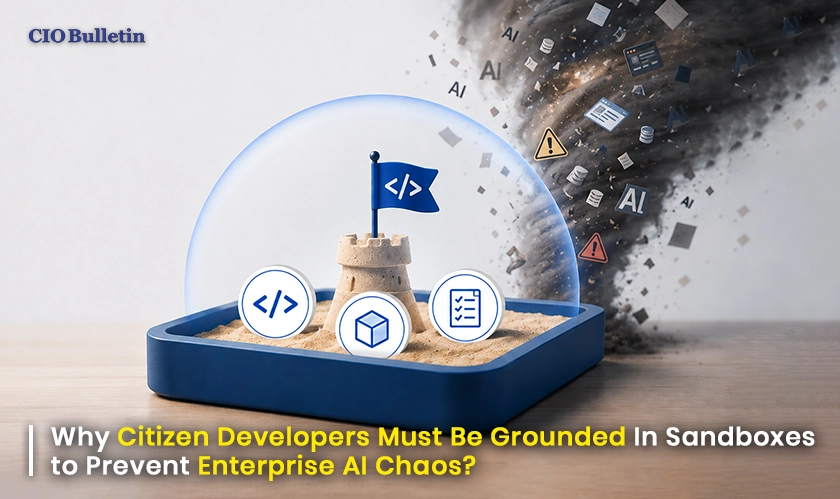
The modern enterprise is witnessing a quiet revolution as everyday business users transform into tech innovators. However, giving citizen developers a blank check to build AI solutions without boundaries is proving to be a dangerous gamble. As organizations rush to democratize technology, industry experts warn that the line between helpful local automation and unchecked operational chaos is growing dangerously thin. A new strategic framework published by CIO Bulletin reveals that the secret to scaling this innovation safely lies in “bounded contextual autonomy,” providing a secure sandbox rather than total freedom.
Many small tools start innocently, perhaps summarizing meeting notes or drafting internal updates. The risk escalates dramatically when these user-built applications begin touching sensitive customer profiles, altering financial workflows, or sending proprietary corporate data to external models. Without clear guardrails, a useful departmental shortcut can accidentally morph into critical enterprise software that lacks proper security oversight.
To maintain order, CIO Bulletin highlights that enterprises must implement a strict risk-based governance model.
Data Sensitivity: Anytime a tool accesses financial, customer, or employee records.
System Modification: Apps that change account states or operational workflows.
External Integration: Moving corporate data into third-party AI platforms.
Operational Dependency: When multiple departments begin relying on a local tool.
Ultimately, the goal is not to kill innovation with bureaucracy, but to blend the ground-level problem-solving of business users with the architectural discipline of IT. By establishing a well-defined sandbox, companies can safely harvest the creativity of their workforce without exposing themselves to compliance disasters.















 consultants ltd.jpg)


