
Home Industry Healthcare What to Know Before Choosing a...
CIO Bulletin
,
26 March, 2026
Author:
CIO Bulletin Team
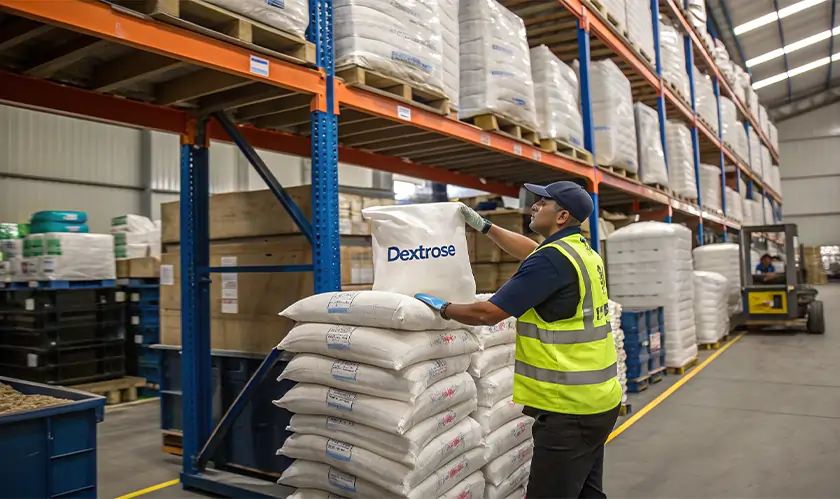
Dextrose shows up everywhere. Food manufacturing, pharmaceutical production, sports nutrition, fermentation, you name it. It's a sweetener in some formulations, an energy carrier in others, and a fermentation substrate in many more. That range of utility is exactly why supplier selection matters more than most buyers initially expect. The wrong partner doesn't just create headaches; it can stall production or trigger compliance failures you won't catch until it's too late.
Sourcing conversations tend to start with price. That's understandable, but it's also where many buyers go wrong. When evaluating a dextrose supplier, the real questions are about purity grade, certification stack, lead time reliability, and how well their documentation holds up under regulatory scrutiny. Price matters, but it's one of several variables that will ultimately determine whether this relationship works at scale.
Get this wrong, and nothing else matters. The grade question has to come first.
Food-grade dextrose meets human consumption standards and is widely used in baked goods, beverages, and confectionery. Pharmaceutical-grade dextrose, also known as USP dextrose, is of a higher purity and is used in IV solutions, drug formulations, and medical devices. These are not interchangeable, and mixing them up creates compliance and safety problems that are genuinely difficult to walk back.
Before approaching any supplier, check your regulatory filings or product specs. That documentation will tell you exactly what grade your formulation calls for.
There are two main forms to know. Monohydrate contains one water molecule per glucose molecule; anhydrous contains none. Monohydrate is the more common choice for food applications, while anhydrous is preferred in dry blends or supplement formats where any moisture introduction creates problems. Know which form your process requires before sourcing, because switching mid-contract is more disruptive than it sounds.
Certifications aren't just paperwork. They reflect how a supplier actually runs their operation, and the gaps in that certification list can be just as telling as what's on it.
For food ingredient suppliers, the baseline expectations are FDA registration for US supply chains, ISO 9001 for quality management systems, and either FSSC 22000 or SQF for food safety management. Kosher and Halal certifications become relevant depending on your target market. None of these are differentiators; they're table stakes.
Pharmaceutical suppliers carry additional requirements. A certificate of analysis for every batch is non-negotiable, and you should be able to request drug master file references when needed; if a supplier can't readily produce them, that tells you plenty.
A supplier's willingness to share audit records is often as informative as the records themselves. Ask whether they accommodate facility audits or, at a minimum, whether third-party results are available on request. Reluctance to engage with those questions is a genuine warning sign. In regulated industries, transparency around production facilities, raw material sourcing, and testing protocols isn't a courtesy; it's expected.
Where dextrose originates and how it reaches you affect both cost and reliability in ways that aren't always visible up front.
Most dextrose is derived from corn starch. Wheat-based versions exist but are far less common in the US market. If your product involves gluten-free labeling or targets consumers with dietary sensitivities, the raw material source needs to be confirmed directly with your supplier. Don't assume. Ask specifically whether their production process addresses the risk of cross-contamination, and get that answer in writing.
The inventory model question also matters more than buyers tend to realize. Direct manufacturers typically offer more pricing stability and better access to technical support. Distributors can move faster, but they introduce an extra layer between you and the production facility, which means less visibility when things go sideways.
Operational fit doesn't get enough attention in supplier evaluations. It should.
Minimum order quantities vary significantly across suppliers. Smaller manufacturers or growing brands can run into real problems when a supplier's minimums only make sense at full truckload volumes. Ask early whether tiered pricing or trial quantities are available before anything is finalized. Locking into a high-volume contract before you've validated production fit is a risk you can avoid.
Lead times deserve the same scrutiny. Seasonal corn demand, broader supply chain disruptions, and carrier availability all affect delivery windows in ways your supplier can predict better than you can. Get average lead times for both peak and off-peak periods, and ask directly how they handle backorders when inventory runs short.
On pricing, the per-kilogram rate is a starting point, not a conclusion. Freight, packaging format (bags vs. bulk), and fees tied to compliance documentation all factor into the real number. A lower unit price can look quite different once those costs are added in.
The strongest suppliers don't just fulfill orders. They support the formulation work behind them, and that distinction matters more the further along you get in production.
Standard documentation should include technical data sheets, safety data sheets, and allergen declarations as part of the default package. If you're operating in a regulated category, your customers will request these documents, and your product files will require them. A supplier who treats documentation as a secondary concern will repeatedly slow you down.
Some suppliers also provide application support, where their technical team can weigh in on usage rates, ingredient compatibility, or processing behavior. That kind of input becomes genuinely valuable during scale-up or reformulation, when small variables start having large consequences.
Picking a dextrose supplier is a compliance decision as much as a procurement one. It shapes your quality control, your documentation trail, and your ability to respond when something goes sideways. Verify certifications, nail down the product form before talking price, and assess whether a supplier's operational setup actually fits your volume and regulatory requirements. The suppliers worth working with will make that evaluation easy.

















































 consultants ltd.jpg)


