
Home Industry Law ethics and legal services Legalia AI Debuts as U.S. Lega...
CIO Bulletin,
24 June, 2026
Author:
Ravathi Sunil
The new AI legal assistant from U.S. Legal Services highlights the growing role of artificial intelligence in making legal information more accessible and tailored.
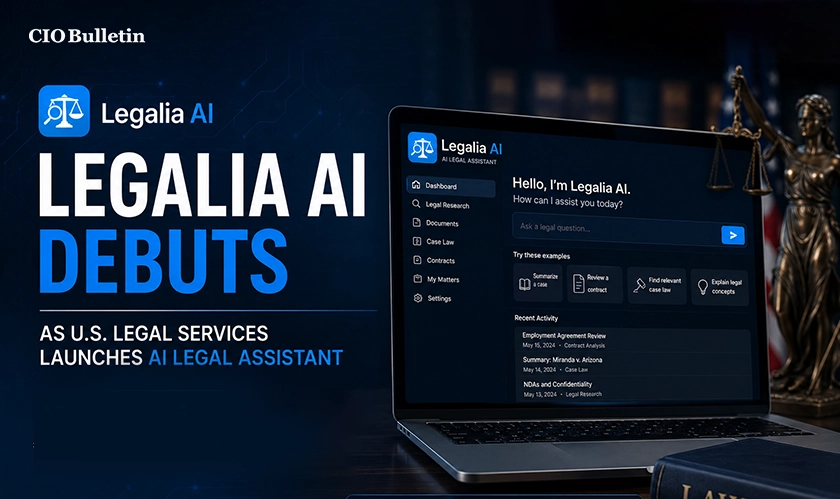
Today, Legalia AI, U.S. Legal Services AI legal assistant, was introduced. For over 50 years, U.S. Legal Services has made assistance human and accessible. All U.S. Legal Services plans contain Legalia AI, which is now accessible to members.
At any time of day, Legalia AI helps members understand their options, provides simple answers to basic legal and policy issues, and directs them to a clear next action. Legalia AI links a member with a lawyer in the U.S. Legal Services statewide network when a case necessitates legal counsel.
"Getting people to real legal help when it matters most has always been our purpose." - Kyle Sweet, Chairman and CEO of U.S. Legal Services.
The purpose of Legalia AI is to assist members, not to represent them in court. It helps members comprehend their options and offers broad legal and policy information. It does not take the place of the lawyers in the U.S. Legal Services network or offer legal advice. Legalia AI links a member with a licensed attorney for advice on a particular case.
CIO Bulletin views this as part of a larger commitment in a quicker, more contemporary member experience across the company's legal, identity, and driver protection plans, Legalia AI is included with every U.S. Legal Services plan rather than offered separately.
The key importance of AI for legal services
AI allows legal professionals to quickly locate relevant information by scanning thousands of court cases, legal documents, and rules in mere seconds.
AI speeds up repetitive tasks such as drafting documents, evaluating contracts, legal summaries and compliance checks.
In the law, AI systems can assist in analyzing documents and identifying trends, hazards and human error.
AI-powered legal assistants can lower operating costs, and improve access to basic legal advice and information.
AI helps in contract evaluation, detects risks, locates key clauses, and confirms compliance with legal requirements.
Everything you need to know about this news
Legal research, contract analysis, document review, compliance monitoring, and the provision of AI-powered legal aid are just a few of the tasks that AI is utilized for in the legal services industry.
Since legal work involves human judgment, ethical decision-making, negotiation skills, and comprehension of complex situations, AI is unlikely to completely replace lawyers. Rather, AI helps attorneys by increasing productivity.
Lawyers may uncover pertinent information more quickly and make more educated conclusions thanks to AI's ability to swiftly scan vast amounts of legal papers, rules, and case histories.
AI legal assistants can increase productivity, speed up access to legal material, automate repetitive operations, and make basic legal assistance more widely available.
Data privacy issues, the veracity of information produced by AI, ethical issues, and the requirement for appropriate human oversight in legal decisions are some of the difficulties.






















 consultants ltd.jpg)


Comments