
Home Industry Law ethics and legal services What to Do After a Crash That ...
CIO Bulletin
,
25 August, 2026
Author:
Guest
NHTSA's early estimate put 2024 traffic deaths at 39,345, a 3.8% decrease from 2023. The agency's finalized 2024 figure, released in 2026, was later reported as 39,254. For 2025, NHTSA's early estimate shows a further 6.7% decline to 36,640 fatalities, the second-lowest fatality rate in recorded U.S. history.
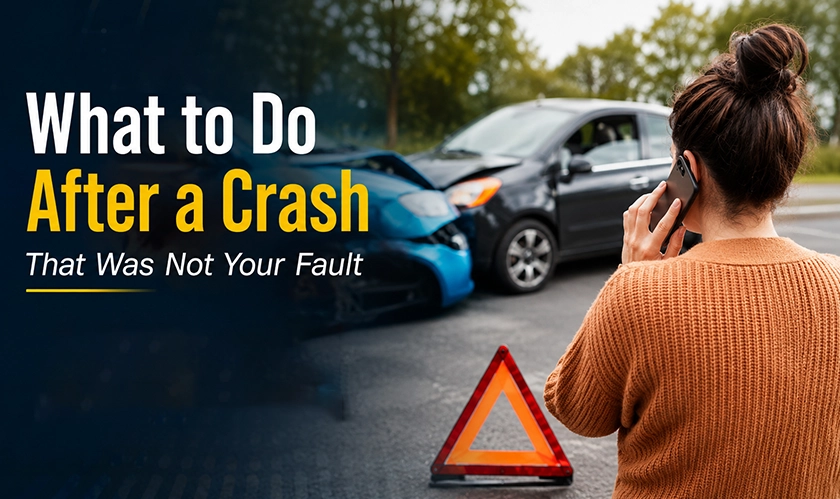
“What to do after a car accident that was not your fault?” This is usually a question that many people tend to ask whenever they are involved in an accident but the other party is grossly negligent. If that is the case, severe bodily injuries, vehicle repair, seeking reimbursement, and other payments would still happen, regardless of who is to blame for the accident.
When looking at who is to blame in relation to any given vehicular collision, it is worth mentioning that different actions can be taken afterwards, and these actions may either aid or harm in establishing the grounds for the argument. The car accident victim should take a few steps to protect their rights from infringement.
Let’s take a look at the proper steps to take when you experience a crash whose liability entirely rests on the other party.
States follow different fault systems. Kentucky is one of only a few choice no-fault states, whereby drivers will be automatically under the no-fault insurance system but can opt out in writing.
The question of whether a driver can pursue a fault-based claim becomes a threshold issue. That answer doesn't come from the accident itself but from whether the driver rejected no-fault coverage in writing beforehand.
Local practice answers this kind of question in a phone call, while national articles never raise it at all.
A claimant found mostly responsible still recovers a reduced share. Most states do not work that way, which is precisely why the general version of this advice fails at the point it matters.
A pure comparative fault system reduces a recovery by the claimant’s share with no floor underneath it. Modified comparative bars recover entirely at either fifty or fifty-one percent depending on the state. There are some jurisdictions that still apply contributory negligence. In these states, the claimant need only prove that the respondent owed them a duty of care. If this is done, these other defenses can be rejected by proportioning the injustice.
Consider the hypothetical case of a person who is held to be 20% at fault and is awarded $100,000 compensation. If he is awarded this amount, he is able to recover 80% of it, which translates to $80,000. This percentage may not always be the same since there are a few factors to take into account, such as whether the concerned state recognizes pure comparative negligence or comparative negligence with a cap. The same person would be barred from claiming anything even if they were found 1% at fault in a state that follows pure contributory negligence rules.
A lawyer can make dealing with these fault systems easier by explaining how they work. You should find someone who focuses on personal injury cases to protect your rights. Florence personal injury lawyer Scott Best has more than 20 years of experience handling legal matters concerning personal injury and will keep you updated throughout your case and will work with you to devise a strategy that will help clients obtain their preferred outcome.
Mayo Clinic notes that whiplash symptoms most often start within days of the injury rather than at the scene, which is the mechanism behind two of the most common claim problems. Telling an officer you feel fine becomes evidence against your case.
A one-week delay between the accident and the initial medical visit, too, can also affect your case. When there is a treatment gap, the insurance company may have a reason to deny that your claim arose during the vehicle accident.
Write down each therapy session that a patient took, the provider offering the service, the diagnosis, the surgery, and the payment terms for that specific service. Affix dates and give the receipts for all the drugs taken so records will reflect them clearly. Maintain a record of payment receipts and any work-related proof at the job. Follow through on the prescribed course, since gaps in treatment get read as evidence the injury was not limiting, whether or not that is true.
Offers land within days, before treatment finishes and before any physician has issued a prognosis. That timing is the product rather than a coincidence, and the release closes the claim permanently. Anyone who later needs surgery or discovers a lasting limitation has nowhere to take it.
Notify your own carrier regardless of who was at fault. Most policies require prompt notice as a condition of coverage. If the other insurer disputes liability, the claim can circle back to your policy. Two clocks run separately here. The policy notice window is one clock, and the limitations period for filing suit is another. Satisfying the first does nothing for the second.
Being not at fault establishes where the claim begins. What it is worth gets decided by which state’s rules attach, what the file shows, and whether anyone signed anything before the picture was complete.
When a vehicle crash cannot be attributed to the driver of the victim's car, the claim process is not always guaranteed to proceed smoothly. Fault, contributory negligence, insurance statutes, and statute of limitations can reduce or eliminate what you would otherwise be entitled to. Such situations differ from state to state.
It is important to document how the accident happened, call for proper medical care quickly, inform the concerned insurance agencies, keep a record of all costs and damages, and most importantly, resist the temptation of hurriedly settling the matter before the effects of the injuries are fully known. No matter how clear the issue of liability seems to be, settlement value would still depend on the law applicable in the circumstances along with the evidence available.



















































 consultants ltd.jpg)


Comments