
Healing has always been personal. Behind every diagnosis is a person hoping for more time, a better quality of life, and a treatment that truly works. Yet, for decades, many advanced therapies, especially in cancer have remained complex, costly, and limited to a small number of patients.
Fate Therapeutics is changing that reality by reimagining how cell therapies are created, scaled, and delivered, placing human impact at the center of scientific innovation.
A Company Built on the Belief That Cells Can Do Better
Fate Therapeutics is a clinical-stage biopharmaceutical company driven by one clear purpose: to create better cell therapies so more patients can benefit from life-changing treatments. The company is dedicated to developing a first-in-class pipeline of programmed, off-the-shelf cellular immunotherapies designed to treat cancer and other serious diseases at scale.
What sets Fate Therapeutics apart is not only what it does, but how it thinks. Instead of relying on personalized, patient-by-patient cell collection, the company has pioneered a new approach called cell programming. This approach allows cells to be engineered, controlled, and produced in a way that mirrors the precision and consistency of traditional biopharmaceutical drugs—while keeping the power of living cells intact.
At the heart of this strategy lies a simple yet powerful idea: better cells lead to better therapies, and better therapies reach more people.
Programming Cells with Purpose
Fate Therapeutics’ innovation begins at the stem cell level. The company works with human induced pluripotent stem cells, commonly known as iPSCs. These cells are remarkable because they can grow indefinitely and transform into almost any type of cell in the human body. This discovery was so groundbreaking that it earned the Nobel Prize in 2012 and Fate Therapeutics has taken it several steps further.
The company genetically engineers iPSCs to include precise, synthetic controls that guide how the cells behave. From there, it creates a single, carefully selected clonal master iPSC line. This master line acts as a renewable source, much like a master formula in drug manufacturing, ensuring every therapy produced is consistent, reliable, and ready to be used when needed.
By directing the fate of these master iPSC lines, Fate Therapeutics produces immune cells that are designed to fight disease with accuracy and strength. The result is an off-the-shelf therapy—available without long waiting times, scalable for large populations, and suitable for use alone or alongside existing treatments.
Turning Stem Cells into Powerful Immune Protectors
One of Fate Therapeutics’ major breakthroughs lies in how it transforms iPSCs into highly effective immune cells. These include T cells and Natural Killer cells, both essential players in the body’s defense system.
T cells are central to adaptive immunity. They recognize specific targets on cancer cells, activate immune responses, and directly destroy diseased cells. Today’s T-cell therapies often require harvesting cells from individual patients, a process that can be slow and demanding. Fate Therapeutics is changing that model by creating engineered T cells from master iPSC lines. This approach enables consistent manufacturing, reliable safety, and the scale required to reach far more patients than ever before.
Natural Killer cells represent another powerful front. As part of the innate immune system, NK cells act quickly, identifying and eliminating abnormal cells without needing prior recognition. They attack cancer cells, release immune-activating signals, and help coordinate a broader, longer-lasting immune response. Fate Therapeutics is advancing a pipeline of iPSC-derived NK cell therapies, including programs developed through collaborations with leading research institutions such as the University of Minnesota and Oslo University Hospital. These therapies are being explored both as standalone treatments and in combination with other anti-cancer agents, expanding their potential impact.
A Platform Designed for Scale, Precision, and Access
Fate Therapeutics’ iPSC platform represents a major leap forward in cellular therapy development. Built on years of expertise, the platform allows for efficient derivation, expansion, and genetic engineering of human iPSCs using proprietary, small-molecule technology. Every step—from single-cell isolation to clonal expansion—is designed to ensure uniformity, safety, and performance.
This platform is backed by a robust intellectual property portfolio, with hundreds of issued and pending patents protecting the company’s innovations. More importantly, it supports a long-term vision: making advanced immunotherapies accessible to large patient populations, not just a select few.
Master iPSC lines provide a stable, well-defined source for producing immune cells such as NK cells, T cells, and CD34+ cells. From these, Fate Therapeutics continues to advance a growing pipeline of off-the-shelf cellular immunotherapies, each built with the same commitment to quality, consistency, and patient impact.
The Fate Therapeutics Destiny Ahead
Stem Cell Innovation of the Year 2026 is not just about scientific achievement, it is about meaningful progress. Fate Therapeutics stands at the intersection of science and humanity, transforming Nobel Prize-winning biology into real-world solutions for people who need them most.
By replacing complex, individualized manufacturing with scalable, programmed cell therapies, the company is redefining what is possible in immuno-oncology and beyond. Its work moves the industry closer to a future where advanced cell therapies are not rare, but ready, available when patients need them, without compromise.
As Fate Therapeutics continues to advance its pipeline, its impact goes beyond laboratories and clinics. It reshapes expectations, proving that innovation can be both cutting-edge and deeply human.
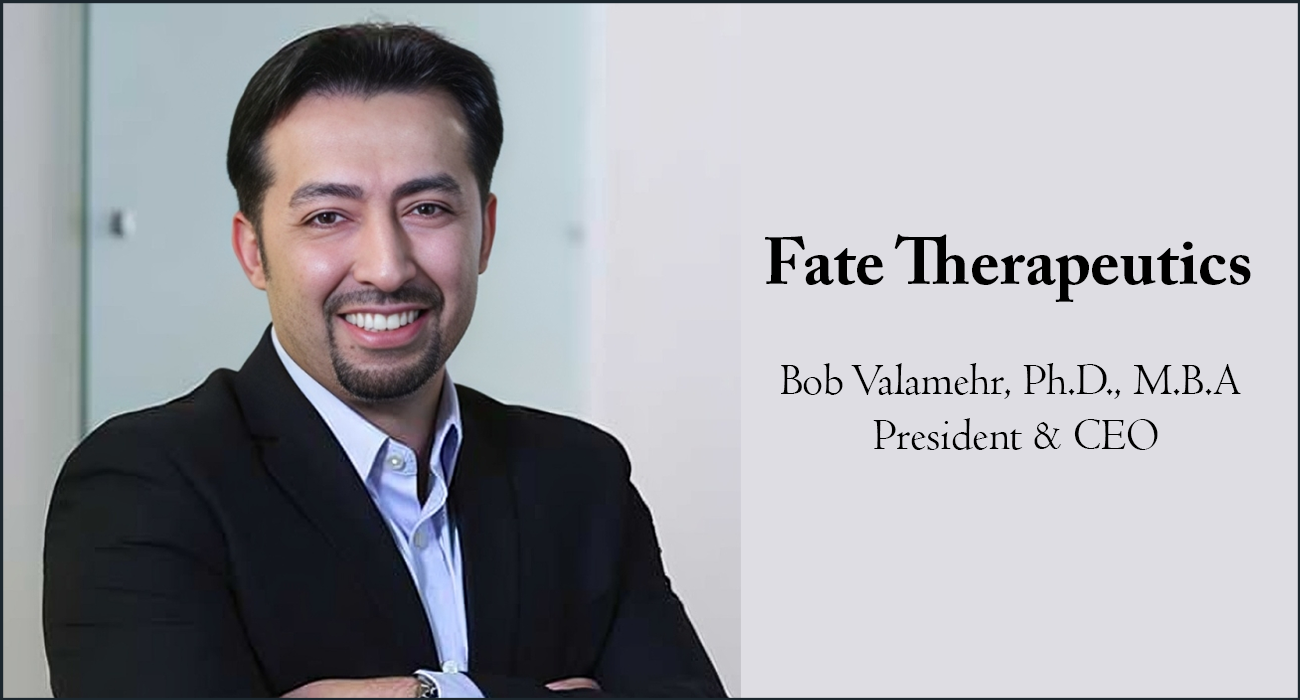
Bob Valamehr, Ph.D., M.B.A. | President and CEO
Bahram (Bob) Valamehr is President and Chief Executive Officer at Fate Therapeutics and is responsible for the company’s finance, administration and operations, including overseeing the company’s research and development, technical operations and translational sciences activities. Previously, Dr. Valamehr led the development of Fate’s iPSC platform and therapeutic areas for nearly 15 years and most recently held the role of President of R&D.
He has co-authored numerous studies and patents related to stem cell biology, immunology, oncology and materials science. Dr. Valamehr received his Ph.D. from the Department of Molecular and Medical Pharmacology at UCLA, his M.B.A. from Pepperdine University and his B.S. from the Department of Chemistry and Biochemistry at UCLA.

















































 consultants ltd.jpg)


