
Enterprise software decisions define how a business operates, grows, and competes. Yet Enterprise Resource Planning (ERP) initiatives are still approached with uncertainty, conflicting advice, and an acceptance that delays and overruns are “part of the process.” The organizations that succeed are the ones that refuse to normalize failure. They seek clear thinking, independent guidance, and experienced leadership that keeps the focus on business outcomes.
HandsFree ERP delivers exactly that. The company is built to make ERP success deliberate, practical, and repeatable. With more than 100 years of combined experience, the firm brings seasoned, real-world expertise to ERP implementations, upgrades, and rescue initiatives. Its principals have spent decades inside the traditional ERP partner ecosystem, giving them a rare, inside-out understanding of how projects succeed and why they fail. Today, that insight is applied exclusively on the client side, where HandsFree ERP acts as a trusted advisor and advocate.
By bridging the already existing gap between internal teams and ERP vendors, HandsFree ERP helps organizations move forward with confidence. The firm blends experienced people, proven processes, and modern tools to guide clients through every critical decision point, from early planning and software evaluation to high-risk implementation milestones. Fit-gap analysis, structured demo management, and board-ready requirements and budget estimates replace confusion with clarity.
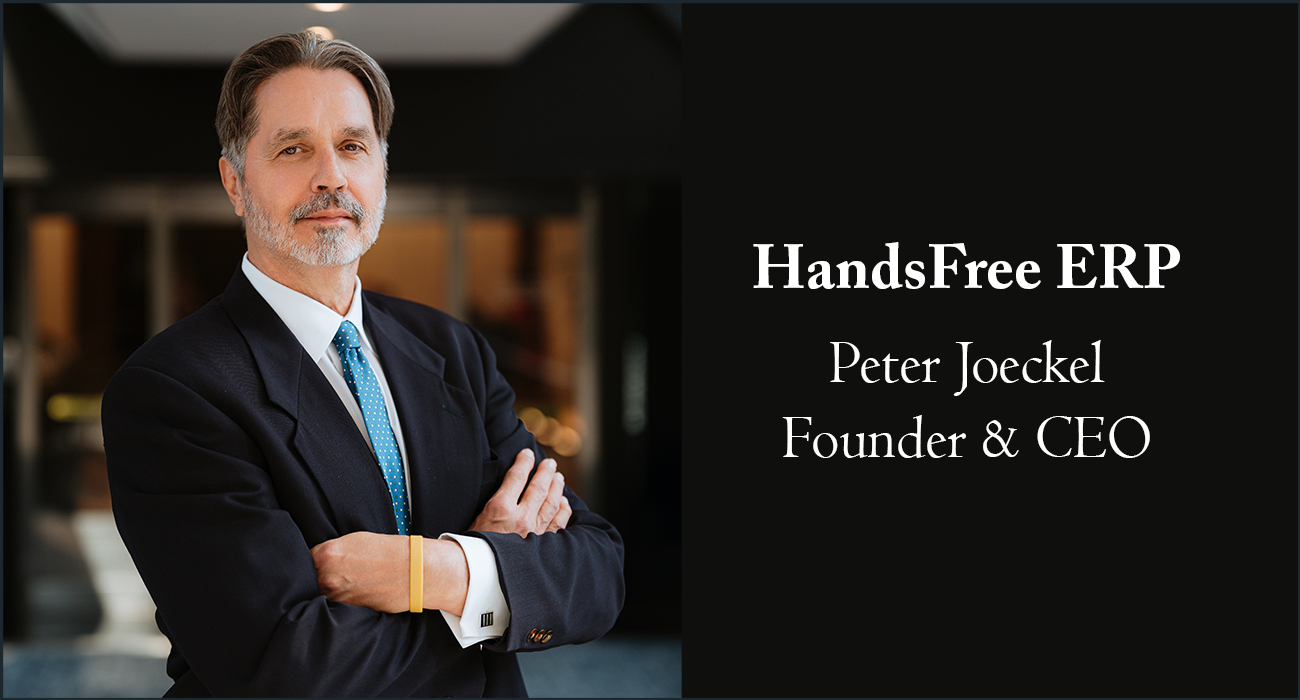
Peter Joeckel, Founder and CEO of HandsFree ERP, spoke exclusively with CIO Bulletin. In the interview, he shared valuable insights into how he and his expert team are revolutionizing traditional ERP delivery models, repositioning ERP from a high-risk undertaking to a reliable strategic asset, one that consistently delivers trusted outcomes and systems precisely aligned with business requirements.
Interview Highlights
Could you share the story behind HandsFree ERP’s inception and the driving vision that shaped its early foundation?
HandsFree ERP was founded out of a recurring pattern observed across hundreds of ERP initiatives: organizations were investing millions in modern ERP platforms, yet struggling to realize the outcomes they were promised, or even worse, projects were killing companies and careers. Despite better software, cloud delivery models, and agile methods, failure rates remained stubbornly high, at about 70%. Even when projects went live “on time and on budget,” they often failed to deliver on scope.
The founding vision of HandsFree ERP was shaped by a simple but powerful insight: ERP failures are rarely caused by technology. They are caused by unclear requirements, poor data discipline, unmanaged workarounds, and decision-making that starts too late, often after a system has already been selected.
HandsFree ERP was created to sit upstream of implementation chaos. Rather than focusing on configuration or implementation, the firm was designed as an independent advisory partner that helps organizations slow down before they speed up, bringing clarity to processes, data, scope, and decision rights, ideally before ERP dollars are committed. HandsFree ERP focuses solely on providing insurance for ERP success by mitigating the typical risks of an ERP project.
The “HandsFree” philosophy reflects the ultimate goal: enabling leaders and teams to operate ERP systems confidently, without constant firefighting, shadow systems, or manual interventions. From day one, the firm’s mission has been to help organizations achieve ERP success with outcomes that are sustainable, scalable, and human-centered.
Could you walk us through services offered by HandsFree ERP and what truly differentiates your services from others?
HandsFree ERP provides a focused portfolio of advisory services designed to de-risk ERP initiatives and accelerate value realization:
ERP Readiness & Discovery
ERP Selection Advisory
Data Readiness, Quality, and Migration Advisory
AI & Agent Readiness Assessments
ERP Recovery & Stabilization
ERP Success Academy (Education & Enablement)
What differentiates HandsFree ERP is not the breadth of services, but the depth of discipline applied before execution begins. Unlike firms that begin with solution demos or configuration workshops, HandsFree ERP starts with operational truth—how work actually gets done, not how it is supposed to work.
The firm operates without software resale commissions, implementation quotas, or vendor bias. This independence allows recommendations to be driven solely by business outcomes, not tool preferences. We cover any ERP and do not get sales commissions from vendors, so we remain totally unbiased. HandsFree ERP also emphasizes repeatable frameworks and decision artifacts, ensuring that executive alignment, scope control, and data governance are established early and reinforced throughout the lifecycle.
How does HandsFree ERP differentiate its advisory approach from traditional ERP consulting models in the market?
Traditional ERP consulting models often prolong the pre-implementation phase through exhaustive requirements gathering and documentation of fragmented legacy processes, driving time and cost without improving decision quality. HandsFree ERP takes a fundamentally different approach, accelerating pre-implementation clarity with tools like Discover to focus on the decisions that matter most, ensuring higher-quality outcomes before delivery begins.
Rather than embedding consultants into implementation teams, HandsFree ERP operates as a client-side advisor, helping executives ask the right questions, define success clearly, and establish guardrails that prevent scope erosion and rework.
Key differentiators include:
Outcome-driven advisory rather than configuration-driven delivery
Early exposure of risks that are often ignored or deferred
Emphasis on business ownership of ERP, not vendor dependency
Structured governance models that survive go-live
This approach ensures ERP programs are led, not outsourced.
How does the ERP Success Academy help organizations build the competencies needed to achieve consistent ERP outcomes?
The ERP Success Academy was created to address a major gap in the ERP market: organizations invest heavily in ERP software, yet invest very little in practical ERP skills.
Most executives and project team members participate in only one or no ERP implementations in their careers. As a result, they are expected to make high-impact decisions without fully understanding what good looks like, where risks typically hide, or how much internal effort is truly required. In many cases, they simply do not know what they do not know.
The ERP Success Academy provides practical—not academic—education, designed specifically for real-world ERP programs. The curriculum is structured for executives, leaders, and core project teams and focuses on topics such as:
ERP fundamentals
Requirements discipline
Data governance
Common implementation risk patterns
Post–go-live accountability
A critical differentiator of the Academy is its focus on internal capacity and capability visibility.
Beyond education, the Academy helps organizations clearly understand:
What internal roles are required
When those resources are needed
For how long they will be needed
Which skills must exist internally versus externally
Too often, internal capacity planning is overlooked entirely. Team members are suddenly expected to perform two full-time jobs—running the business while supporting the ERP project, which leads to burnout, frustration, and, in some cases, key employees leaving mid-project. The Academy exposes these risks early, allowing leadership to plan realistically and protect both the project and the people.
This investment in practical ERP project knowledge is one of the strongest predictors of ERP success. By educating teams early, before critical decisions are made, the ERP Success Academy enables organizations to lead their ERP initiatives with confidence, clarity, and realistic expectations, rather than learning painful lessons too late in the process.
What principles guide HandsFree ERP’s work in ensuring data readiness, data quality, and migration discipline in ERP projects?
HandsFree ERP treats data as a strategic asset, not a technical afterthought. The firm operates on several core principles:
ERP does not fix data; ERP amplifies it
Bad data migrated faster is still bad data
Ownership matters more than tools; tools just ensure speed and quality
Data decisions must precede configuration
HandsFree ERP helps clients define data strategy and ownership, data standards, and data quality thresholds before migration begins. The firm advocates for iterative mock migrations, exception-based cleansing, and business-led validation rather than IT-only testing.
Migration is approached as a transformation activity, not a mechanical transfer. This discipline dramatically reduces post-go-live disruptions, accelerates adoption, and ensures that clients get the maximum value from their new ERP.
What approach does the company take when helping clients choose the right ERP solution?
HandsFree ERP’s selection methodology begins by decoupling business needs from vendor narratives. Clients are guided through a structured discovery process that defines:
Business capabilities required (not features)
Business process requirements within the industry, including best practices
Regulatory and industry constraints
Integration realities
Data maturity
Change capacity
Only once these elements are clearly documented does the firm move into solution evaluation. Demos are controlled, scripted, and scored against real-world scenarios, not marketing scripts.
We help clients find the right implementation partner as well, if requested. This is an important part of the total solution.
This ensures ERP decisions are based on fit-for-purpose alignment, realistic cost modeling, and long-term scalability rather than brand recognition or sales pressure.
What internal framework does HandsFree ERP use to uncover hidden operational workarounds such as Shadow ERP, and how does this discovery influence implementation planning?
One of HandsFree ERP’s most impactful contributions is its ability to surface Shadow ERP; the spreadsheets, side systems, manual processes, and workarounds that quietly run the business.
The firm uses a structured operational discovery framework that combines:
Process walkthroughs
Data lineage mapping
Exception analysis
Cross-functional interviews
These insights are used to influence implementation planning by:
Identifying hidden scope early
Preventing automation of broken processes
Reducing resistance by acknowledging reality
Informing change management and training strategies
By making invisible work visible, HandsFree ERP helps clients design ERP solutions that truly reflect how the business operates.
With the industry’s focus shifting toward higher implementation standards, how does HandsFree ERP view its alignment with the expectations set by the “ERP Implementation Excellence Award 2026?”
HandsFree ERP views its recognition and alignment with the ERP Implementation Excellence Award 2026 as validation of its founding principles.
As the industry raises expectations around implementation quality, value realization, and accountability, HandsFree ERP’s advisory-first, data-disciplined, outcome-driven model aligns naturally with these standards.
The firm believes excellence is not defined by go-live dates, but by:
Adoption
Operational stability
Decision transparency
Measurable business outcomes
HandsFree ERP is bridging the gap between what clients desire and how partners and vendors deliver within appropriately set expectations, both ways. Ultimately, it is a win-win because client expectations are realistic, so the partner does not have to manage the project under unrealistic pressures and therefore deliver in fear of losing the business altogether, unless they try to meet them (with change orders creeping in).
This award reflects a broader industry shift, one that HandsFree ERP has been championing since its inception.

The Stalwart Leader behind HandsFree ERP’s Success
Peter Joeckel is the Founder and CEO of HandsFree ERP. With over three decades of experience across ERP implementations, advisory roles, and enterprise transformation initiatives, he is recognized for his candid, outcome-focused perspective on ERP success.
Peter has worked with organizations across manufacturing, distribution, professional services, and technology, often stepping in where ERP initiatives are at risk or already failing. His thought leadership focuses on requirements discipline, data integrity, and the human factors that determine whether ERP investments succeed or stall.
He is also a frequent speaker, advisor, and educator on ERP strategy, AI readiness, and operational transformation.















































 consultants ltd.jpg)


