
Home Technology Medical device Why Is Artificial Intelligence...
CIO Bulletin
,
17 July, 2026
Author:
Gayathri Sr
A landmark analysis reveals a massive regulatory imbalance as one visual field captures the lion's share of medical tech clearances.
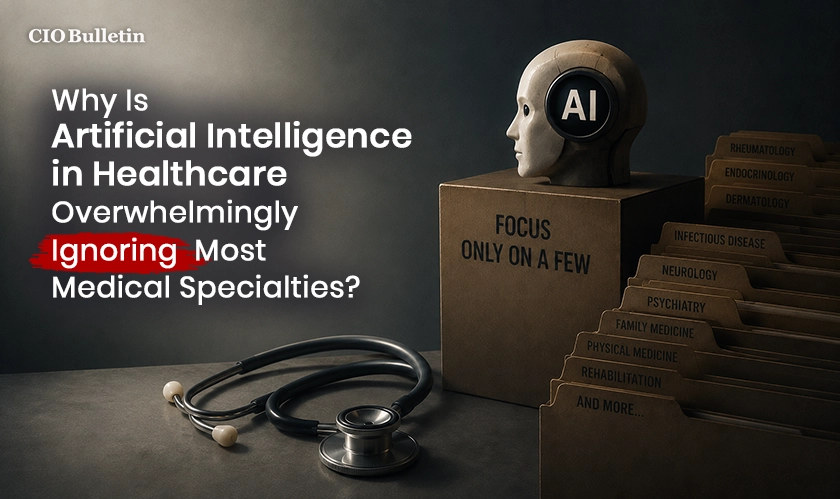
When people imagine the future of Artificial Intelligence in Healthcare, they often picture virtual therapists, automated lab tests, or smart diagnostic systems helping doctors across every medical department. However, a groundbreaking 30-year regulatory analysis of the U.S. Food and Drug Administration (FDA) database shows a surprising reality: nearly the entire medical tech revolution is happening in just one room of the hospital.
As reported by CIO Bulletin, a longitudinal study published in the medical journal Cureus analyzed 1,430 AI-enabled devices cleared by the FDA between September 1995 and December 2025. The findings are startling. Instead of a balanced rollout across medicine, a staggering 76.5% of all approved AI products, totaling 1,094 devices, belong strictly to radiology.
While image-heavy diagnostics are surging ahead, other crucial areas of Artificial Intelligence in Healthcare are being left far behind.
The study's lead author, Dr. Pouyan Golshani, an interventional radiologist at Kaiser Permanente Los Angeles Medical Center, explained the trend:
“The cumulative regulatory record demonstrates rapid growth that has been concentrated in image-rich diagnostic specialties, with limited representation across many specialties that account for substantial clinical activity in the United States.”
This vast disparity means that while x-ray, CT, and MRI machines are rapidly getting smarter, patient care in other critical specialties is seeing almost zero AI integration.
The Top Three Monopoly: Together, radiology, cardiology, and neurology account for a massive 90.6% of all FDA clearances.
The Underrepresented Fields: Out of more than 1,400 clearances, pathology secured only 9 approvals, microbiology had 6, and obstetrics and gynecology managed a mere 4.
The Complete Zero: Not a single AI device has been cleared under the psychiatry or behavioral health review panels.
Exponential Growth: Despite the imbalance, the market is moving incredibly fast. Annual clearances skyrocketed from less than two devices per year before 2014 to a record 331 approvals in 2025 alone.
Market Domination: The research also revealed that 67.8% of the 740 companies on the list have only cleared a single device, while a small group of just 13 elite manufacturers hold over 17% of all clearances.
This bottleneck raises critical questions for the future of patient care. In order to truly revolutionize medicine, developers and regulators must find ways to bridge this gap, bringing the immense power of machine learning out of the imaging labs and into every corner of the healthcare system.
Everything you need to know about this news
Radiology is inherently "image-rich." Computers excel at recognizing visual patterns in high-resolution scans (like X-rays and MRIs) faster than they can process more subjective or qualitative patient data, making imaging software an easier fit for machine learning algorithms.
The study showed that a massive 96% of these devices (1,376 out of 1,430) were cleared through the FDA's streamlined 510(k) pathway. This process is faster because it only requires companies to prove their tool is "substantially equivalent" to a product that is already legally on the market.
Psychiatry and behavioral health rely on complex human interactions, verbal patterns, and behavioral observations rather than digital images or electrical signals. This makes it much harder to train and validate standard computer algorithms to safely diagnose or treat patients.
Yes. The market is highly concentrated, with just 13 companies securing over 17% of all FDA clearances. Conversely, the vast majority of software developers (nearly 68%) are “one-hit wonders” that have only successfully passed a single device through regulatory clearance.
To expand the reach of AI, researchers and developers must focus on creating algorithms that can securely analyze electronic health records, genomic data, and lab cultures. Regulators may also need to refine approval pathways to better evaluate tools that do not rely on medical imaging.



















































 consultants ltd.jpg)


Comments