
Home Technology Medical device ITEN Battery Programme: Will T...
CIO Bulletin
,
23 July, 2026
Author:
Gayathri Sr
French innovator ITEN is pushing the boundaries of battery technology to deliver safer, smaller, and longer-lasting power sources for critical medical implants.
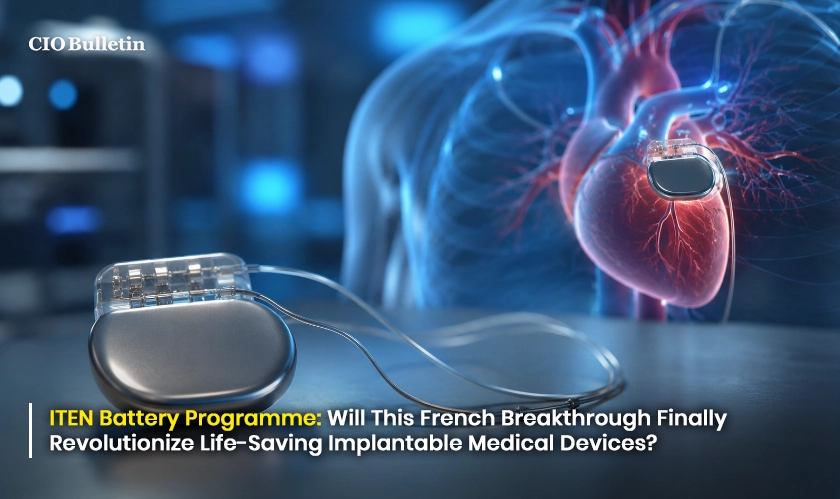
ITEN battery programme is generating significant buzz in the global medical technology sector as the French solid-state battery specialist takes a bold step into high-stakes implantable devices. The company has launched a dedicated development initiative named SOLIMED to create next-generation solid-state batteries specifically designed for Class III implantable medical devices, including advanced cardiac assist systems.
For patients with life-critical implants, battery performance is everything. Traditional batteries often force patients to undergo repeated surgeries for replacements and limit device miniaturization. ITEN’s new programme aims to change that reality.
Part of the European IPCEI Tech4Cure programme, the ITEN battery programme focuses on developing compact, high-capacity solid-state batteries using a fully ceramic, nanomaterial-based design. Unlike conventional lithium-ion batteries that use liquid electrolytes, ITEN’s technology eliminates flammable materials, greatly reducing safety risks inside the human body.
The company is targeting impressive performance goals: an energy density of 600 Wh/L, capacity above 2 Ah, and the ability to recharge to 80% in under 20 minutes. These advancements could lead to smaller implants, faster wireless charging, and significantly longer battery life, potentially reducing the need for replacement surgeries.
“Implantable medical devices represent one of the most demanding applications for any energy storage technology. Safety is paramount, but it must be combined with high energy density, fast charging, reliability and long operating life. This development program is a major milestone for ITEN,” said Vincent Cobée, Chief Executive Officer of ITEN.
The programme also explores biocompatible packaging materials that could replace traditional titanium casings, enabling even more compact and integrated designs. While cardiac assist devices are the initial focus, the technology holds promise for neurostimulators, hearing implants, and other advanced medical solutions.
According to CIO Bulletin’s analysis, the ITEN battery programme could accelerate innovation in the implantable medical device market by addressing one of its biggest bottlenecks, reliable, safe, and long-lasting power.
Everything you need to know about this news
It uses a completely solid-state, ceramic-based design without liquid electrolytes, offering superior safety and performance for implants inside the human body.
The initial focus is on Class III devices, particularly implantable cardiac pumps, with future applications in neurostimulators and other critical implants.
ITEN aims to recharge the battery to 80% capacity in less than 20 minutes, enabling convenient wireless charging.
Yes. Longer battery life is a core goal, which could significantly decrease the frequency of replacement surgeries.
The SOLIMED project is actively underway, with the programme expected to deliver breakthroughs that will strengthen Europe’s position in advanced medical technologies.



















































 consultants ltd.jpg)


Comments