
Home Industry Real estate Why Three Lakh per Square Foot...
CIO Bulletin,
11 June, 2026
Author:
Gayathri Sr
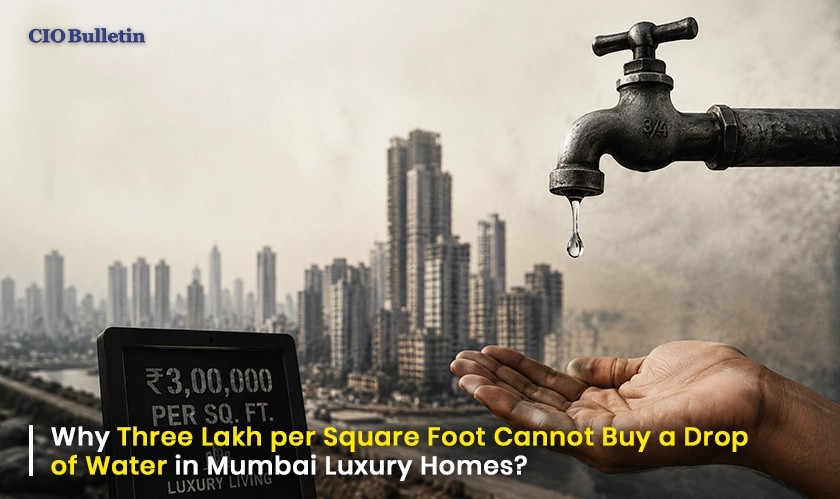
Even a staggering price tag of three lakh rupees per square foot cannot guarantee basic amenities as civic infrastructure struggles to match elite real estate expansion.
A bizarre paradox is unfolding in India’s financial capital, where the most affluent neighborhoods are confronting a humbling equalizer. The market for Mumbai luxury homes is touching unprecedented heights, with ultra-premium sky villas in Worli and Malabar Hill trading at a jaw-dropping ₹3 lakh per square foot. Yet, behind these glitzy, high-tech facades, multi-millionaire residents are currently experiencing mandatory 10% citywide water cut. An investigation by CIO Bulletin reveals a widening chasm between aggressive vertical real estate development and the stagnant civic infrastructure supporting it.
The municipal corporation recently implemented strict supply reductions because local reservoirs dropped to a critical 13% capacity. While these elite residential towers boast infinity pools, private clubhouses, and imported water fixtures, they remain entirely tethered to an aging public utility network that is failing to keep pace with urban growth.
According to data analyzed by CIO Bulletin, the city's daily drinking water deficit has already crossed the 400-million-liter mark, forcing even ultra-luxury associations to rely heavily on private water tanker syndicates.
Seawater Desalination: A high-tech coastal plant is being designed by Israeli water experts to convert 200 million liters of ocean water daily.
The Gargai Reservoir Project: A massive new dam initiative scheduled to break ground in late 2026 to capture monsoon runoffs.
The Pinjal Infrastructure Plan: A secondary long-term dam project designed to channel an additional 865 million liters into the urban grid.
This stark utility crisis presents an uncomfortable question for global investors looking at luxury markets. While premium developers can easily build world-class structures, they cannot independently build the massive public dams required to sustain them. Modern buyers are beginning to realize that true luxury might no longer be defined by a prestigious address, but by uninterrupted access to basic survival resources.

















 consultants ltd.jpg)


