
Home Technology Red hat Can Red Hat OpenShift Save Ent...
CIO Bulletin
,
15 July, 2026
Author:
Gayathri Sr
The Hybrid Cloud Giant Drops a High-Stakes Upgrade to Weaponize Virtual Workloads Against Rising Financial and Security Vulnerabilities.
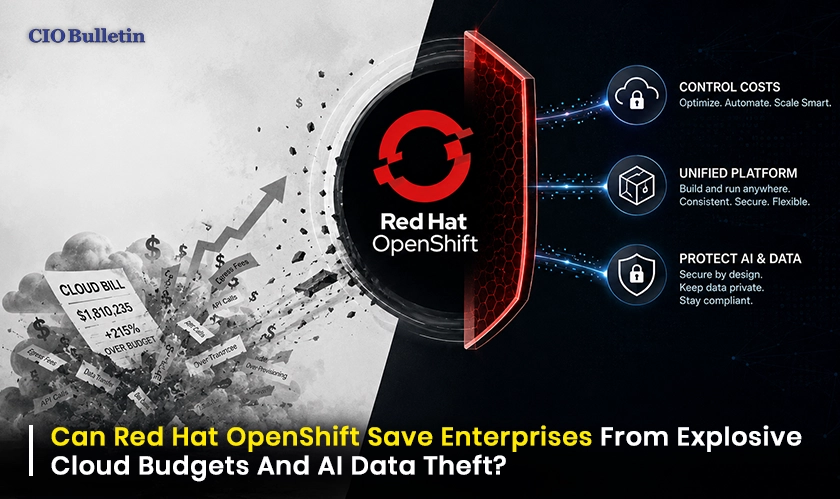
The global enterprise space just hit a critical crossroads where running massive artificial intelligence workloads is draining corporate wallets and leaving sensitive data exposed to sophisticated threats. In a definitive move to solve this double-edged crisis, the general availability of Red Hat OpenShift 4.22 has officially been announced, aiming directly at cutting infrastructure waste while radically locking down corporate computational spaces. According to technology analysts tracking the launch at CIO Bulletin, this latest iteration introduces stripped-down base images to minimize the digital attack surface and rolls out hardware-isolated sandboxed containers to secure processes at the absolute lowest computational level.
As organizations ramp up machine learning operations, the cost of specialized cloud computing has become unsustainable for many IT budgets. The latest platform upgrade introduces advanced open-source auto-scaling capabilities specifically designed to right-size compute instances instantly. Corporate teams can now seamlessly integrate spot instances for fault-tolerant projects, capturing dramatic cost savings without risking application uptime.
“Announced July 14, Red Hat OpenShift 4.22 continues to harden the platform foundation to meet growing security standards, helping reduce the manual effort of compliance and risk mitigation,” stated the official release from Red Hat.
Beyond structural budget relief, the introduction of a new "Confidential AI" technology preview addresses the industry's biggest nightmare: data leakage during runtime execution. Tech reviews published by CIO Bulletin highlight that organizations can now process highly sensitive proprietary algorithms within a cryptographically isolated slice of memory and CPU. Backed by enhanced virtualization capabilities, including multi-volume snapshots for streamlined disaster recovery and resilient edge fencing, the enterprise tech sector finally has a concrete blueprint to run heavy AI models at peak performance without losing financial or structural control.
Everything you need to know about this news
The system integrates an advanced open-source auto-scaler that dynamically right-sizes compute instances and supports cost-efficient spot instances to eliminate paid, idle cloud resources.
It is a state-of-the-art framework that isolates proprietary AI algorithms and sensitive datasets inside a secure, cryptographically locked portion of the hardware, preventing data theft even during active processing.
The release introduces a minimal Universal Base Image that strips away non-essential code packages, severely reducing the available paths or attack surfaces that malicious actors can exploit.
It adds new volume group capabilities that execute multi-volume snapshots for virtual machines, providing a highly reliable, crash-consistent backup mechanism to keep operations running.
CIO Bulletin provides deep technical analysis and objective reporting on modern cloud advancements, giving business leaders the insights required to deploy high-efficiency infrastructure solutions seamlessly.



















































 consultants ltd.jpg)


Comments