
Home Industry Renewable energy Can India’s Renewable Energy...
CIO Bulletin
,
30 June, 2026
Author:
Ravathi Sunil
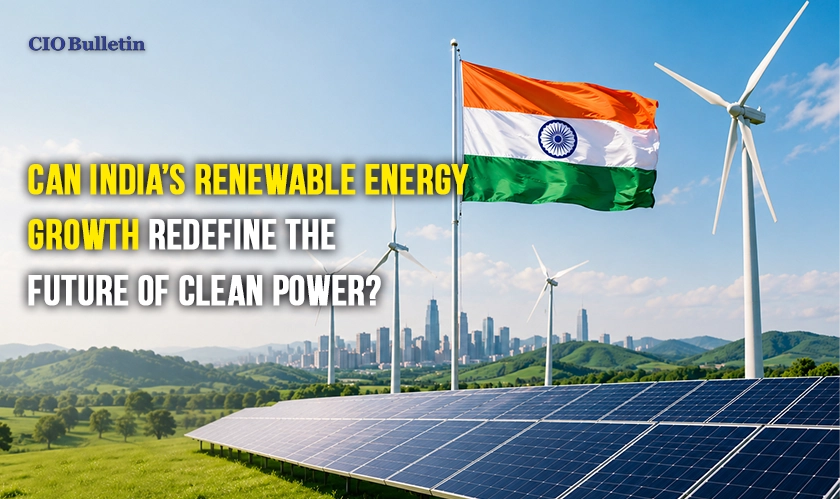
India’s renewable energy expansion marks a historic milestone, placing the nation among the world’s top clean energy leaders.
According to the Renewable Energy Statistics 2026, India’s renewable energy is ranked third in the world for Renewable Energy Installed Capacity, according to Union Minister for New and Renewable Energy and Consumer Affairs, Food, and Public Distribution Shri Pralhad Joshi. India has surpassed Brazil in the ranking. The figures as of December 2025 were made public by the International Renewable Energy Agency.
India’s renewable energy milestone reflects a powerful shift from energy dependence to clean energy leadership on the global stage.
As of March 31, 2026, India's installed non-fossil fuel capacity was 283.46 GW, comprising 8.78 GW from nuclear power and 274.68 GW from renewable sources. The US built a record 55.3 GW of non-fossil capacity during FY 2025–2026, the largest annual increase to date nearly twice the addition made the year before. Five years ahead of its 2030 objective under the Paris Agreement, the nation also achieved a noteworthy milestone in June 2025 when it attained 50% of its cumulative installed electricity capacity from non-fossil sources.
There is a significant accomplishment; in July 2025, renewable energy sources supplied 51.5% of India's 203 GW of electricity demand, the greatest percentage ever.
In FY 2025–2026, non-fossil sources accounted for 29.2% of total electricity generation, while renewable energy (including big hydro) supplied 26.2%.
Over the course of the year, India generated 1,845.9 billion units (BU) of energy.
India's base of renewable manufacturing has grown considerably. While wind turbine production capacity has climbed to nearly 24 GW, solar module manufacturing capacity has grown from 2.3 GW in 2014 to roughly 172 GW in 2026.
This expansion has been aided by policy initiatives that support the government's self-reliance objectives, such as lower GST on renewable energy equipment and incentives for domestic battery manufacture.
According to the reports tracked by CIO Bulletin, an important step toward a cleaner and more sustainable future has been taken with India's ascent to become the world's third-largest holder of renewable energy capacity.
Everything you need to know about this news
With the help of government programs, private investment, and the rising demand for sustainable power, India quickly expanded its solar, wind, and other clean energy projects to reach this milestone.
India's growth in renewable energy contributes to the world's shift to cleaner energy sources, enhances energy security, lowers carbon emissions, and lessens reliance on fossil fuels.
Solar, wind, hydropower, biomass, and other cutting-edge clean energy technologies account for the majority of India's renewable energy capacity.
Limitations on energy storage, system upgrades, land availability, funding needs, and integrating significant volumes of renewable electricity into the national grid are some of the major obstacles.
By boosting investments in clean technologies, enhancing infrastructure, promoting innovation, and fortifying alliances throughout the renewable energy industry, India can keep moving forward.



















































 consultants ltd.jpg)


Comments