
Home Industry Renewable energy How Are Singapore and Indonesi...
CIO Bulletin
,
06 July, 2026
Author:
Ravathi Sunil
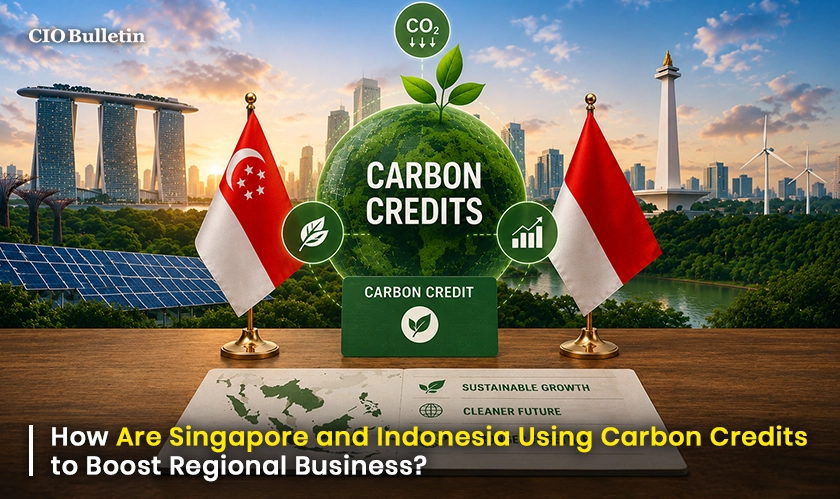
Singapore and Indonesia are expanding cooperation on carbon credits and cross-border trade to accelerate sustainable growth, strengthen SME collaboration, and advance the region's green economy.
Singapore and Indonesia have decided to collaborate on carbon credits and facilitate easier cross-border trade for Indonesian small and medium-sized businesses (SMEs). Additionally, Singapore Energy Interconnections, Sembcorp Industries, and Keppel Electric signed contracts with Indonesia's sovereign wealth fund, Danantara. This will open the door for the cross-border electricity project by offering a clear path for talks and negotiations.
Mr. Wong stated that Singapore "has every confidence" in Indonesia's future during a press conference with Prabowo Subianto, the President of Indonesia. To strengthen bilateral relations, the two leaders convened for their second Singapore-Indonesia leaders retreat in Istana Merdeka in Jakarta.
“We want Indonesia to succeed because our futures are closely linked. And our confidence in Indonesia is reflected in our actions.” - Lawrence Wong, Prime Minister of Singapore.
According to the reports tracked by CIO Bulletin, Singapore and Indonesia signed a memorandum of understanding on carbon credits under Article 6 of the Paris Agreement. According to a separate press release from the Ministry of Trade and Industry (MTI), the agreement was signed by Indonesia's Minister of Environment Mohammad Jumhur Hidayat and Deputy Prime Minister and Minister for Trade and Industry Gan Kim Yong, indicating both nations commitment to collaborate on carbon markets that expedite climate action.
The agreement states that Singapore and Indonesia will share knowledge and data about carbon markets collaborate on an agreement to put it into effect in line with Article 6, and find carbon credit projects with high integrity, according to MTI.
Last week, the two nation’s environment ministries also signed a second memorandum of understanding on environmental cooperation, which will increase collaboration in areas including waste management.
Singapore and Indonesia are also committed to increasing their supply chain resilience to help each other navigate any external shocks, he said. In a joint statement on supply chain resilience, Mr Gan and Indonesia's Coordinating Minister for Economic Affairs, Airlangga Hartarto, voiced deep worry about the situation in the Middle East and its consequences for world peace and stability. According to the federation, both institutions have pledged to collaborate on digital enablement, policy involvement, and capability creation.
Everything you need to know about this news
Singapore and Indonesia have agreed to engage on carbon credits, increase cross-border commerce for SMEs, extend energy cooperation, and improve supply chain resilience.
The alliance seeks to promote investment in low-carbon projects, support climate action under Article 6 of the Paris Agreement, and produce high-integrity carbon credit projects.
In order to help nations meet their climate targets, Article 6 offers a framework for collaboration through international carbon markets and emissions reduction initiatives.
The deal is designed to streamline cross-border trade, improve market access, and provide new business opportunities for Indonesian small and medium-sized firms.
The two nations are collaborating to create a more robust regional energy supply chain, expanding cross-border electricity projects, and bolstering renewable energy cooperation.

















































 consultants ltd.jpg)


Comments